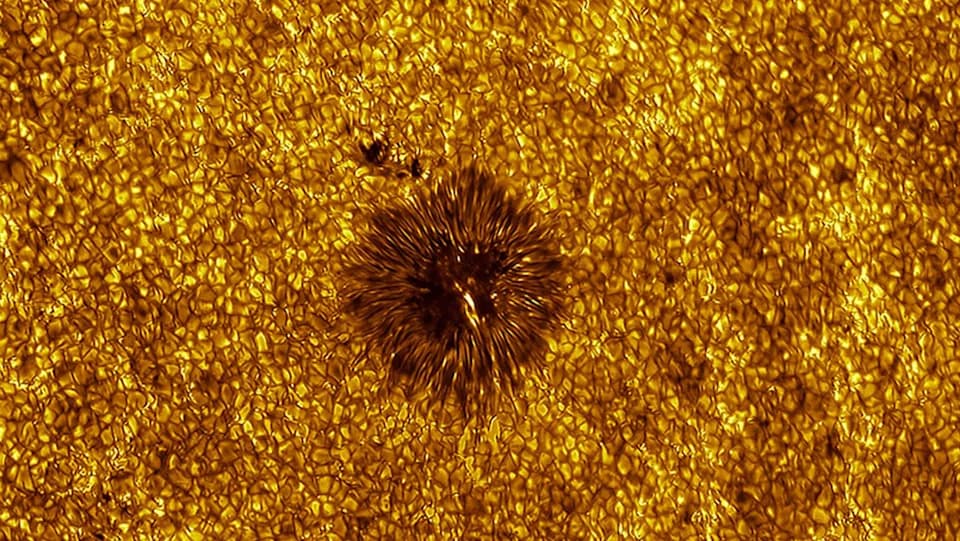
Using the Daniel K. Inouye Solar Telescope, researchers captured the sharpest image yet of the Sun's photosphere, revealing fine, whirling structures at magnetic boundaries. Analysis shows these swirls are Kelvin‑Helmholtz Instability (KHI), a fluid/plasma instability long predicted but not previously seen so clearly in the photosphere. Numerical simulations support the observation, and the results were published in Nature.
Record-Sharp Solar Image: DKIST Captures First Clear Detection of Kelvin‑Helmholtz Swirls
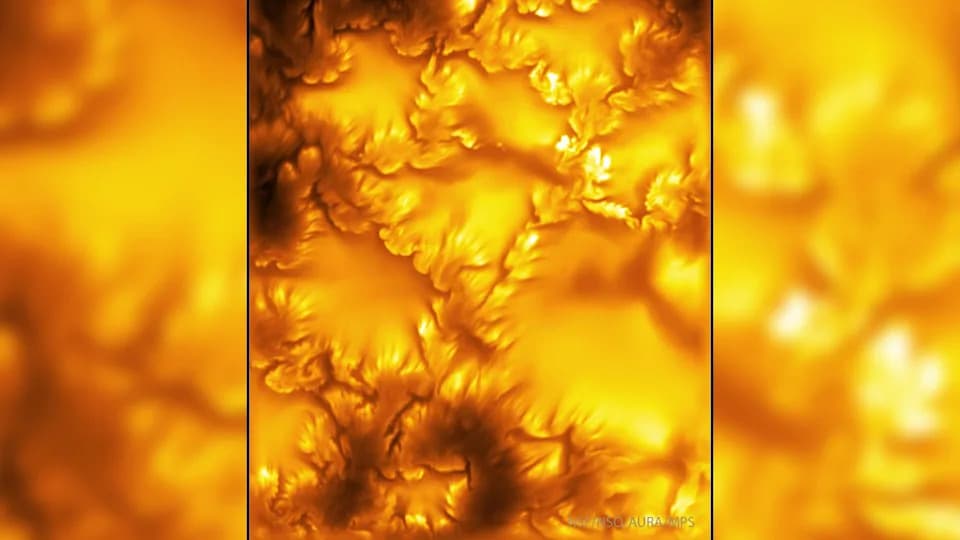
This image of the sun — the sharpest ever snapped — was captured by the NSF Inouye solar telescope. | Credit:NSF,NSO,AURA,MPS,Inouye Tel
Scientists have captured the sharpest-ever image of the Sun's visible surface using the U.S. National Science Foundation's Daniel K. Inouye Solar Telescope (DKIST). The unprecedented resolution reveals fine, fast-moving structure in the solar photosphere and offers new insight into the plasma physics that drive stellar activity.
An international team analyzing DKIST data — including researchers from the National Solar Observatory (NSO), the National Center for Atmospheric Research's High Altitude Observatory (NCAR/HAO), and Germany's Max Planck Institute for Solar System Research (MPS) — identified unusual, whirling patterns at the edges of magnetic regions.
Detailed analysis shows these swirls are direct evidence of Kelvin‑Helmholtz Instability (KHI), a fluid/plasma instability that arises when adjacent layers move at different velocities. Although KHI has long been predicted in the Sun's atmosphere, this is the first time it has been seen so distinctly in the solar photosphere.
The observations include high-resolution stills and a time-lapse sequence that lets viewers watch solar plasma flow and roll in real time, providing an intuitive view of the dynamics involved. Numerical simulations conducted alongside the observations support the interpretation that the features are KHI, and they help clarify how such instabilities develop near magnetic boundaries.
“We believe that the discovery of Kelvin‑Helmholtz Instability in the solar photosphere, backed up by analysis of numerical simulations, is a major step forward in our understanding of the dynamics and evolution of solar and stellar plasma, and will serve as a basis for future discoveries,” said David Boboltz, deputy director at the National Solar Observatory.
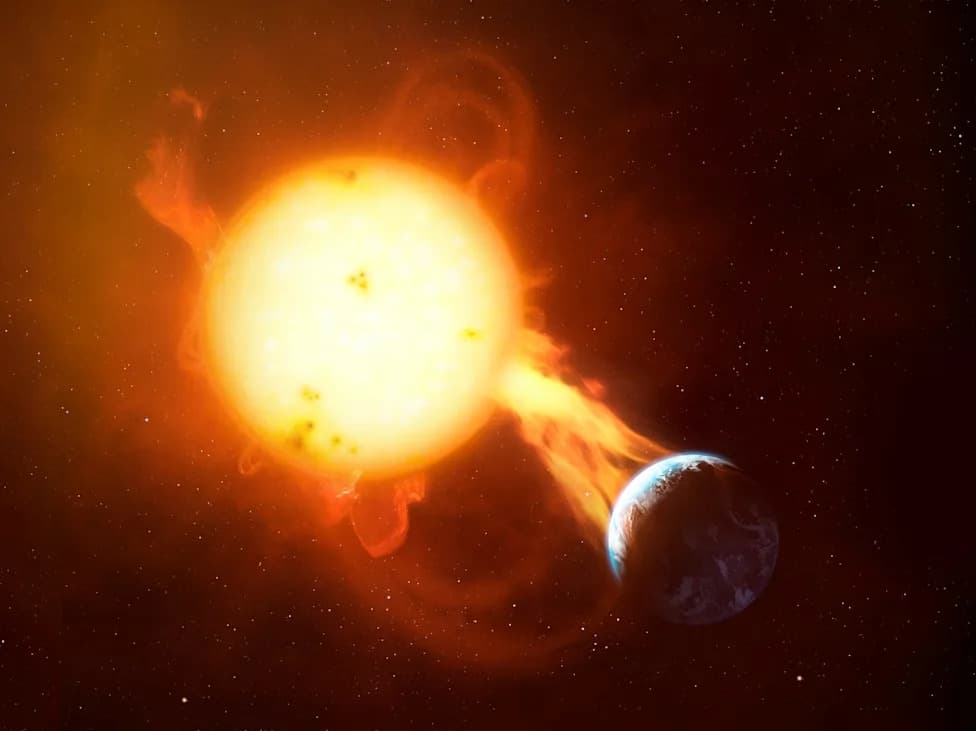
A peer-reviewed paper describing these findings was published recently in the journal Nature. Beyond the scientific advance, the images demonstrate DKIST's ability to resolve previously unseen small-scale processes on the Sun, improving our understanding of solar behavior and its effects on space weather.
Help us improve.