
Much of Ireland will experience a deep partial solar eclipse next Wednesday evening, with peak coverage exceeding 90% in many areas and Skellig Michael reaching approximately 98% obscuration. The event begins at about 18:10 BST, with exact times varying by location. Astronomers warn never to look directly at the Sun during a partial eclipse and recommend certified eclipse glasses or projection methods. Later that night the Perseid meteor shower peaks under a new moon, offering ideal conditions to see up to about 100 meteors per hour from a dark site.
Deep Partial Solar Eclipse Will Darken Much Of Ireland — Perseid Meteor Shower Peaks Later
County Kerry Coast will see most of the sun blocked out [BBC]
Skywatchers across the island of Ireland will be treated to two major celestial events next week: a deep partial solar eclipse in the early evening, followed by the peak of the Perseid meteor shower later that night.
What To Expect
More than 90% of the Sun will be obscured for much of Ireland on Wednesday evening, making this the deepest partial eclipse visible on the island until September 2090. Holidaymakers in parts of Spain will be able to see a total solar eclipse.
David Moore, Editor of Astronomy Ireland Magazine, said:
“Not only is it the first total eclipse visible from western Europe since 1999, but just a few hours later it's one of the best meteor showers of the year – as if to celebrate the event with celestial fireworks.”
The partial eclipse is expected to begin at roughly 18:10 BST, though exact times will vary by location.
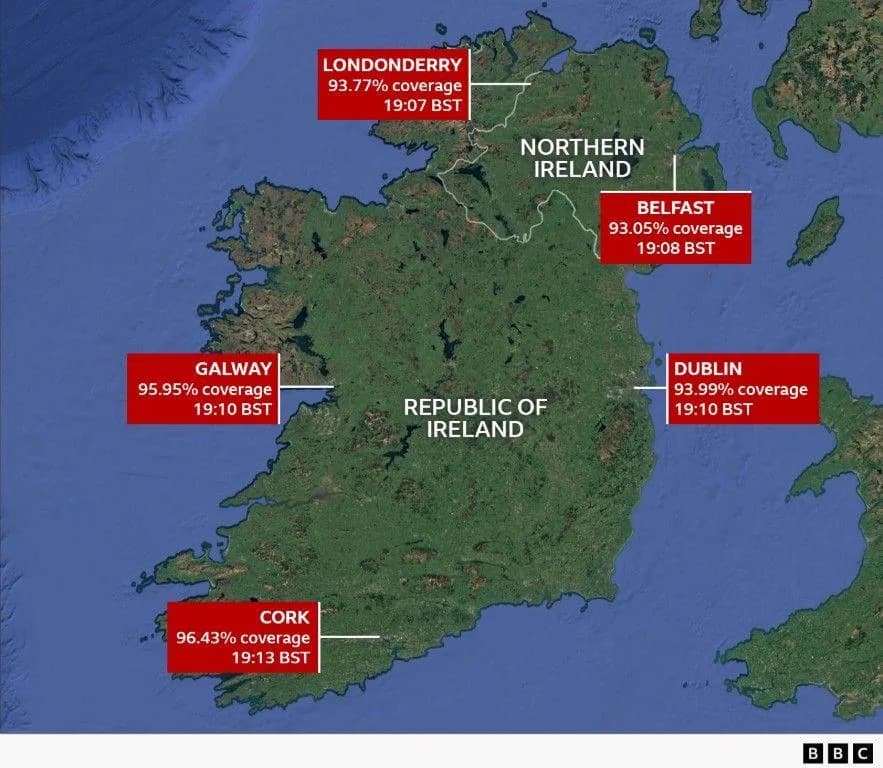
Estimated Peak Coverage
At maximum eclipse, coverage will vary by location. Examples include:
- Skellig Michael (Co. Kerry): ~98.01%
- Cork: ~96.43%
- Galway: ~95.95%
- Belfast: ~93.05%
- Londonderry (Derry): ~93.77%
Dr Rok Nežič of Armagh Observatory and Planetarium warned that the sky should become noticeably darker: “Even though more than 90% of the Sun will be covered, it will still be kind of bright, but it should seem like you're under some thick cloud.” He added that the effect will be apparent but not as dramatic as a total eclipse.
Safety: Do Not Look Directly At The Sun
Astronomers strongly advise never to look directly at the Sun during a partial eclipse. Even a small visible crescent is bright enough to cause permanent eye damage because the retina has no pain receptors.
Safe viewing options:
- Use certified eclipse glasses for naked-eye viewing (do not use them while looking through binoculars or a telescope).
- Project the Sun's image onto a white card with a telescope or binoculars (do not look through optics while pointing them at the Sun unless a proper solar filter is fitted).
- Make a pinhole viewer from a cereal box, or use a kitchen colander to create multiple projections.
- Avoid pointing an unfiltered smartphone or digital camera directly at the Sun — intense light can damage sensors.
As David Moore noted: “The only thing you can look at with the naked eye is a total solar eclipse and there hasn't been one of those on Irish soil since 1724, and there won't be another one visible until September 2090.”
The Perseid Meteor Shower
Several hours after the eclipse, the Perseid meteor shower reaches its peak late on Wednesday night and into Thursday. A new moon means moonlight should not interfere with viewing, creating favourable conditions if skies remain clear.
The Perseids are caused by dust and small rock fragments from comet Swift-Tuttle. When these particles enter Earth's atmosphere at high speed they heat the surrounding air and create brief streaks of light. Meteors can appear anywhere in the sky, but their paths appear to radiate from the constellation Perseus, which will rise in the north-east and climb higher during the night.
Viewing Tips
- Find a dark location away from streetlights and bright buildings.
- Allow at least 10–20 minutes for your eyes to adjust to the dark.
- No binoculars or telescope are needed; they restrict your field of view. Lie back and scan the sky with your eyes.
- Under ideal conditions, observers might see up to around 100 meteors per hour.
Timings (Approximate Local Times)
Northern Ireland (Start – Peak – End – % Obscured)
Armagh – 18:10 – 19:08 – 20:03 – 93.66%
Belfast – 18:10 – 19:08 – 20:03 – 93.05%
Derry – 18:09 – 19:07 – 20:02 – 93.77%
Omagh – 18:10 – 19:08 – 20:03 – 93.97%
Republic Of Ireland (Start – Peak – End – % Obscured)
Cork – 18:15 – 19:13 – 20:08 – 96.43%
Dublin – 18:12 – 19:10 – 20:05 – 93.99%
Galway – 18:12 – 19:10 – 20:06 – 95.95%
Limerick – 18:13 – 19:12 – 20:07 – 96.03%
Skellig Michael – 18:14 – 19:13 – 20:09 – 98.01%
With clear skies, observers can enjoy a dramatic early-evening solar event followed by one of the year’s most active meteor displays later the same night.
Help us improve.





















