
The LINK servicing satellite launched July 3 to save the nearly 22-year-old Neil Gehrels Swift Observatory, which risks reentry if it falls below about 185 miles (300 km). LINK entered a multi-axis spin around July 25 after two reaction wheels failed and cold-gas thruster performance degraded. Engineers slowed the tumble to 1.47 deg/s using thruster burns and under 100 grams of electric-propellant, and plan a software update to restore orientation. A close survey and grapple are delayed by about a month; if successful, LINK’s ion thrusters would take 2–3 months to raise Swift back to a safe orbit.
Rescue Mission in Trouble: LINK Regains Control but Swift’s Fate Is Still Uncertain
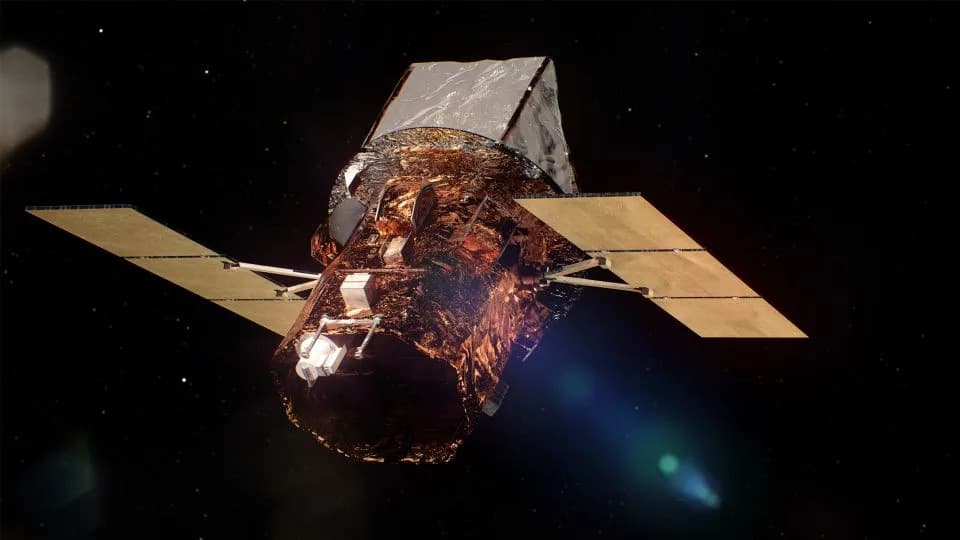
This illustration depicts the Neil Gehrels Swift Observatory spacecraft in orbit. - NASA Goddard Space Flight Center
A fast-paced, nine-month effort to save NASA’s long-serving Neil Gehrels Swift Observatory from reentering Earth's atmosphere has hit a major glitch — but engineers say recovery remains possible.
What Happened
The Neil Gehrels Swift Observatory, in low-Earth orbit for nearly 22 years, is descending because increased atmospheric drag driven by heightened solar activity has reduced its altitude. NASA warned Swift could reenter if it drops below an operational threshold of roughly 185 miles (300 kilometers).
To avert that outcome, NASA contracted Arizona-based Katalyst Space Technologies to design, build, test and launch a robotic servicing satellite named LINK. LINK launched on July 3 aboard a Northrop Grumman Pegasus XL rocket, air-launched from the Stargazer L-1011 aircraft.
Commissioning and the Anomaly
Initial commissioning appeared successful: LINK deployed solar arrays, fired thrusters, and began navigation and sensor checks. On July 13 Katalyst reported LINK was midway through activation. By July 15 NASA said the team had already patched early communications and attitude-control anomalies, including a problem with one of three reaction wheels.
Late in July the mission suffered a more serious problem: around July 25 LINK entered a multi-axis spin and briefly lost reliable communications. Troubleshooting revealed two of its three reaction wheels were not operable and the cold-gas thruster system showed degraded performance. That combination limited the satellite's native ability to control orientation.
Recovery Actions
Katalyst and NASA used a sequence of thruster burns to arrest the tumble. Over several days the team reduced rotation from roughly 9 degrees per second to about 4 deg/s, and then to a controlled 1.47 deg/s. Engineers conserved propellant by using one of LINK’s electric-propulsion thrusters to slow the spacecraft, consuming under 100 grams of propellant.
- Flight software patches and operational workarounds were implemented to restore communications and attitude control after earlier anomalies.
- The team plans a software update to restore commanded spacecraft orientation and enable the precise maneuvers required for rendezvous.
Next Steps
The initial close survey of Swift — originally planned for late July to map safe grappling points — is now expected about a month later. If the survey and grapple succeed, LINK will secure the observatory and use its three ion thrusters to gradually raise Swift’s orbit. Katalyst and NASA estimate the boost could take roughly two to three months of steady ion thrusting.
Risks And Context
Mission managers emphasize the operation remains risky. Shawn Domagal-Goldman, division director of astrophysics at NASA, said it is remarkable the teams reached this point and cautioned that even flawless execution can encounter unforeseen hazards. Kieran Wilson, principal investigator for LINK at Katalyst, noted that complex missions — even those with longer development cycles and larger budgets — can fail for mundane reasons.
Why It Matters
Swift's unique, rapid-response capabilities have supported studies of gamma-ray bursts, gravitational-wave counterparts, comets and black-hole activity. Because there is no planned replacement with the same abilities, NASA judged a rescue attempt to be a cost-effective option. Swift is currently not conducting science observations to preserve power while awaiting a potential rescue; a successful boost would allow science operations to resume.
"Even if everyone does everything perfectly, there still might be risks that we cannot control ahead of us. I'm just deeply thankful that we're even giving this a go." — Shawn Domagal-Goldman, NASA
Katalyst and NASA continue to evaluate revised and innovative approaches to the rendezvous and remain cautiously optimistic that LINK can still complete the mission to preserve Swift.
Help us improve.





















