
The James Webb Space Telescope's NIRCam captured a fresh, detailed image of a compact region in the Carina Nebula known as the Treasure Chest, revealing a cluster of roughly 70 young stars. The cluster lies about 7,500 light-years away and includes a star roughly 19 times the mass of the Sun. New data revise the cluster's age to about 1.3 million years, demonstrating how JWST observations are refining our picture of clustered star formation.
JWST Reveals a Dazzling 'Treasure Chest' of Baby Stars in the Carina Nebula
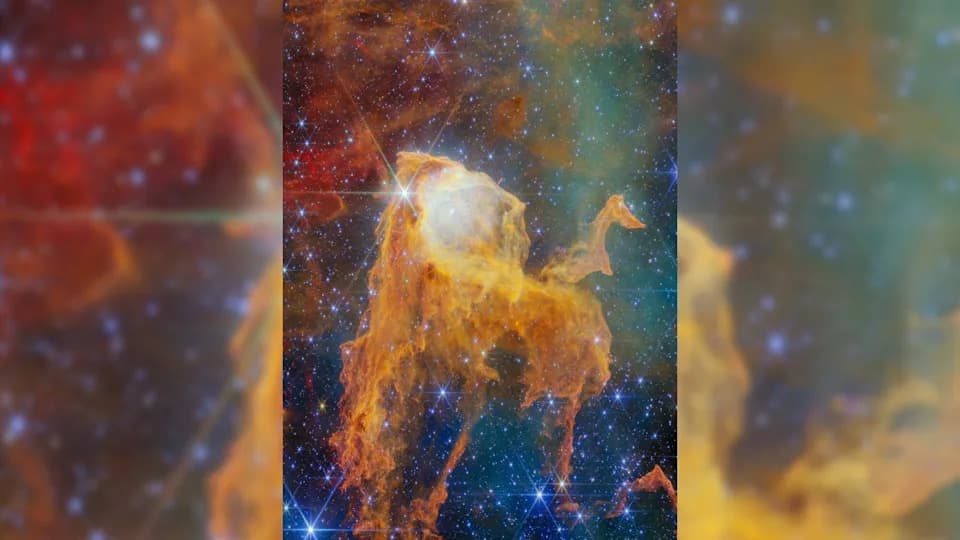
The Carina Nebula's "Treasure Chest" stuns in this new image captured by the James Webb Space Telescope. | Credit: ESA/Webb, NASA & CSA, M. Reiter
The James Webb Space Telescope (JWST) has returned a striking new view of a compact region within the Carina Nebula that astronomers call the "Treasure Chest." Captured with JWST's Near-Infrared Camera (NIRCam), the image peels back obscuring dust to reveal intricate filaments of gas and a dense cluster of newborn stars.
Located roughly 7,500 light-years away in the southern constellation Carina, the Carina Nebula is a vast stellar nursery. NIRCam's sensitivity to near-infrared light allows astronomers to peer through dusty clouds and map structures that are hidden at visible wavelengths.
The feature nicknamed the Treasure Chest contains a compact cluster of about 70 young stars. The most massive member of the group is estimated to be roughly 19 times the mass of the Sun, making it a dominant source of radiation and powerful stellar winds that shape the surrounding nebula.
New JWST data have revised the cluster's estimated age to about 1.3 million years, up from earlier estimates near 100,000 years. That change highlights how successive, higher-quality observations can substantially alter astronomers' understanding of when and how stars form in clustered environments.
Beyond age estimates, NIRCam helps distinguish embedded protostars from surrounding nebular emission and reveals how massive stars carve cavities in the gas as they evolve. As the Treasure Chest cluster matures, its stars will brighten and excavate clearer gaps in the cloud, unveiling more of the region's structure and history.
Image credit: ESA/Webb, NASA & CSA, M. Reiter
Help us improve.





















