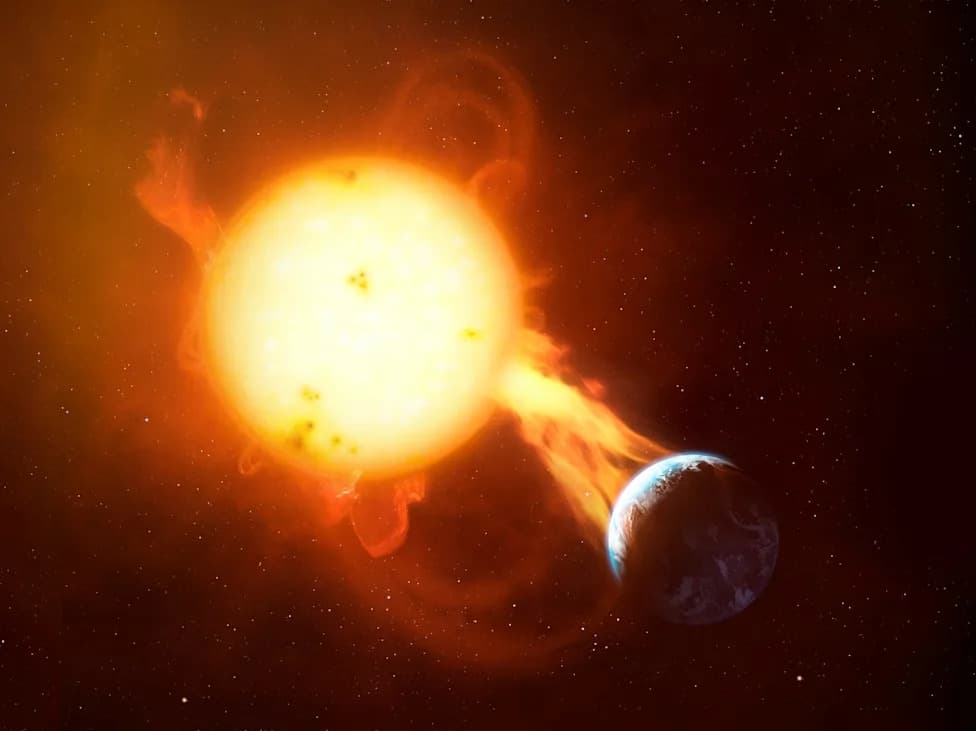
High-resolution time-lapse images from the Daniel K. Inouye Solar Telescope reveal thousands of tiny vortices on the Sun’s photosphere, providing the first direct evidence of Kelvin–Helmholtz instability on our star. Captured at 416 nm and published in Nature, the observations match computer simulations down to the vortices’ spacing. Scientists say these small whirlpools—tens of miles across—may twist magnetic fields, helping drive flares, coronal mass ejections and possibly contributing to coronal heating.
Thousands of Tiny Whirlpools on the Sun: Inouye Telescope Captures First Direct Evidence of Kelvin–Helmholtz Instability
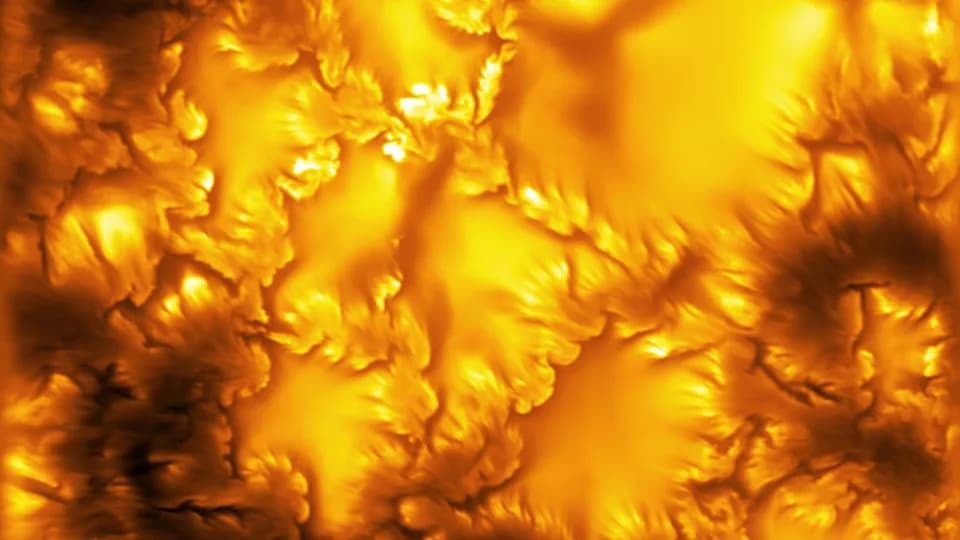
The highest-resolution image of the sun's surface (photosphere) ever captured, taken at 416 nm by the Inouye Solar Telescope. It reveals deformed boundaries of magnetic elements and ultrafine scale stripes, both associated with Kelvin-Helmholtz instability. | Credit: NSF/NSO/AURA/MPS
Image: The highest-resolution image of the Sun's photosphere yet captured — taken at 416 nm by the Daniel K. Inouye Solar Telescope — reveals distorted magnetic boundaries and ultrafine dark stripes associated with Kelvin–Helmholtz instability. Credit: NSF/NSO/AURA/MPS
New, ultra-high-resolution observations from the Daniel K. Inouye Solar Telescope in Hawaii have revealed thousands of tiny whirlpools twisting across the Sun’s visible surface (the photosphere). These small vortices, some only tens of miles across, are the first direct visual confirmation on the Sun of a long-predicted fluid phenomenon known as Kelvin–Helmholtz instability.
Kelvin–Helmholtz instability — named for Lord Kelvin and Hermann von Helmholtz, who described it in the 19th century — occurs when two adjacent streams of fluid (or plasma) slide past one another at different speeds, creating shear that rolls into spiral patterns. Until now, this process had not been observed directly at the fine scales visible on the solar surface.
Researchers compared time-lapse footage from the Inouye Telescope (captured at 416 nm) with computer simulations of the photosphere and found a striking match, down to the average spacing and structure of the vortices. The findings were published Aug. 5 in the journal Nature.
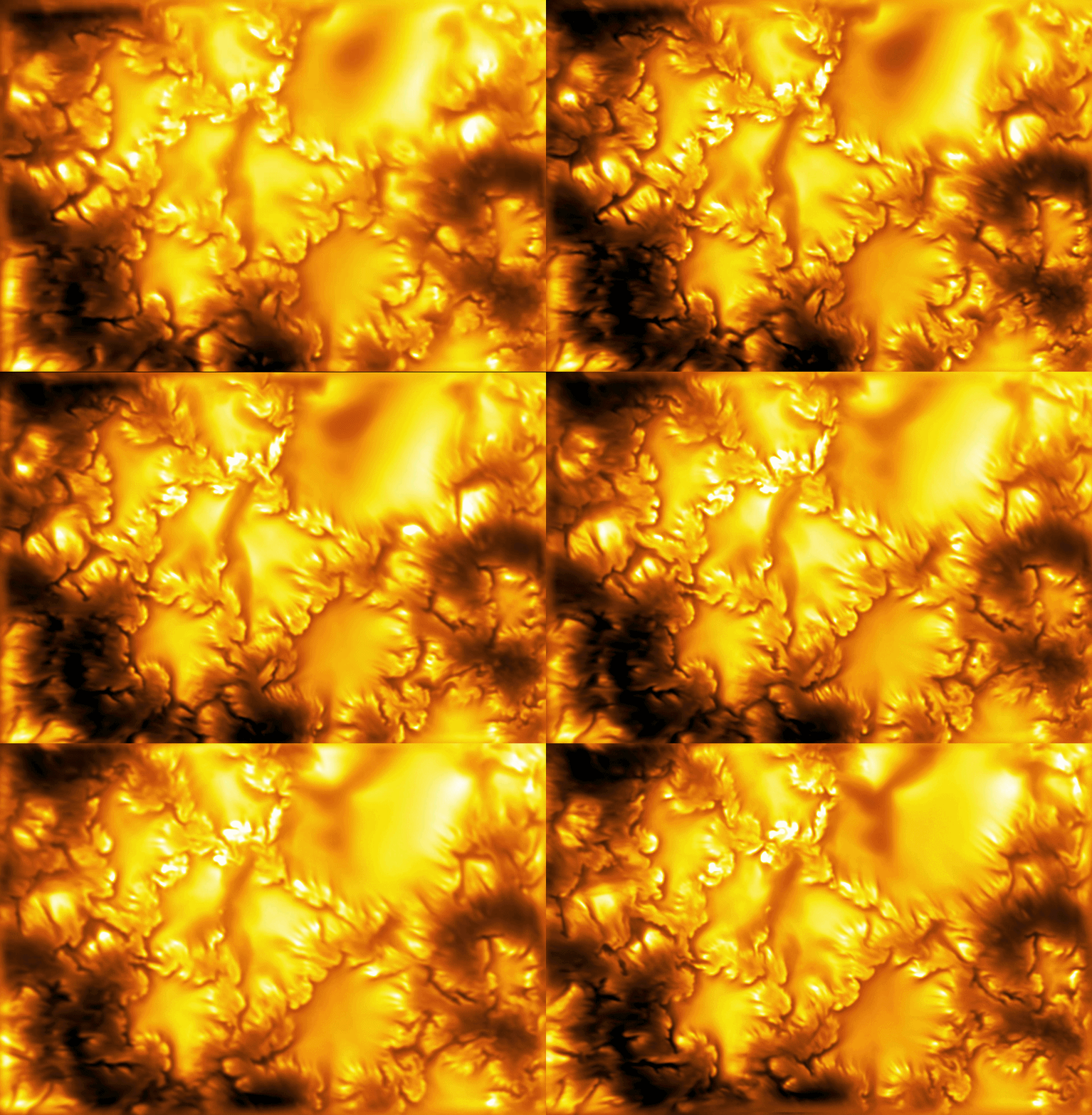
A time-lapse view of the Inouye telescope's obseravtions of the sun. | Credit: NSF/NSO/AURA/MPS
What the Images Show
The footage reveals dozens of small vortices clustering along the edges of magnetic regions. Some vortices are accompanied by delicate, dark striations — ultrafine features that are consistent with Kelvin–Helmholtz behavior in a magnetized plasma. The telescope’s resolution allows scientists to resolve features just tens of miles across, a scale at which these phenomena had been invisible to previous instruments.
Why It Matters
These miniature whirlpools may play an important role in solar dynamics. By twisting and mixing magnetic field lines, the vortices could help build up the energy that powers solar flares and coronal mass ejections (CMEs). Understanding how energy is transferred from the photosphere upward is central to explaining why the Sun’s corona reaches temperatures around 2 million °F (about 1 million °C) while the surface remains far cooler.
Thomas Rimmele, Chief Technologist at the National Solar Observatory, noted that these observations offer new clues about how small-scale motions might contribute to coronal heating and energetic space weather events.
The research team plans to deploy automated tracking algorithms to follow these vortices across large datasets. Quantifying their frequency, lifetimes and energy transport will help scientists assess how much miniature Kelvin–Helmholtz events contribute to coronal heating and to the space weather that can disrupt satellites, communications and power grids on Earth.
Source: Daniel K. Inouye Solar Telescope observations; study published Aug. 5 in Nature. Credit: NSF/NSO/AURA/MPS.
Help us improve.