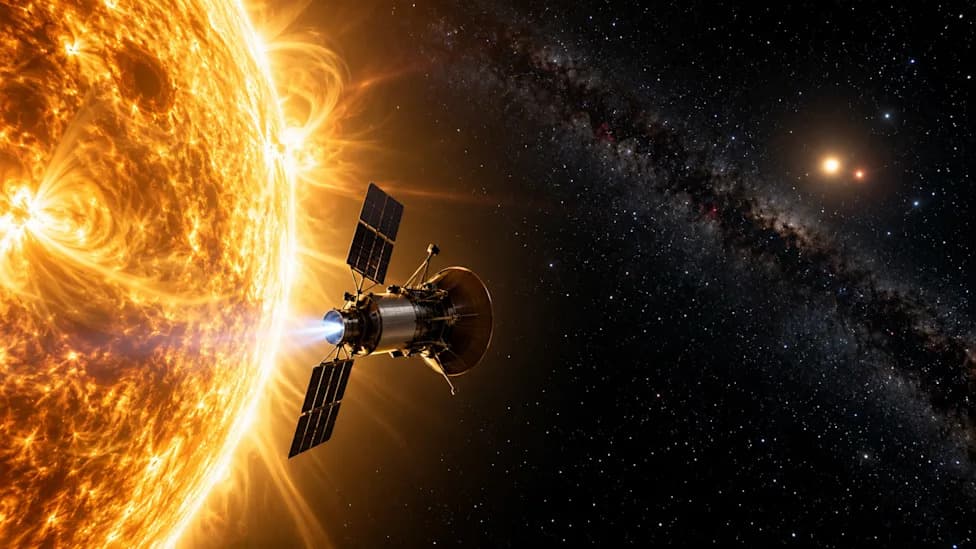
JPL engineers executed a coordinated "Big Bang" power reconfiguration on Voyager 2 on July 9, swapping higher-power heaters and a heat-using tape recorder for lower-power alternatives after successful tests in May–June. The change should keep Voyager 2’s three remaining instruments operating for roughly another year. Engineers updated the probe’s safe-mode settings to use the lower-power devices by default and are preparing similar procedures for Voyager 1, balancing energy savings against thermal risks in interstellar space.
JPL’s 'Big Bang' Power Swap Extends Voyager 2’s Mission — Similar Steps Planned for Voyager 1
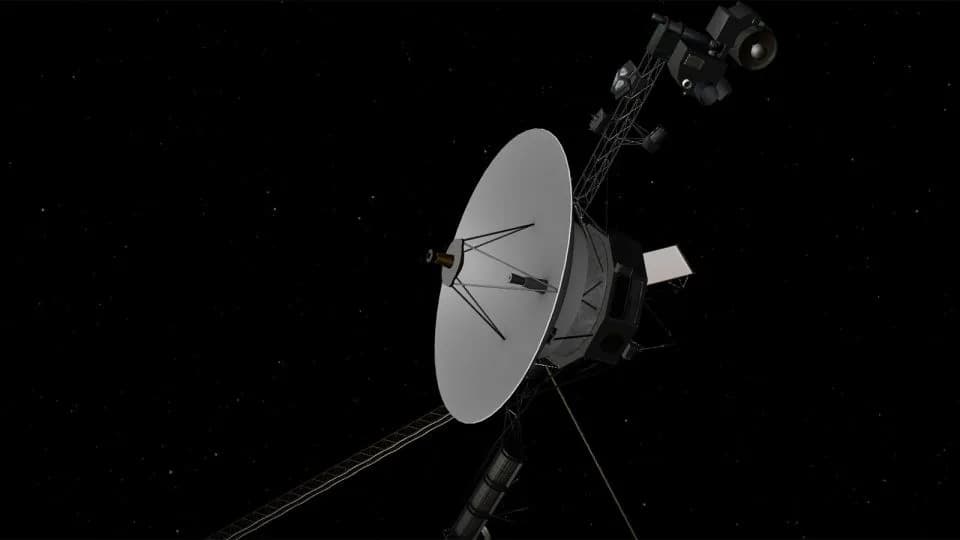
Voyager 2 and its twin, Voyager 1, launched in 1977. - NASA
Engineers at NASA’s Jet Propulsion Laboratory (JPL) report early success after a carefully planned power reconfiguration nicknamed the “Big Bang” that should buy the aging Voyager 2 spacecraft roughly another year of science operations.
Voyager 2 is now about 21.35 billion kilometers (13 billion miles) from Earth; its twin, Voyager 1, sits near 25.40 billion kilometers (16 billion miles). Launched in 1977, the two probes remain the most distant active human-made spacecraft as they travel beyond the heliosphere — the Sun’s magnetic and particle bubble.
Both Voyagers are powered by radioisotope thermoelectric generators (RTGs), which convert heat from decaying plutonium into electricity. The RTGs lose an estimated ~4 watts of output per year, so JPL engineers have spent decades selectively shutting down systems to conserve power.
What the "Big Bang" Did
On July 9, the team executed a coordinated command sequence that simultaneously turned off two higher-powered dedicated heaters and a digital tape recorder (used only for its residual heat) and activated two lower-power heaters plus another lower-power residual-heat source. The swap reduces electrical draw while preserving sufficient heat for critical systems and instruments.
Before the full implementation, JPL ran tests in May and June to verify power consumption and thermal margins. An initial power test on May 13 closely matched predictions and gave engineers confidence to proceed. The team also updated Voyager 2’s onboard software so that, if the spacecraft enters safe mode, the lower-power configuration becomes the default protective state.
"This was a team effort, the culmination of a year of work...we had extended the life of the spacecraft and science return by 2 years or more," said Kareem Badaruddin, Voyager mission manager at JPL.
Why It Matters
According to NASA, the changes should allow Voyager 2 to run its three remaining science instruments for roughly an additional year. Conserving power on Voyager 1 with a similar reconfiguration could also permit the restart of the Low-energy Charged Particles experiment, which was powered down in April but whose small 0.5-watt stepper motor has been kept active — a sign the instrument could be revived if sufficient power exists.
Engineers must balance every action against the harsh thermal environment of interstellar space. If heaters or systems are turned off improperly, fuel lines could freeze and the probes might lose the ability to point their high-gain antennas toward Earth, ending communications and science operations. For Voyager 1, a successful power test was completed in late July and a thermal test was planned for late August (scheduling subject to telemetry).
Because of the vast distances, commanding the Voyagers is slow: a one-way signal to Voyager 2 takes nearly 20 hours, while Voyager 1 requires about 24 hours one way. That latency forces careful planning and verification of every maneuver.
While both spacecraft were built to the same design, JPL notes they behave slightly differently in practice; the procedures developed and tested on Voyager 2 are being adapted for Voyager 1 with those differences in mind.
Help us improve.