Scientists have engineered lettuce and tobacco to produce myoglobin, a major meat protein, by inserting optimized pig myoglobin genes into plant chloroplasts using a 'gene gun'. The transgene was stably inherited and modified plants remained healthy and fertile. Yields reached ~810 mg/kg (lettuce) and ~800 mg/kg (tobacco) dry weight — about ten times lower than animal muscle by dry weight — but plant cultivation's greater resource efficiency could make per-hectare yields competitive. Incomplete heme incorporation limits functional myoglobin, and future work will target heme metabolism and other optimisations.
Plants That Make Meat: Lettuce and Tobacco Engineered To Produce Myoglobin
(nito100/iStock/Getty Images)
Researchers have, for the first time, engineered common crop plants to produce myoglobin — a key protein responsible for the color and some sensory attributes of meat — by inserting optimized pig myoglobin genes into chloroplasts of lettuce (Lactuca sativa) and tobacco (Nicotiana tabacum).
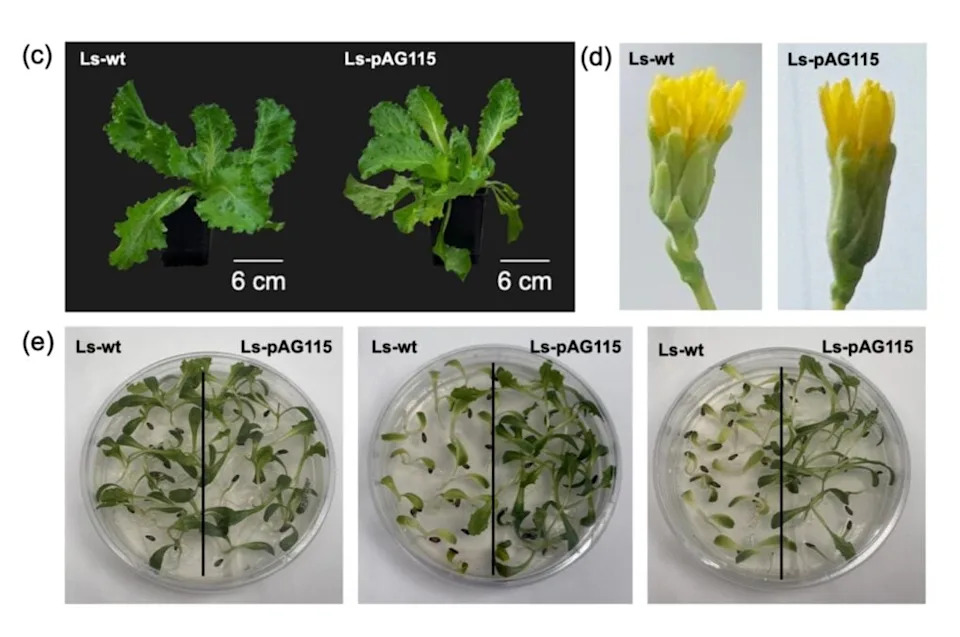
Comparisons of lettuce in the experiment, with wild-type (natural) lettuce on the left in each photo, and engineered forms on the right. (Groff et al.,Front. Plant Sci., 2026)
Study Overview
The work, published in Frontiers in Plant Science and reported by ScienceAlert, was led by Alexia Groff at Imperial College London. The team used biolistic transformation (a 'gene gun') to deliver the genes into seedlings' chloroplasts, confirmed correct DNA integration, and grew plants to maturity. The transgene was stably inherited: engineered plants produced seed that passed the trait to the next generation.

YouTube Thumbnail
Methods and Results
The researchers detected myoglobin accumulation of approximately 810 mg per kilogram of dry weight in lettuce and about 800 mg/kg dry weight in tobacco. Although those levels are roughly ten times lower than typical animal muscle on a dry-weight basis, the authors note that plant cultivation is far more resource-efficient than livestock farming, so per-hectare yields and environmental impacts could make plant-derived myoglobin competitive.

Subscribe to ScienceAlert's free fact-checked newsletter
'Our study demonstrates, for the first time, that higher plants can stably produce myoglobin, one of the key proteins responsible for many of meat's desirable properties,' Groff said. 'The transformed plants remained healthy, fertile, and showed no significant impairment of photosynthesis.'
Challenges and Future Directions
A key limitation identified by the team is incomplete heme incorporation: while the myoglobin polypeptide folded correctly, not all molecules were assembled with heme, the iron-containing cofactor required for full myoglobin function. The researchers propose improving heme biosynthesis or transport in chloroplasts to raise the fraction of fully functional myoglobin and increase overall yields.
Applications and Implications
Potential uses include extracting plant-derived myoglobin for incorporation into plant-based meat products to improve color and sensory properties, or consuming engineered leaves directly as an ingredient. More work is needed to compare the full life-cycle environmental footprint and production costs against conventional livestock and alternative protein systems.
The study is presented as a proof of principle that chloroplast molecular farming can produce high-value food proteins, and the authors are optimistic about extending the approach to other functional proteins.
Reported in Frontiers in Plant Science and covered by ScienceAlert. Corresponding author: Alexia Groff, Imperial College London.
Help us improve.