New paper in Science Advances: Researchers propose that bacteria and archaea independently evolved the enzymatic metabolisms that made them free‑living, implying two separate transitions from chemistry to cellular life. Analysis of ~420 core metabolic reactions suggests LUCA had enzymes for only about half of them, while environmental metals catalyzed the rest. The team outlines four phases from metal‑driven chemistry to enzyme dominance and demonstrates that phosphite can drive phosphorylation without ATP in laboratory experiments, offering a plausible prebiotic energy route.
Radical Study: Life May Have Emerged Twice — Bacteria and Archaea Independently Became Free‑Living
(witsawat sananrum/iStock/Getty Images Plus)
Life on Earth — yours, mine, and every other cellular organism — rests on an extraordinary chain of chemical and evolutionary events stretching back more than four billion years. A provocative new study in Science Advances argues that the critical transition from non‑living chemistry to free‑living cells may have occurred independently in the two primary domains of life: bacteria and archaea.
The research team, led by scientists at Heinrich Heine University Düsseldorf, analyzed a core metabolic network of roughly 420 reactions that convert simple molecules (H2, CO2, NH3, H2S and phosphate) into amino acids, nucleotide bases and cofactors. Using comparative protein‑structure analysis and an algorithm that orders enzyme functions by structural complexity, the authors inferred the relative timing of enzyme emergence across bacterial and archaeal lineages.
YouTube Thumbnail
Key Findings
LUCA Was Only Partially Enzymatic. The study concludes that the last universal common ancestor of cells (LUCA) likely encoded enzymes for only about half of the core reactions. The other half, the authors argue, were plausibly catalyzed by inorganic metals and minerals present in reactive environments such as hydrothermal vents.
Four Phases From Environmental Catalysis To Enzyme Dominance. The paper outlines a stepwise model: (1) an initial metal‑driven phase where environmental catalysts promoted key reactions; (2) a transitional phase when proto‑cells began producing primitive enzyme analogues; (3) progressive replacement of environmental catalysts by genetically encoded enzymes; and (4) a final state in which cells became independent of external metals and qualify as free‑living.
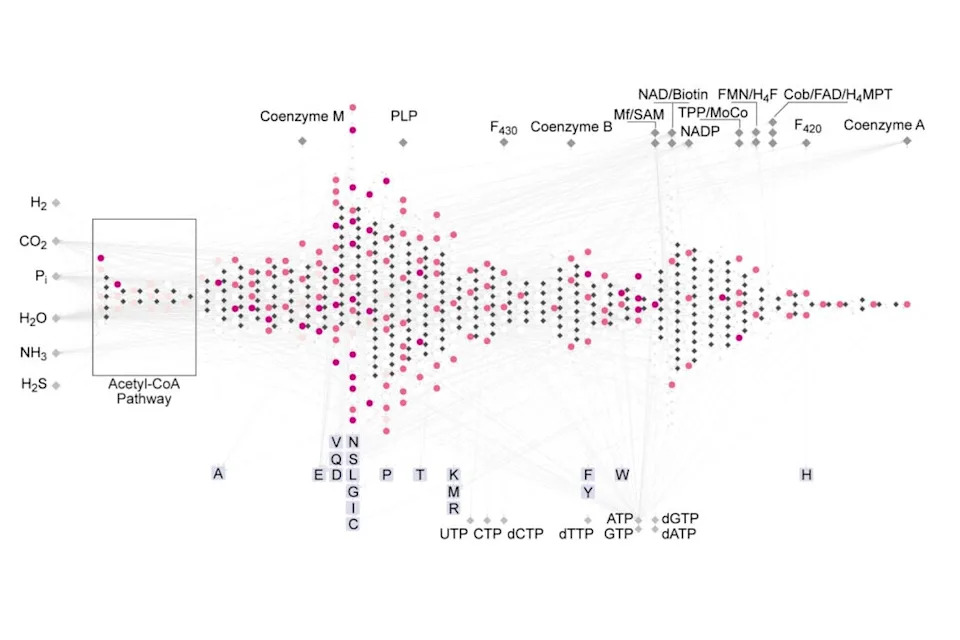
Starting compounds are shown at the left; they are converted by metabolism into the building blocks of life. The 420 enzymatic reactions are indicated as circles, and chemical metabolites as diamonds; lines connect reactions that share metabolites. Circles shown in magenta shading indicate reactions that could have been catalyzed by inorganic compounds in the environment where metabolism of the first cells arose. (HHU/Nadja Hoffmann)
Parallel, Independent Inventions. Crucially, many essential reactions are catalyzed by structurally distinct enzymes in bacteria and archaea. The researchers interpret this pattern as evidence that the two domains independently evolved enzyme systems that replaced environmental catalysts after their lineages diverged — in other words, two independent origins of free‑living cellular chemistry.
Prebiotic Energy Chemistry
A longstanding puzzle is how energy currency molecules such as ATP could have played a role before enzymes existed to make them. The team reports laboratory chemistry showing that phosphite — a reduced form of phosphorus found at hydrothermal vents — can drive phosphorylation reactions in water when combined with catalysts such as palladium. This suggests a plausible non‑enzymatic route to early phosphorylation chemistry that could have powered primitive metabolic steps.

Subscribe to ScienceAlert's free fact-checked newsletter
"We are looking at one origin of the genetic code, but two origins of life," says William Martin (Heinrich Heine University Düsseldorf), summarizing the study's bold interpretation.
Caveats And Open Questions
Origin‑of‑life research remains highly debated. Definitions of “life,” the nature of the prebiotic medium (aqueous vents versus more viscous matrices), the role of cofactors and phosphate chemistry, and the robustness of phylogenetic inferences from protein structure are all active areas of discussion. The phosphite‑driven phosphorylation experiments are promising but do not by themselves prove a complete pathway from geochemistry to genetically encoded metabolism.
Even if future work supports the study's core claims, the implication is nuanced: rather than a single trunk (LUCA) giving rise to all cellular life in an already free‑living state, the evolutionary tree may have had parallel trunks that only later became fully enzyme‑driven and independently free‑living.
Reference: Study published in Science Advances by researchers at Heinrich Heine University Düsseldorf and collaborators.
Help us improve.