President Trump urged the Senate to pass the Sunshine Protection Act after the House approved it 308-117, arguing permanent daylight saving time would improve safety, health and the economy. The bill won bipartisan support in the House but faces uncertain prospects in the Senate, with lawmakers in both parties expressing skepticism. Supporters point to studies suggesting extra evening daylight could reduce crime, traffic accidents and some health risks; critics warn of darker winter mornings. An AP-NORC survey found just 12% of Americans favor the current twice-yearly clock changes.
Trump Urges Senate to Approve Permanent Daylight Saving Time After 308-117 House Vote

President Donald Trump urged the Senate to pass legislation making daylight saving time permanent, calling the twice-yearly clock changes "foolish" and "very costly."
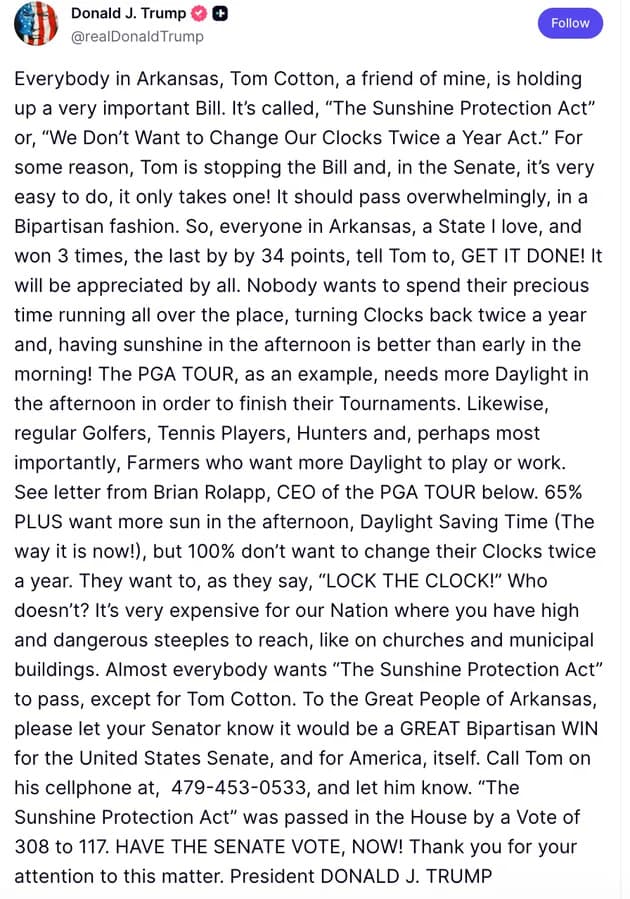
President Donald Trump on Tuesday urged the Senate to quickly pass the Sunshine Protection Act after the House of Representatives approved the bill 308-117. He said ending the twice-yearly clock changes would improve public safety, boost the economy and benefit Americans' health.
The House vote cleared the measure with bipartisan support, but the bill's fate in the Senate remains uncertain as lawmakers from both parties have raised questions. The White House previously circulated an internal memo urging lawmakers to back the change and called the proposal a "popular, common-sense reform."

President Donald Trump said the Senate should pass the Sunshine Protection Act to make daylight saving time permanent.
What Trump Said
'For many years, the vast majority of Americans have asked to make Daylight Saving Time permanent, but no Administration has been able to get it done, until now,' Trump wrote on Truth Social. He described the twice-yearly clock changes as 'foolish,' 'inconvenient' and 'very costly,' and urged Republican senators to lift holds so the bill can move forward.
Trump and supporters argue that keeping daylight saving time year-round would provide an extra hour of evening sunlight, which they say could reduce crime, lower traffic accidents (especially pedestrian collisions), improve mental and cardiovascular health, and boost industries that benefit from evening activity, such as retail, restaurants, sports and tourism.
Support, Opposition, And Public Opinion
Support for the Sunshine Protection Act has tended to come from representatives in coastal states, while opposition is more concentrated among lawmakers from the Midwest and agriculture-heavy regions. Several state legislatures have already passed laws that would keep their states on daylight saving time if Congress authorizes the change. Hawaii and most of Arizona do not observe daylight saving time.

President Donald Trump called for an end to the twice-yearly clock changes, arguing permanent daylight saving time would improve public safety and boost the economy.
Public-opinion data show significant interest in altering current practice. An AP-NORC survey released in December found just 12% of Americans favor keeping the current system of switching clocks twice a year; nearly half oppose it and about 40% said they had no opinion.
Notes And Outlook
Proponents cite studies and reports linking extra evening daylight to reduced crime and improved public health. Opponents and some experts caution that permanent daylight saving time would shift more darkness into winter mornings, which could create safety or health concerns for morning commutes and schoolchildren. Ultimately, Congress must act to change the federal timekeeping rules before states can implement permanent daylight saving time.
Fox News Digital's Adam Pack contributed to this report.
Help us improve.