The Growing Up in Scotland cohort study of 3,786 children found that screen time by itself was not consistently associated with poorer psychosocial development. No significant links appeared at ages 5 and 10; at 15 years only very high video-game use was linked to greater difficulties. Teens using social apps >1 hour/day were unexpectedly less likely to show above‑average difficulties, though causality is uncertain. The authors emphasize that activity type and context matter more than total hours.
New Longitudinal Study: Screen Time Effects Depend More on Activity Than Hours
(LSOphoto/iStock/Getty Images Plus)
Digital screens are a central part of everyday life, and children are getting access to phones, tablets and video games at younger ages. But does more screen time necessarily harm children’s psychosocial development? A new longitudinal analysis suggests the answer is more nuanced than simple hour-based limits.
Study Overview
Researchers from the University of Edinburgh and Imperial College London analyzed data from 3,786 participants in the Growing Up in Scotland cohort to examine associations between out-of-school screen use at ages 5, 10 and 15 and psychosocial development (emotional, behavioural and social functioning). The analysis, published in JAMA Network Open (McQuaid et al., 2026), adjusted for potential confounders including sex, race/ethnicity, household income and cognitive test scores.
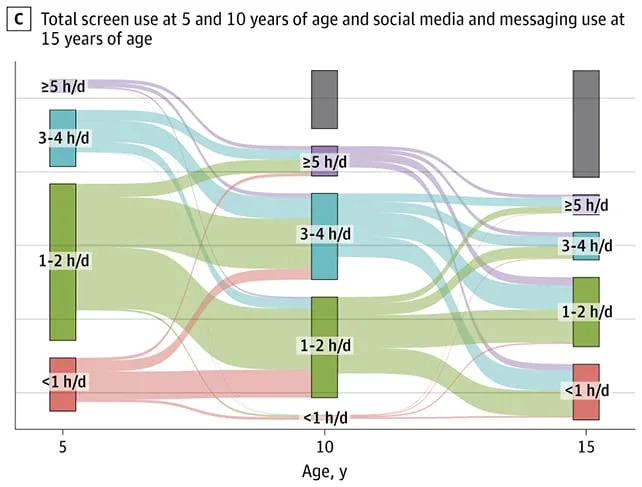
The amount of screen time varied depending on age. (McQuaid et al.,JAMA Netw. Open, 2026)
Key Findings
The main results are broadly reassuring. The study found:
- No significant association between overall screen use and developmental difficulties at ages 5 or 10.
- At age 15, only very high electronic game use (not other forms of screen time) was associated with higher difficulties scores.
- Early high screen use (in childhood) was linked to greater difficulties at age 10, but that relationship did not persist at age 15.
- Unexpectedly, adolescents who used social media and messaging apps for more than one hour per day were less likely to score in the "above-average difficulties" range than peers who used these apps for under an hour—an association the authors caution could reflect social selection rather than a causal benefit.
Interpretation and Caveats
The authors conclude that how screens are used appears to matter more than total time alone. They caution that associations do not prove causation: adolescents with stronger social skills may be more likely to use social apps, and other family- or community-level factors can influence both screen use and psychosocial development.

YouTube Thumbnail
"No significant associations were found between screen use and developmental difficulties at 5 or 10 years of age, and an association with higher difficulties score at 15 years of age was only seen for very high use of electronic games," the paper reports.
Expert Commentary and Next Steps
Independent experts highlight important directions for future research. Professor Victoria Whitington (Adelaide University) recommends collecting detailed data on what children do on screens and whether activities are solitary or social. Psychologist Pete Etchells (Bath Spa University) notes that apparent links often weaken once third variables are accounted for, reflecting the broader social context in which screen use occurs.
It is also important to note that the cohort’s data collection began in 2009—shortly after the first iPhone and before the first iPad—so device ownership and platform use have changed substantially since then. More recent cohorts may show different patterns.

Subscribe to ScienceAlert's free fact-checked newsletter
Bottom Line
In this cohort, screen time alone was not consistently linked to poorer psychosocial development. The findings suggest policy and parental guidance should focus less on rigid hour limits and more on the type of screen activity, the social context, and how device use fits into children’s broader lives.
Source: McQuaid et al., JAMA Network Open (2026)
Help us improve.