
Apophis, a ~370-meter asteroid, will pass within about 32,000 km of Earth in April 2029. Researchers modelled the asteroid's trajectory and the population of known and unseen debris near geosynchronous orbit and found a small but real chance that untracked fragments could strike Apophis. Any impact would likely make only a modest crater and ejecta plume, not alter the orbit, but could complicate efforts by ESA's RAMSES and NASA's OSIRIS-APEX to distinguish tidal effects from impact effects. The authors urge enhanced high-altitude debris surveillance before 2029.
April 2029: Apophis Will Sweep Close By — Space Junk Could Complicate Once-in-a-Lifetime Observations
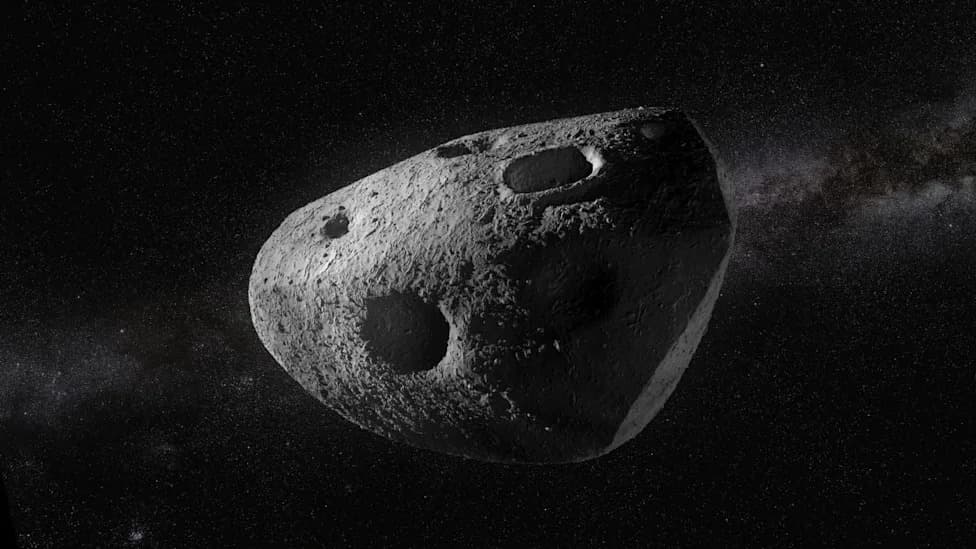
Asteroid Apophis will fly past Earth on 13 April 2029. (ESA-Science Office CC BY 4.0 INT)
In April 2029, asteroid 99942 Apophis — a rock roughly 370 meters (1,210 feet) across — will pass unusually close to Earth, coming within about 32,000 kilometers (20,000 miles). Scientists have repeatedly refined its trajectory and are confident it poses no imminent collision threat to people on Earth. But new research warns that untracked human-made debris in high Earth orbit could interfere with the scientific observations planned for the encounter.
YouTube Thumbnail
Why This Flyby Matters
Apophis's close approach will give researchers a rare opportunity to watch how Earth's gravity changes an asteroid's spin, surface structure and internal behavior. Tidal forces during the flyby could trigger landslides, seismic activity and reveal subsurface material — all phenomena that missions can study to better understand asteroid physics and planet–small-body interactions.
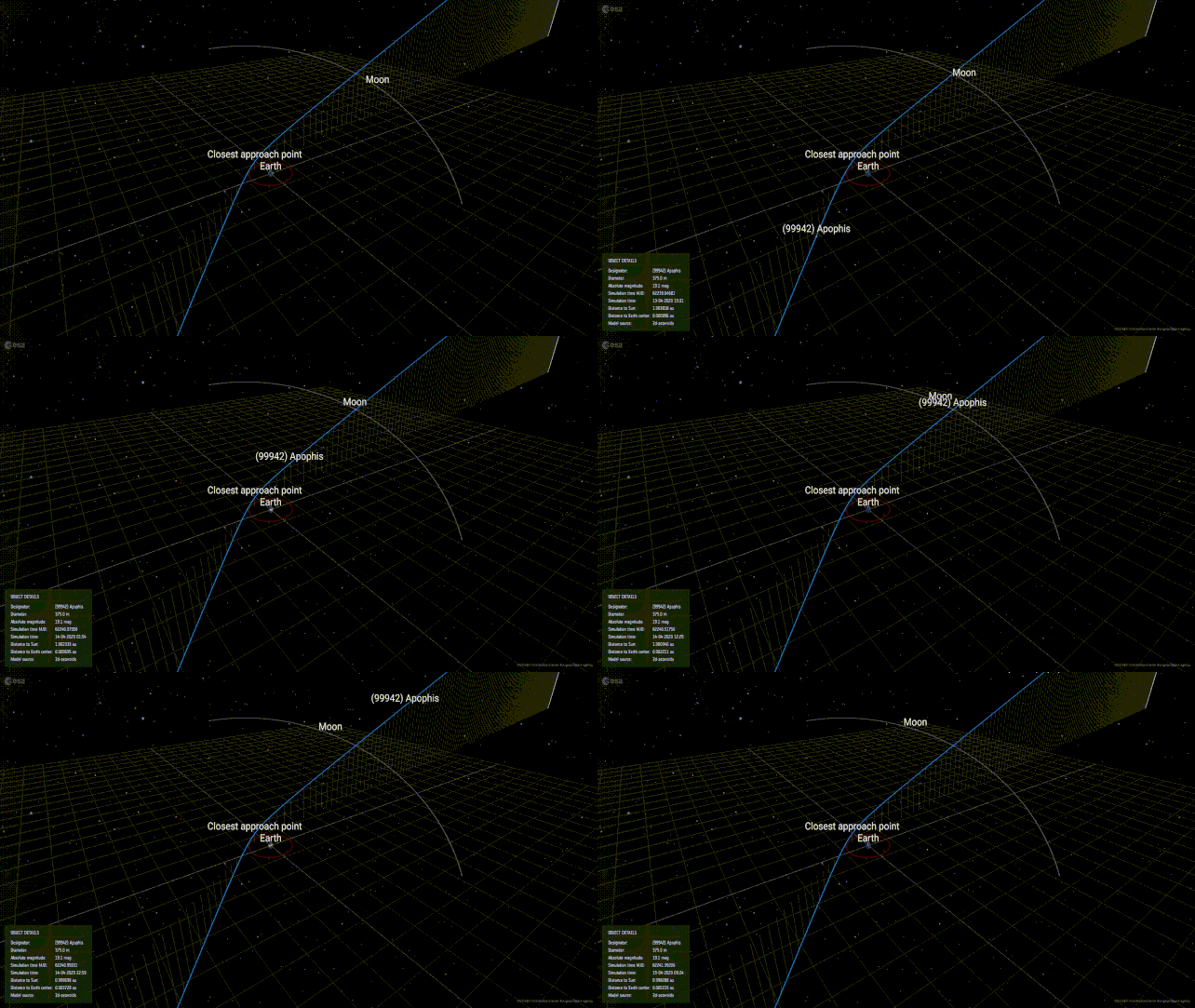
The projected trajectory of Apophis carries it harmlessly past both Earth andthe Moon. (ESA)
Missions on Watch
Two spacecraft missions — ESA's RAMSES and NASA's OSIRIS-APEX — are slated to observe Apophis in unprecedented detail. RAMSES plans to deploy surface instruments such as a gravimeter and seismometer, while OSIRIS-APEX will provide complementary remote sensing and context for the flyby.
YouTube Thumbnail
The Space-Junk Question
Physicist Giulia Schettino and astrodynamicist Alessandro Rossi (IFAC/CNR) modelled Apophis's well-constrained trajectory alongside the catalogued population of objects near geosynchronous orbit (GEO, roughly 36,000 km altitude) and a simulated population of smaller, untracked fragments. Their simulations produced a surprising result: although most scenarios are safe, there is a small but non-negligible chance that an untracked piece of debris could pass very near or even collide with Apophis during the GEO portion of its path.

Subscribe to ScienceAlert's free fact-checked newsletter
"I was expecting a 'null experiment' — no interactions — but some simulated objects came within a few kilometers of the asteroid," Rossi said.
What an Impact Would Mean
Importantly, the study finds that a strike by a small fragment would be unlikely to change Apophis's orbit in any meaningful way. Instead, an impact would probably create a modest crater and a plume of ejecta. While not catastrophic, such an event could complicate scientific interpretation: it would become harder to disentangle changes caused by Earth's tidal forces from those caused by the collision.
Rossi notes that surface instruments (if deployed) might detect the impact as a seismic or gravimetric signal, and remote sensors could record ejecta. He also emphasizes that a collision in GEO would be unlikely to trigger a Kessler syndrome cascade — GEO is far less crowded than low-Earth orbit, so ejecta from the asteroid are unlikely to start many secondary collisions.
What This Tells Us About High-Altitude Debris
The paper highlights a broader and underappreciated problem: many small fragments in high Earth orbit remain effectively invisible to current surveillance systems. Large objects are tracked routinely, but the small debris population near GEO is poorly constrained. That uncertainty enables the low but real risk identified in the simulations.
Recommendations
Schettino and Rossi recommend improving surveys of high-altitude debris ahead of the 2029 encounter. New surveillance telescopes planned under the EU Space Surveillance System are expected to help fill these knowledge gaps and reduce uncertainties about the GEO population.
The study was published in The Planetary Science Journal. While Apophis remains safe from an Earth-impact perspective, protecting the scientific value of its flyby requires better awareness of small debris in high orbits.
Help us improve.





















