The New York Times profile of Chungbuk Semiconductor High School triggered widespread domestic coverage of Korea’s semiconductor "Meister" high schools. These institutions — exemplified by Chungbuk and the new Daegu Semiconductor Meister High School — combine simulated fabs, deep industry partnerships and high placement rates to channel graduates into firms like Samsung, SK Hynix and onsemi. While automation raises questions about future job numbers, proponents argue it increases demand for the highly skilled technicians these schools produce. Nationwide, about 60 Meister schools train talent across advanced fields, forming a layered pipeline for Korea’s high-tech industries.
Why the World Spotted Korea’s Semiconductor 'Meister' High Schools Before Domestic Media Did
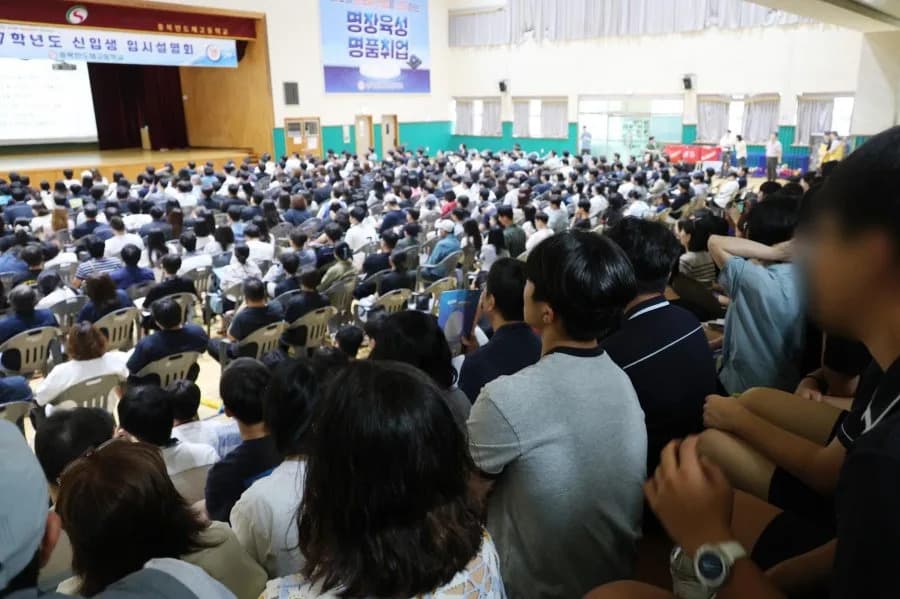
Prospective students and parents attend a 2027 admissions information session at Chungbuk Semiconductor High School in Eumseong County, North Chungcheong Province, South Korea, in July. Photo by Yonhap
International attention on Korea’s semiconductor education model — led by a June 26 New York Times profile of Chungbuk Semiconductor High School — prompted a sudden surge of domestic coverage. The story exposed not only the strength of specialized vocational training for the chip industry, but also how reactive local reporting was to an outside spotlight.
How the Spotlight Fell
Chungbuk Semiconductor High School, located in Eumseong County, North Chungcheong Province, enrolls nearly 300 students and is the oldest of South Korea’s four semiconductor Meister high schools. Until the NYT feature, the school’s intensive industry-linked training largely escaped national attention. The international profile drew visitors — reportedly including foreign broadcasters — eager to study the school’s model and the grassroots origins of Korea’s chip boom.
What Makes Chungbuk Stand Out
The school’s appeal is practical and measurable: six simulated fabrication centers, partnerships with major chipmakers, a placement rate near 96% and a fully residential student body. Chungbuk reports 118 placement agreements across manufacturing, testing and maintenance — far more partnerships than its roughly 100 graduates a year can fill. Employers named among partners include Samsung, SK Hynix and U.S. chipmaker onsemi.
Curriculum, Training and Industry Integration
Founded in 1969 as Mugeuk Comprehensive High School, Chungbuk transitioned into a semiconductor-focused institution in 2006, was renamed in 2008 and became a Meister school in 2010. Its departments cover semiconductor manufacturing, equipment and chemicals, and students train on donated industry equipment in facilities modeled on real fabs. Practical training intensifies toward graduation with marathon 12-hour sessions and year-long team projects presented each October.
This year’s addition of structured "project classes" deepens industry ties: chip companies set real problems in March, students spend six months researching and prototyping, and then present solutions to the school. Teachers say this experience replicates the problem-solving and collaboration expected on the factory floor.
Financial Support And Hiring Pipelines
Tuition and dormitory fees are waived for all students at Chungbuk, and special hiring tracks connect talented students directly with employers. The Samsung Meister scholarship selected 15 second-year students this year based on grades, offering internships, up to 5 million won over two years and a job guarantee upon graduation. SK Hynix operates annual special recruitment rounds that factor in academic standing and a "Young Meister" certification for technical skills, service and language ability.
Alumni loyalty is notable: graduates who earn significant bonuses often return to support current students, underscoring the close ties between schools, students and industry employers.
A Broader Trend: More Schools, More Sectors
Chungbuk is one instance of a broader strategy. In March, Daegu Electronics Technical High School relaunched as Daegu Semiconductor Meister High School — the region’s first of its kind — enrolling about 498 students with 66 teachers (roughly a 1:8 teacher-student ratio). South Korea now has roughly 60 Meister high schools across advanced sectors such as IT, software, biotechnology and energy, building a layered talent pipeline from secondary education through industry.
Automation Concerns and the Value of Skilled Workers
Critics note that chipmaking is capital-intensive and increasingly automated, potentially limiting labor demand. That caution is reasonable, but it misses the schools’ core function: as automation raises technical complexity, the remaining roles require higher skills. Meister schools train students for those demanding positions, ensuring the workforce keeps pace with technological change.
Conclusion
International coverage shone a light on institutions that have quietly supplied Korea’s semiconductor industry with trained talent for years. Whether or not the domestic press had been slow to notice, these schools illustrate a strategic, long-term investment in vocational education — a grassroots strength that helps explain Korea’s resilience and competitiveness in high-tech manufacturing.
Author: Nohsok Choi, former chief editor of the Kyunghyang Shinmun and former Paris correspondent. The opinions expressed are his own.
Help us improve.