The Ohio Division of Wildlife Resources disclosed the investigation that led to the conviction of William Bethel and Justin A. Booth, two operators of the Creek Kings Outdoors YouTube channel, for years of illegal deer hunting across the Columbus, Ohio area. Investigators found repeated hunting inside Three Creeks Metro Park and discovered deer falsely claimed as taken in Kentucky were actually taken in Ohio. Each pleaded guilty to 20 counts, received nine days in jail, lost hunting privileges for five years, and faced combined penalties of just over $37,000.
YouTube Poaching Ring: Creek Kings Outdoors Duo Convicted After Years Of Illegal Deer Hunts
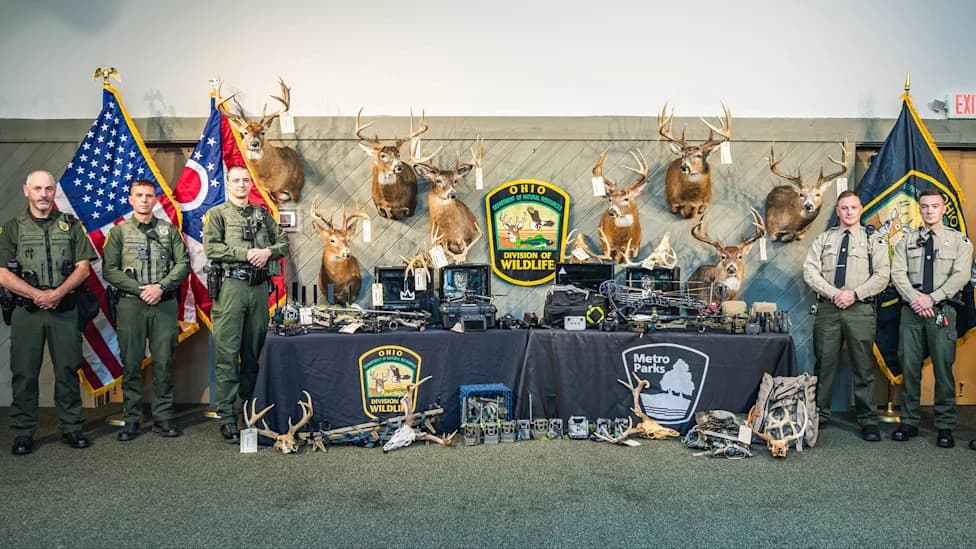
A photo of the recovered wildlife and officers from the Creek Kings poaching bust.
The Ohio Division of Wildlife Resources (DWR) has detailed the investigation that led to the conviction this spring of two men behind the Creek Kings Outdoors YouTube channel for a years-long campaign of illegal deer hunting in the Columbus metropolitan area.
Columbus residents William Bethel, 28, and Justin A. Booth, 23, were charged in September with dozens of wildlife violations documented from 2019 through 2025. Many of the incidents had been posted to their Creek Kings Outdoors channel, which has since been removed. A DWR probe that lasted more than a year found repeated illegal hunting in Three Creeks Metro Park and on other properties where the pair had no permission. Investigators also determined that deer the men claimed were tagged in Kentucky were actually taken in Ohio.
How Investigators Uncovered the Scheme
Franklin County wildlife officer and lead investigator Mark Williams said the motive was financial: the men were seeking higher view counts, sponsorships and online notoriety. "The most viewed videos on a deer hunting channel are generally going to be the ones where you kill a trophy buck," Williams told the Wild Ohio Podcast. "More views, more subscriptions means that they have a lot more bargaining power when it comes to talking to a sponsor in the future."
"Every deer that they killed on their channel was killed or possessed illegally in some way, shape, or form," — Mark Williams, Franklin County wildlife officer
Williams was alerted in February 2024 after park staff found bait, tree stands and trail cameras inside Three Creeks Metro Park, where hunting is prohibited. Officials confiscated the equipment and monitored the area through the next hunting season. Photographs captured the men entering the park, and an employee recognized them from their channel. Investigators learned Booth lived adjacent to the park, which explained how the pair frequently entered and exited the property.
Confrontations and Evidence
Park staff eventually confronted the cousins in the woods. On one occasion Booth was found wearing camouflage and carrying a tree-stand harness, claiming he had been calling for a dog; that story later faltered. Bethel was documented removing digital evidence and concealing cameras. Witnesses also reported seeing a deer the men claimed was shot in Kentucky; the deer had not been field-dressed, a detail investigators say is a common sign the animal had been killed nearby rather than transported long distances.
Williams emphasized that while many outdoor creators follow ethical standards and obey wildlife laws, others exploit wildlife resources for personal gain. "This is the modern commercialization and wildlife laws are being broken," he said. "They were selling the experience of poaching a deer and presenting it as honest hunting."
Charges And Sentencing
In May, Bethel and Booth each pleaded guilty to 20 counts, including hunting deer without a permit, hunting without permission, hunting during closed season, failing to check deer, and criminal trespass. After fines, fees and court costs, their combined financial penalties totaled just over $37,000. Each was ordered to serve nine days in jail, had hunting, fishing and trapping privileges revoked for five years, and was barred from Columbus and Franklin County Metro Parks for five years.
The DWR case highlights how social-media incentives can encourage illegal behavior and underscores the role of public vigilance and coordinated investigation in protecting wildlife and public lands.
Help us improve.