Researchers led by Angela Zoumplis used environmental RNA from 167 samples to reveal a diverse, transcriptionally active community of eukaryotic microbes living in the hypersaline brine beneath Taylor Glacier's Blood Falls. These organisms—diatoms, dinoflagellates, haptophytes and ciliates—are concentrated near the outflow and genetically distinct from modern coastal relatives, suggesting long isolation. The brine may have acted as a liquid refuge, preserving descendants of an ancient marine ecosystem for at least 1.5 million years.
Living Fossils Beneath Blood Falls: Ancient Marine Microbes Survive Under Taylor Glacier
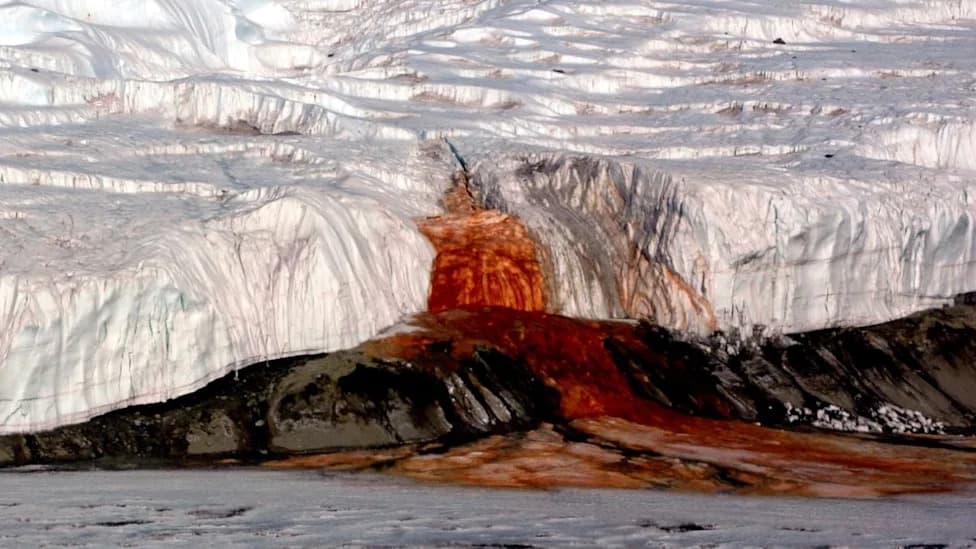
Blood Falls is one of the strangest landmarks in Antarctica. (National Science Foundation/Peter Rejcek)
Set against the stark white of Taylor Glacier, Antarctica's famous Blood Falls pours a deep red stream into Lake Bonney. The color comes not from algae but from iron-rich hypersaline brine trapped beneath the glacier that oxidizes and rusts when exposed to oxygen.
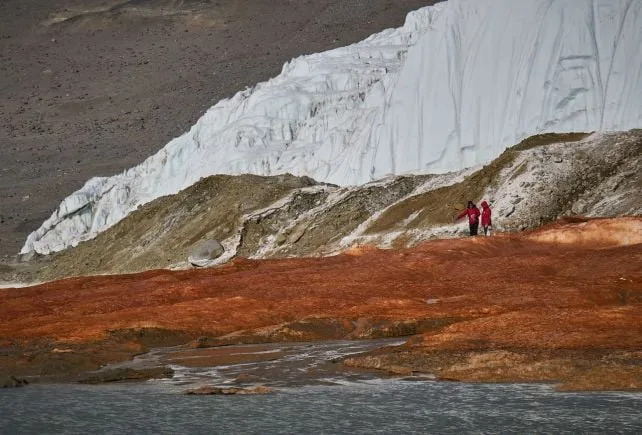
Members of the research team collecting samples at Blood Falls. (Bryan Minnear)
A new study published in Nature Geoscience and led by microbiologist Angela Zoumplis (University of California, San Diego) shows that this subglacial brine hosts a diverse, transcriptionally active community of eukaryotic microbes. The findings suggest these organisms could be the living descendants of a marine ecosystem that was isolated beneath the ice for millions of years.
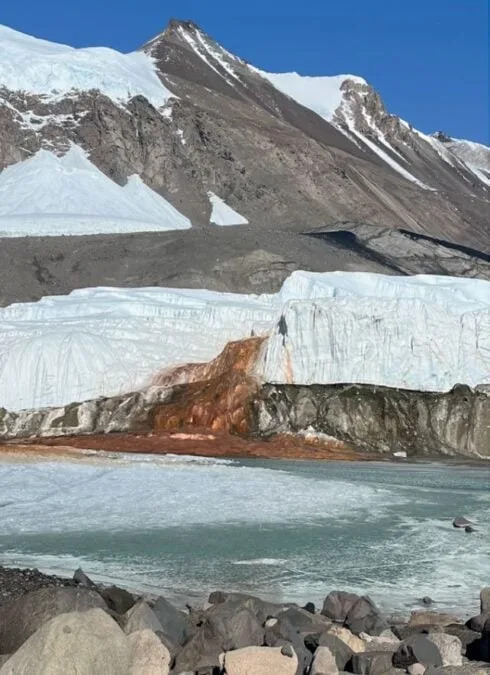
Blood Falls seeps from beneath Taylor Glacier and flows into Lake Bonney. (Zoumplis et al.,Nat. Geosci., 2026)
What the Researchers Did
The team collected 167 samples from the Blood Falls outflow, nearby sediment, ice, mud, the McMurdo Dry Valleys, and coastal marine sites. Instead of analyzing DNA alone, they sequenced environmental RNA to identify organisms that were actively alive and metabolizing in the system, not just present as dead genetic fragments.
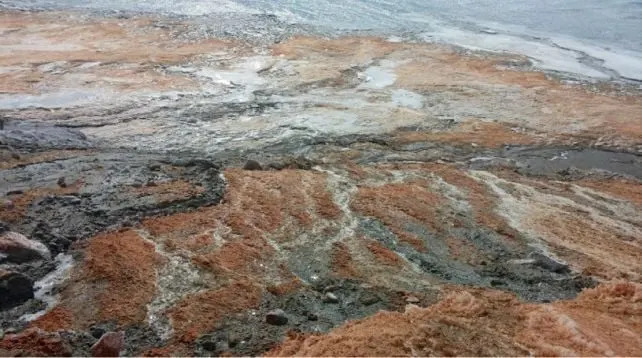
Red mud and sediment at the base of Blood Falls. (Zoumplis et al.,Nat. Geosci., 2026)
Key Findings
The analyses revealed a concentrated, distinctive assemblage of eukaryotic microbes around Blood Falls, including groups typically associated with oceans: diatoms, dinoflagellates, haptophytes, and ciliates. Their RNA profiles indicate these organisms were transcriptionally active beneath the glacier, carrying out normal cellular processes despite extreme cold and salinity.

Subscribe to ScienceAlert's free fact-checked newsletter
Spatial patterns and genetic comparisons argue against a simple explanation that these microbes were recent wind- or waterborne arrivals from the coast. Instead, many lineages are clustered around Blood Falls and show genetic differences from modern marine relatives consistent with long-term isolation.
How They Might Have Survived
The authors propose several nonexclusive mechanisms that could have allowed these lineages to persist while Antarctica transformed into an icy continent. Hypersalinity lowers the freezing point of water and can create liquid refuges beneath ice sheets. Some taxa display adaptations to high salinity, and others may have survived prolonged dormant states before reactivating when conditions permitted.
If this interpretation is correct, Blood Falls offers a rare opportunity to study living descendants of organisms that inhabited Antarctica before the modern ice sheet formed—effectively a biological window into preglacial Antarctic environments.
"In highlighting this area as a unique refuge of ancient lineages, this study establishes a foundation for future work on how relict ecosystems illuminate past environmental change and future polar vulnerability."
The research was led by Angela Zoumplis and appears in Nature Geoscience. Historically, Blood Falls was first recorded by Thomas Griffith Taylor in 1911 and has fascinated scientists ever since.
Help us improve.