
Webb Telescope spectra reveal magnesium-rich clay minerals on Neptune's inner moons Proteus, Larissa and Galatea and in its inner rings. Because such clays form only after prolonged liquid water–rock interaction, the material likely originated in the deep interiors of much larger ancient icy bodies. Researchers argue that Triton's capture from the Kuiper Belt early in the solar system's history probably destabilized Neptune's original moons, causing collisions that produced today's inner moons and rings. A less likely alternative is that another Pluto-sized object was torn apart by Neptune's gravity.
Webb Telescope Finds Clay on Neptune's Moons — Evidence of a Billion-Year-Old Catastrophe
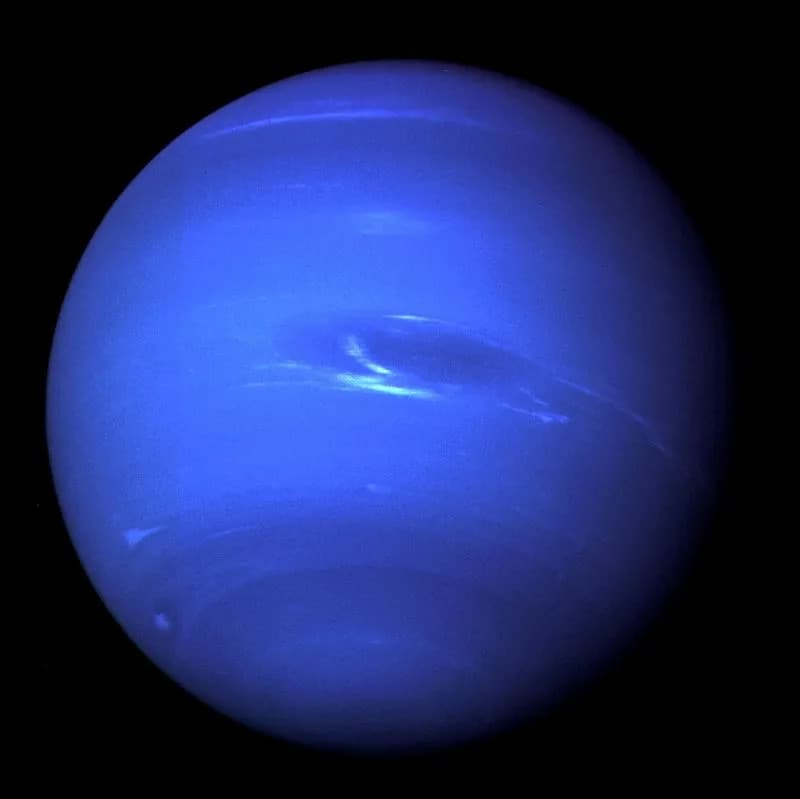
FILE PHOTO: The planet Neptune, including its "Great Dark Spot" - a storm in the atmosphere and the bright, light-blue smudge of clouds that accompanies the storm - is seen in this image taken by the NASA spacecraft Voyager 2 less than five days before its closest approach of the planet on August 25, 1989. NASA/JPL-Caltech/Handout via REUTERS /File Photo
New observations from NASA's James Webb Space Telescope have detected magnesium-rich clay minerals on three of Neptune's inner moons — Proteus, Larissa and Galatea — and in the planet's inner dusty rings. These minerals normally form where liquid water alters rock, implying the material originated deep inside much larger icy bodies that were later disrupted.
What Webb Saw
Spectra obtained by Webb reveal signatures consistent with clay minerals similar to those found on the dwarf planet Ceres and in some meteorites. Clay formation requires prolonged contact between liquid water and rock, conditions that the small, cold inner moons of Neptune could not provide in place.
"These minerals require prolonged contact between liquid water and rock to form," said planetary scientist Ryleigh Davis, lead author of the study published in Science Advances. "The clay had to come from somewhere else — the deep interior of a much larger ancient world."
How This Might Have Happened
The research team argues that the most plausible explanation is the capture of Triton, a former Kuiper Belt object that is roughly Pluto-sized. Shortly after the solar system formed (about 4.5 billion years ago), during a chaotic era when the giant planets were migrating, Neptune likely captured Triton. Triton's capture and subsequent gravitational interactions would have destabilized Neptune's original moons, driving many into destructive collisions and exposing the deep, clay-bearing interiors of those larger bodies. Debris from that collision cascade then reassembled into the small inner moons and rings we observe today.
Triton is unique among large moons because it orbits in the opposite direction to Neptune's rotation (a retrograde orbit), a strong clue that it was captured rather than formed in place. Today Triton comprises more than 99% of the mass of Neptune's entire satellite system.
Alternative Scenarios and Broader Significance
The authors note a less likely alternative: that a different Pluto-sized Kuiper Belt object passed close to Neptune and was tidally shredded, supplying clay-rich material to the inner system. Another piece of the puzzle is Nereid, an outer moon with a highly elliptical orbit; its composition suggests it may have been the lone survivor of Neptune's original moons.
Beyond reconstructing Neptune's violent history, the discovery is important because it provides direct access to material from the deep interiors of ancient icy worlds — material normally hidden beneath thick ice shells and accessible only through modeling or meteorite studies. In short, Webb has given astronomers a rare look at planetary building blocks that were literally turned inside out by a cosmic collision.
Technical Note
The observations and interpretations are reported in Science Advances. The lead author is Ryleigh Davis (formerly at Caltech, now a postdoctoral researcher at the University of California, San Diego). The study links spectral detections of magnesium-rich clays on Proteus, Larissa, Galatea and inner ring material to a catastrophic disruption event early in Neptune's history.
Reported by: Will Dunham. Editing: Daniel Wallis.
Help us improve.





















