Researchers propose a new indirect search for dark matter in which dark-matter particles decay into gravitons that convert into photons via the Gertsenshtein effect in large-scale magnetic fields. The conversion is most effective inside cosmic filaments—structures that may occupy up to 30% of the observable Universe and contain coherent but extremely weak magnetic fields. Detecting an excess gamma-ray flux from extragalactic filaments, relative to Fermi telescope backgrounds, would be the key signature. This idea relies only on the new assumption that dark matter can decay to gravitons; the graviton-to-photon conversion follows standard physics.
Dark Matter May Decay Into Gravitons That Create Detectable Gamma Rays
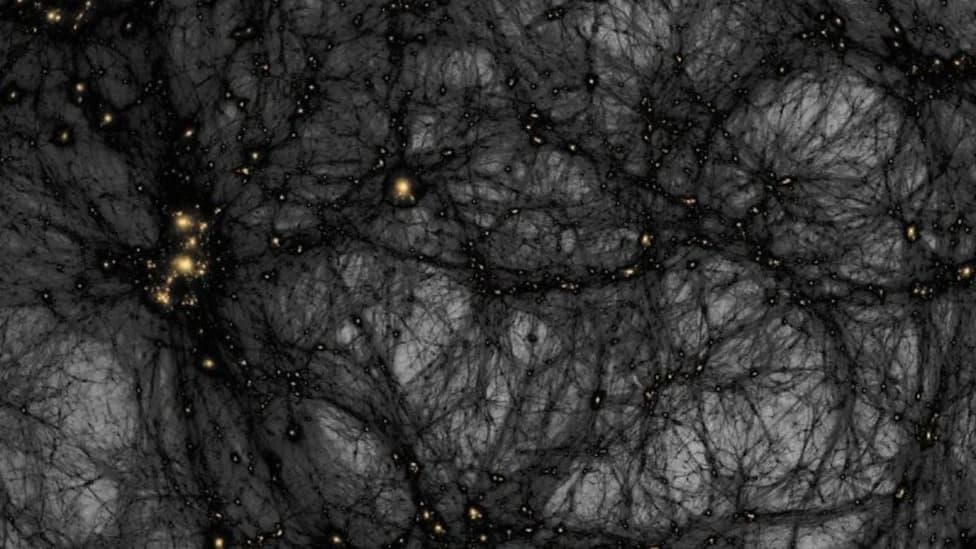
A simulation of dark matter forming the scaffolding for the Universe's visible matter. (Ralf Kaehler/SLAC National Accelerator Laboratory, American Museum of Natural History)
Most of the Universe's matter is invisible. Ordinary luminous matter—galaxies, stars and glowing gas—accounts for roughly 15 percent of cosmic matter; the rest is dark matter, a mysterious substance that interacts primarily through gravity and helps bind galaxies and clusters together.
YouTube Thumbnail
In a paper published in Physical Review D, a team of physicists proposes a novel indirect search for dark matter: instead of looking for dark matter that annihilates or scatters in detectors, they suggest that dark-matter particles might decay into gravitons—hypothetical quanta of the gravitational field—which could then convert into photons as they pass through large-scale magnetic fields in intergalactic space.
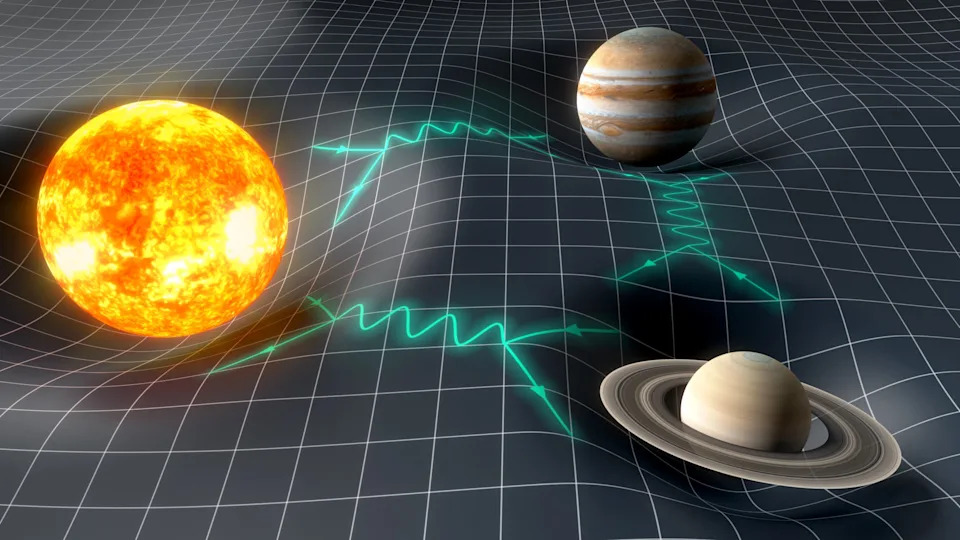
A conceptual rendition highlighting the invisible, gravity-propagating effects of gravitons.(Y. Gominet IMCCE/Observatoire de Paris/textures from NASA)
How the Signal Would Arise
The conversion mechanism is the Gertsenshtein effect, a well-known prediction of classical and quantum physics in which a gravitational wave or graviton can transform into an electromagnetic wave (photon) when traversing a magnetic field. If dark matter decays into gravitons at cosmological distances, those gravitons traveling through coherent magnetic fields in the cosmic web could produce photons, including high-energy gamma rays.
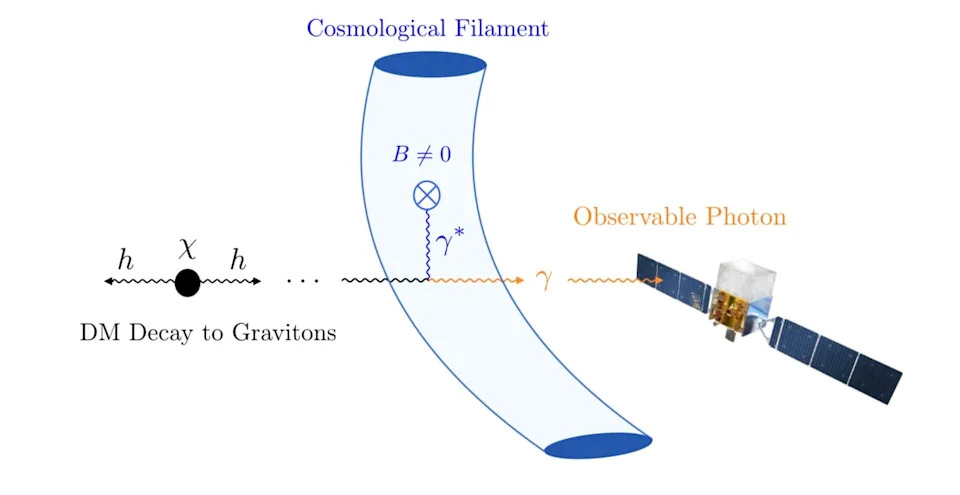
A schematic illustration of the authors' proposed search strategy, focused on finding evidence of dark matter decaying into gravitons and then into photons via the Gertsenshtein effect.(Dunsky et al.,Physical Review D, 2026)
Where to Look
The authors identify cosmic filaments—long, threadlike structures of gas, dust and galaxies that weave the cosmic web—as the most promising environments for conversion. Filaments may occupy up to ~30% of the present Hubble volume and host magnetic fields that are coherent over millions of light-years, albeit extremely weak (order 10−9 gauss or smaller). The long path lengths through these weak but extensive fields improve the chance of graviton-to-photon conversion.
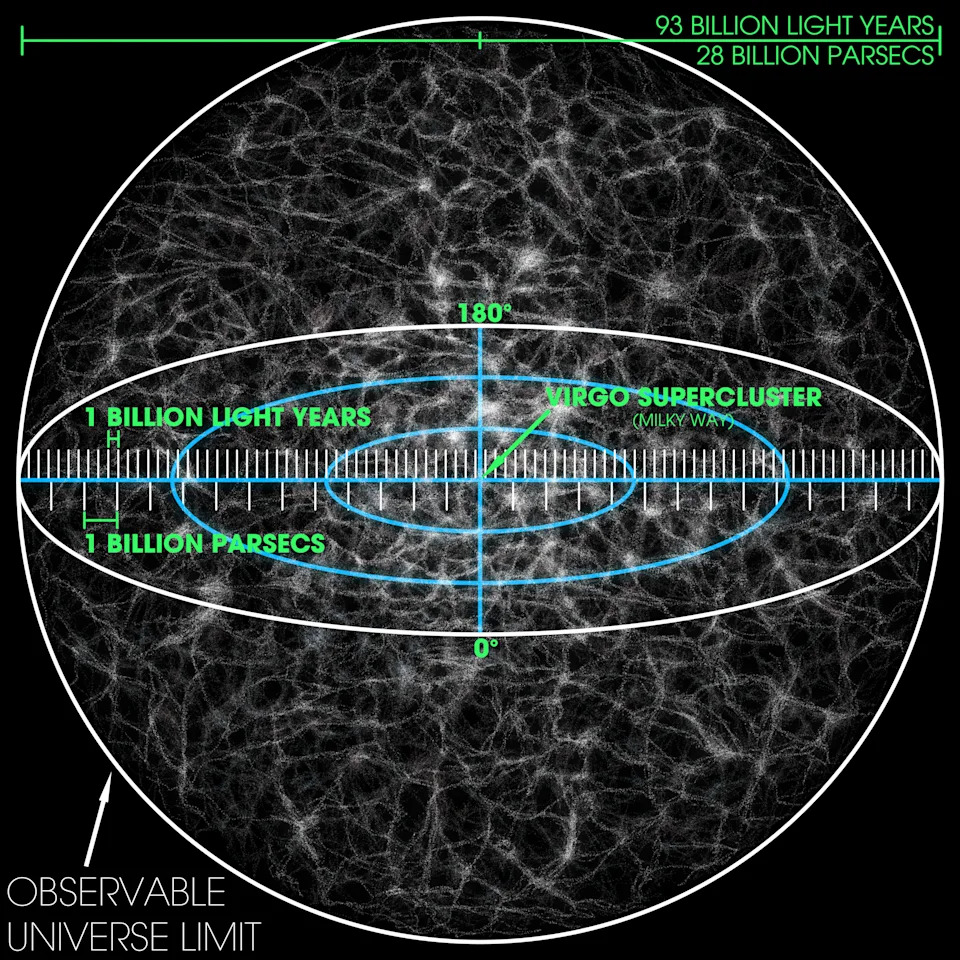
The Hubble volume is represented by the inner blue circle.(Andrew Z. Colvin/Wikimedia Commons)
Observational Strategy
The predicted observational signature is an excess gamma-ray flux along sightlines that intersect intergalactic filaments, compared with the gamma-ray background level measured by instruments such as the Fermi Gamma-ray Space Telescope. Unlike many dark-matter searches that focus on the Galactic center, this channel would produce a predominantly extragalactic signal because significant conversion requires cosmological distances and extended filamentary fields.

Subscribe to ScienceAlert's free fact-checked newsletter
Key point from the authors: The graviton-to-photon conversion is Standard-Model physics; the only new ingredient assumed is that dark matter can decay to gravitons.
Prospects and Next Steps
Current telescopes like Fermi can already constrain some scenarios, but the authors note that a next-generation instrument—such as a proposed Advanced Particle-astrophysics Telescope—could improve sensitivity to this decay channel by roughly an order of magnitude. Future work will refine filament magnetic-field models, map potential target sightlines, and search for gamma-ray excesses correlated with the cosmic web.
This approach opens a complementary search strategy for dark matter: instead of hunting in galactic centers or deep underground detectors, it directs attention to intergalactic space and to indirect signatures produced by a dark-matter → graviton → photon cascade.
Help us improve.