The Centre for Palaeogenetics analysed genomes from 521 woolly mammoths and found a pronounced difference in sex ratios between natural deposits and human-associated bone accumulations. Natural, dispersed sites were mostly male (66%), while accumulation sites linked to human activity were predominantly female (70%). Researchers suggest hunters encountered female-led herds more often—perhaps because those herds moved predictably—rather than preferring females solely for their smaller size. The study also reports the first known X0/XX mosaicism (Turner-like) case in an extinct mammoth.
Ancient DNA Shows Upper Palaeolithic Hunters Favoured Female Woolly Mammoths

Mammoths were a vital resource for Ice Age survival - Denis-Art
A major ancient-DNA study finds that Ice Age hunters disproportionately targeted female woolly mammoths. Scientists at the Centre for Palaeogenetics in Stockholm analysed genome data from 521 woolly mammoths across Eurasia and North America—including 448 individuals sequenced for the first time—to infer the genetic sex of each animal and compare remains from natural settings with those from human-associated bone accumulations.
Key Findings
Remains recovered from dispersed, natural depositional settings were predominantly male (66 percent), consistent with solitary adult males being more likely to die alone in natural traps such as sinkholes or landslides. By contrast, mammoth bone accumulations associated with human activity were strongly female-biased (70 percent).
Dr David Díez del Molino, co-senior author, said the comparison of sex ratios across contexts indicates that human activity was the primary driver behind these dense bone accumulations.
Why Females?
Lead author Dr Hannah Moots cautions that the pattern is unlikely to be a simple size preference. If woolly mammoths had social behaviours similar to modern elephants, female-led matriarchal herds could have mounted group defences that made direct attacks risky. Alternatively, female herds may have followed more predictable movement routes across the landscape, increasing the chance that Upper Palaeolithic hunter-gatherers encountered them—either while hunting living animals or scavenging carcasses.
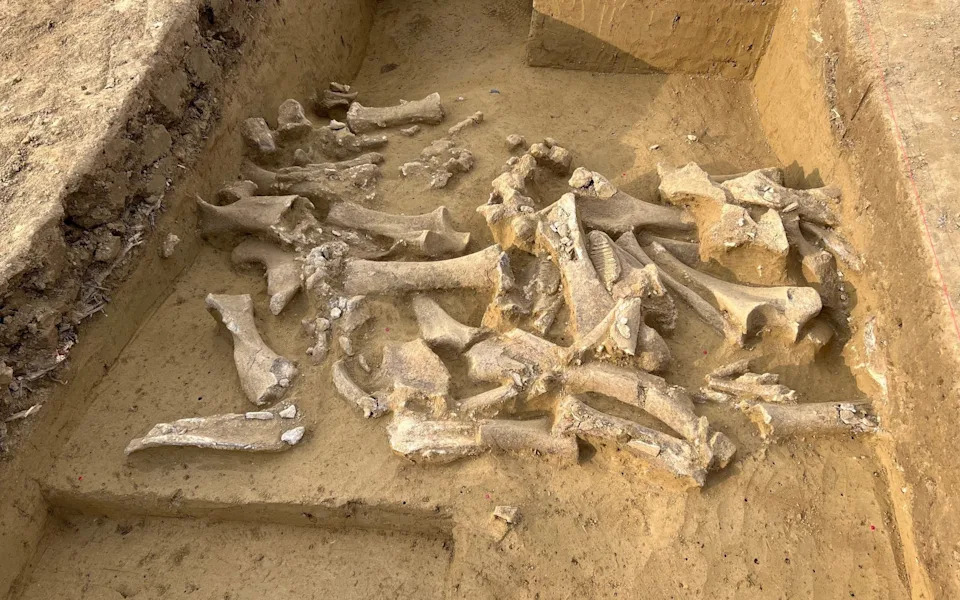
An accumulation of female mammoth bones - Marc Handel/Austrian Academy of Sciences/SWNS
Scope and Methods
The study sampled mammoth bone accumulations from 11 key Ice Age archaeological sites dated to roughly 20,000–30,000 years ago. The dataset compared 100 individuals from human-associated accumulation sites with 421 mammoths from natural depositional contexts, giving an unprecedented sample size for behavioural inference about both humans and mammoths.
Additional Genetic Discovery
The team also identified a mammoth from Wrangel Island (Russia) with X0/XX mosaicism—some cells carrying a single X chromosome and others two—a chromosomal condition analogous to Turner syndrome in humans. This is the first documented case of such sex-chromosome mosaicism in an extinct species.
Why It Matters
Mammoths were a vital resource for Ice Age human populations, supplying meat and fat, hides for clothing and shelters, bones for structures, and ivory for tools and ornaments. The study demonstrates how large-scale ancient DNA analyses can resolve long-standing archaeological debates and reveal aspects of animal behaviour and human cultural practice tens of thousands of years ago.
Help us improve.