
The Flatiron Institute team led by Tom Wagg used detailed simulations of the Milky Way’s 13.6‑billion‑year history to estimate the hidden population of stellar‑mass black holes. They find roughly 170 million such black holes today—an average of about one new black hole every 80 years, though most formed early. Near the Sun the predicted density is about one per 6,250 cubic parsecs, and natal kicks produce a thicker black hole disk (~790 pc) than the stellar thin disk (~306 pc). Future surveys measuring masses and motions can test supernova and black hole formation models.
The Milky Way’s “Galactic Underworld”: Simulations Predict ~170 Million Hidden Black Holes
(Victor de Schwanberg/Science Photo Library/Getty Images)
Black holes are notoriously elusive. Except when they briefly brighten by accreting matter, they emit no light, leaving astronomers to infer their presence indirectly. That invisibility makes it difficult to count how many stellar-mass black holes inhabit our galaxy.
A team led by astrophysicist Tom Wagg of the Flatiron Institute has tackled this problem by building detailed simulations of the Milky Way’s 13.6‑billion‑year history. Their models trace star formation, stellar deaths, black hole births and galactic evolution to estimate the present-day population and distribution of stellar-mass black holes across the Galaxy.
YouTube Thumbnail
The simulations indicate that roughly 170 million stellar-mass black holes should exist in the Milky Way today. The authors report their results in a manuscript submitted to AAS journals and posted on the preprint server arXiv while the paper undergoes peer review.
Stellar-mass black holes form when massive stars exhaust their nuclear fuel and their cores collapse. The outer layers explode as a supernova while the core becomes an extremely dense object whose gravity prevents light from escaping. Because these remnants are effectively dark, models and indirect measurements are essential to estimate how many there are and where they are located.
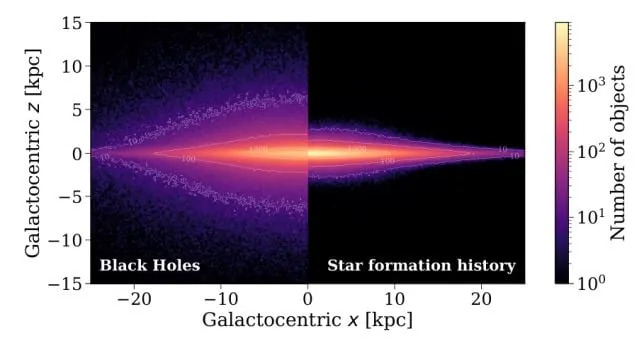
The distribution of black holes (left) compared to the birthplaces of their parent stars (right) as though looking at the galaxy edge-on. (Wagg et al., arXiv, 2026)
Although 170 million sounds large, it is sparse on galactic scales. Near the Sun’s distance from the Galactic center the simulations predict about one black hole per 6,250 cubic parsecs (one parsec = 3.26 light-years), equivalent to a cube roughly 18.4 parsecs on a side. Averaged over the Milky Way’s lifetime, that population corresponds to about one new stellar-mass black hole every 80 years, though most formed early when star formation rates were much higher.
Importantly, the models predict distinct spatial and kinematic signatures. Many black holes receive asymmetric impulses at birth—so-called natal kicks—from lopsided supernova explosions. These kicks send black holes on long trajectories through the Galaxy; a few are even accelerated fast enough to escape the Milky Way entirely, but most remain bound and redistribute over time.

Subscribe to ScienceAlert's free fact-checked newsletter
The team finds that the black hole population occupies a much thicker disk than the Galaxy’s thin stellar disk: the simulated black hole disk has a scale height near 790 parsecs, compared with the stellar thin disk’s ~306 parsecs. The simulations also predict a mass-dependent effect: lighter black holes tend to reach greater heights above the Galactic plane because they receive relatively stronger kicks, while heavier remnants are more likely to accrete fallback material that damps the recoil.
These mass and motion signatures are scientifically valuable. Upcoming and ongoing surveys that measure black hole candidates’ masses and trajectories—via gravitational microlensing, astrometric motion (for example, with Gaia), and other techniques—could discriminate between competing models of supernova physics and black hole formation. If observations match the simulations’ predictions, it will strengthen the use of population models as probes of galactic history.
In short, the Milky Way’s hidden “Galactic Underworld” may serve as an archive of the Galaxy’s past. The authors’ full results are available on arXiv while the manuscript undergoes formal peer review.
Help us improve.





















