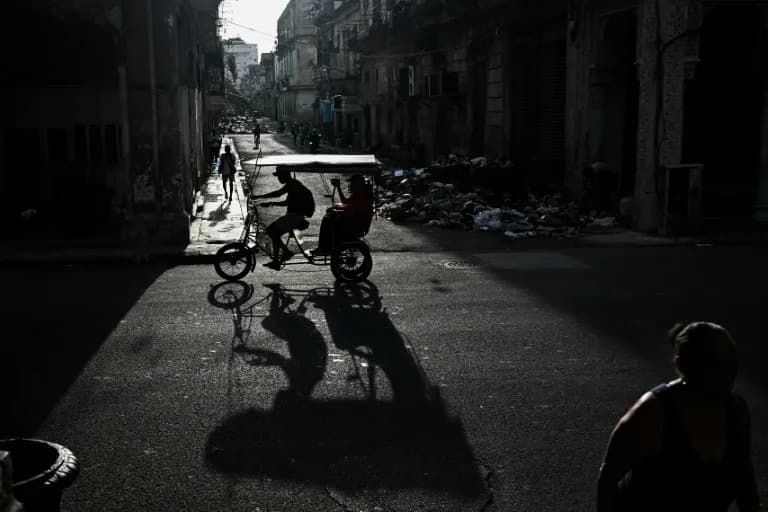
Cuba suffered a partial collapse of its national grid at 6:07 p.m. (22:07 GMT), leaving five of 15 provinces without power. Authorities say chronic fuel shortages and aging thermal plants have increased the risk and duration of outages; some Havana blackouts have exceeded 30 hours. The island has seen five nationwide blackouts in 2026 and 10 since late 2024. Lawmakers are rolling out market-oriented reforms and opening key services to private firms to help address shortages.
Partial Grid Collapse Leaves Five Cuban Provinces in Darkness; Government Cites Fuel Shortages
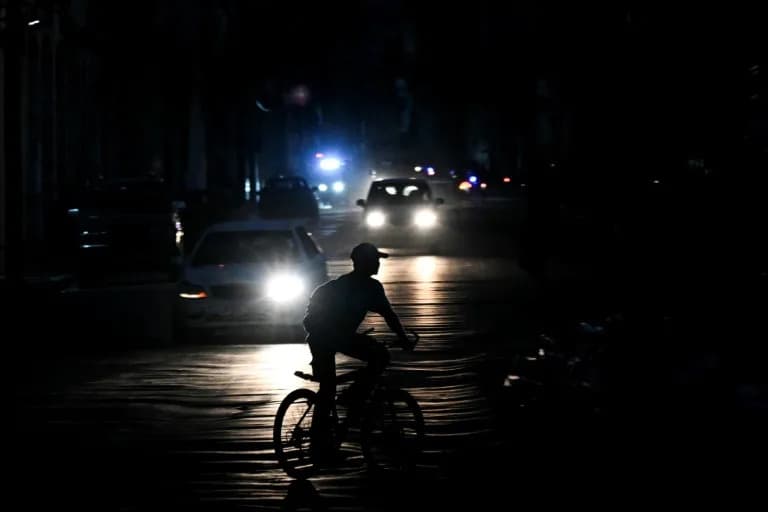
A man rides his bicycle down a street during a blackout in Havana (YAMIL LAGE)
Havana and parts of western Cuba were plunged into darkness on Saturday after a partial collapse of the national electricity grid, the state utility Unión Eléctrica (UNE) reported. The outage occurred at 6:07 p.m. (22:07 GMT) and left five of the country's 15 provinces without power.
UNE said chronic fuel shortages — which Cuban authorities attribute to tightened U.S. restrictions and reduced imports — have undermined the grid's resilience and made reliance on diesel-powered emergency generators increasingly impractical. Cuba, with a population of about 9.4 million, has endured several prolonged outages in recent weeks; some blackouts in Havana have lasted more than 30 hours, and other regions have faced multi-day power losses.
Since the start of 2026, the island has seen five nationwide blackouts, including three in July within a 10-day period. UNE says there have been 10 major national outages since late 2024. The backbone of Cuba's system — seven thermal power plants — has been in operation for more than four decades and is reported to be in various states of disrepair.
"We live practically like fireflies here — in the dark all the time. You never know when you'll have power; it's our sad reality," said Julian Gonzalez, a 72-year-old carpenter who spends time near the Malecon seawall in Havana to cope with the heat and outages.
Havana blames U.S. measures and tighter fuel supplies for the deteriorating state of the electricity network. U.S. officials counter that years of underinvestment and mismanagement have left the grid vulnerable to failures. UNE said the only Russian tanker authorized to deliver fuel this year — carrying roughly 100,000 tons of crude in March — has exhausted those reserves.
Beyond fuel restrictions, the Trump administration has intensified sanctions on Cuban state-owned enterprises, prompting some foreign companies to pause or suspend operations in the country. Diplomatic talks between the United States and Cuba have shown little movement: Cuban Foreign Minister Bruno Rodríguez said in late June that months of dialogue produced "no progress."
Facing mounting pressure, Cuban lawmakers have approved a series of market-oriented reforms intended to attract investment and loosen the state's role in parts of the economy. Officials announced plans to open key services — including gas stations, electricity generation, waste collection and pharmacies — to private firms as part of efforts to address shortages and modernize services.
Public frustration over the rolling outages is palpable across the island, with residents reporting disruptions to daily life, commerce and healthcare services. UNE and government ministries say they are working to stabilize generation and repairs, but recovery timelines remain uncertain.
Help us improve.