Recreational segregation shaped 20th-century America: public pools, beaches and amusement parks were often segregated by law or custom, enforced by violence and local officials who prioritized 'public order.' Desegregation, suburban flight, privatization and federal housing policies shifted recreational access into private hands, contributing to closures and unequal urban landscapes. Contemporary exclusionary incidents continue to echo this history.
The Overlooked History of Segregated Swimming Pools and Amusement Parks
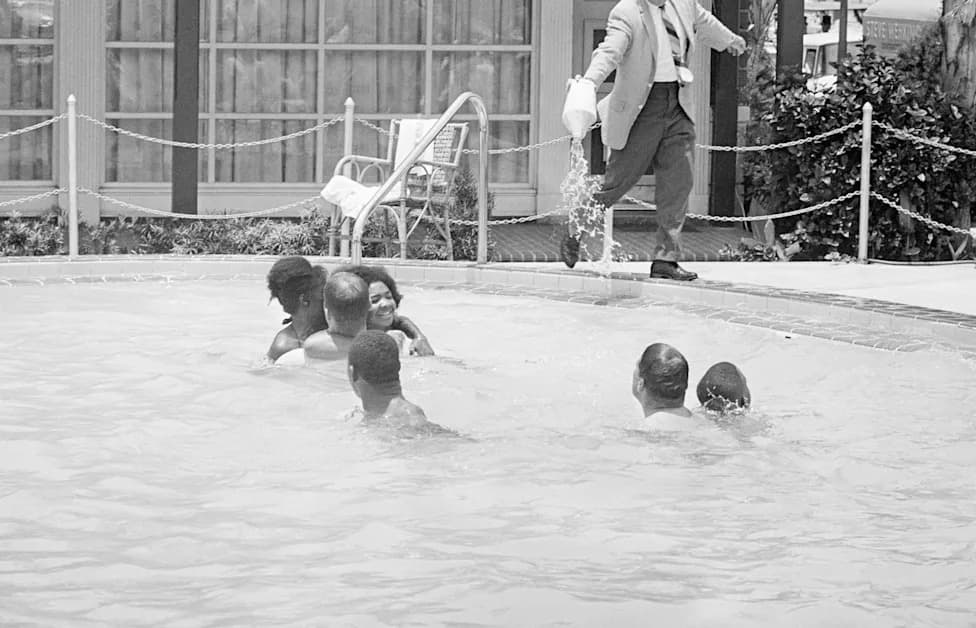
When a group of white and African American integrationists entered a St. Augustine, Fla. segregated hotel pool in 1964, the hotel manager poured acid into it.AP Photo
Summers often bring familiar images: lazy afternoons by the pool, a trip to a neighborhood amusement park, or long humid days at the shore. But these memories were not universal in 20th-century America. Municipal pools and urban amusement parks flourished — often on the condition that African Americans be excluded.
A Legacy of Exclusion
As a social historian who has written about segregated leisure, I argue that recreational segregation is a largely forgotten but deeply consequential chapter in American racial history. Public pools and beaches became some of the most contested and segregated public spaces in both Northern and Southern cities. Segregation rested on racialized stereotypes that portrayed Black people as diseased or sexually dangerous; local officials also warned that racial mixing would provoke violence. For many city leaders, separation equaled social order.
Violence, Riots, and the Excuse of 'Order'
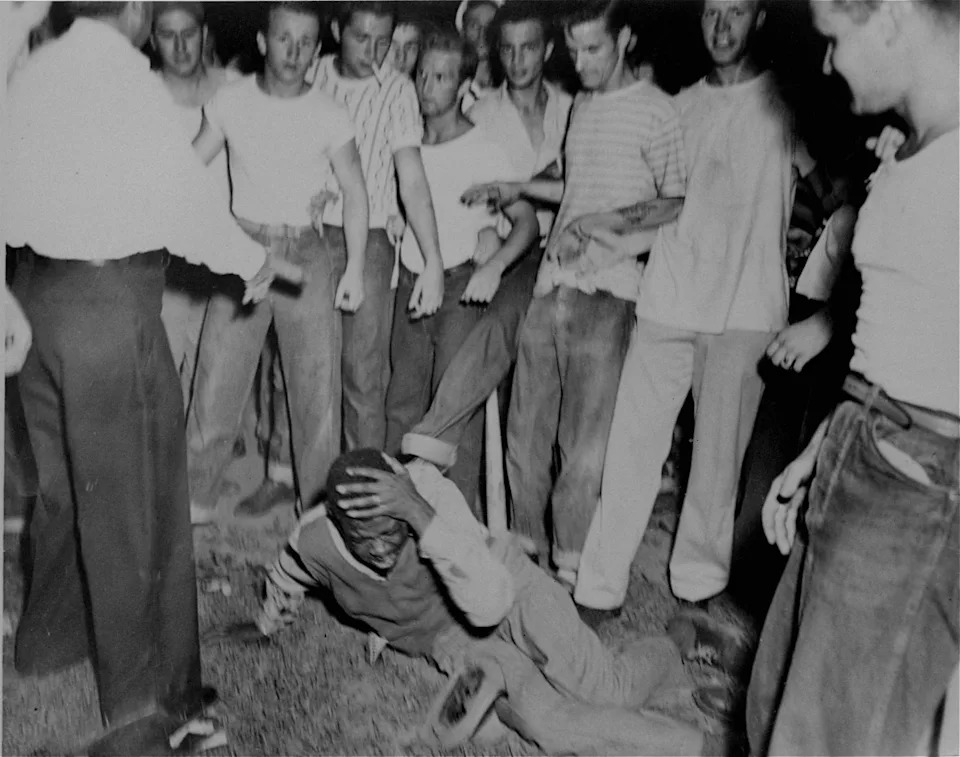
Those fears were often self-fulfilling. When activists or municipal authorities opened pools to Black swimmers, white mobs sometimes responded with attacks: officials and witnesses reported nails scattered on pool floors in Cincinnati, bleach and acid poured into pools in St. Augustine, and beatings in Philadelphia. Large pool riots occurred in the late 1940s in cities such as St. Louis, Baltimore, Washington, D.C., and Los Angeles.
Surrounded by a group of white youths, an unidentified Black man grimaces as a policeman tries to halt an attack on him in St. Louis, Missouri, in 1949. AP Photo
Even where civil-rights laws existed, they often failed to protect African Americans. In 1960 the chairman of Charlotte's Park and Recreation Commission acknowledged that 'all people have a right under law to use all public facilities including swimming pools,' yet he argued that pools 'put the tolerance of the white people to the test' and concluded that 'public order is more important than rights of Negroes to use public facilities.' In practice, managers could exclude Black swimmers whenever they claimed 'disorder' might follow—meaning access was governed by perceptions of order, not the law.
Surrounded by a group of white youths, an unidentified black man grimaces as a policeman tries to halt an attack on him in St. Louis, Missouri, in 1949.AP Photo
Amusement Parks, Youth, and Racial Anxiety
Amusement parks — developed at the ends of trolley and ferry lines from the 1890s onward — intensified these anxieties. Facilities such as park swimming pools, dance pavilions and roller-skating rinks provoked particular fear because they gathered young people in close, playful contact. The sight of scantily clad bathers flirting or dancing raised specters of interracial sex and danger to young white women in the eyes of many white owners and patrons.
Some park owners argued that excluding African Americans preserved a 'virtuous' or 'safe' white leisure environment. But exclusion simply reinforced racial stereotypes and deepened inequality.
Desegregation, Privatization, and the Decline of Public Recreation
Civil-rights protests targeted amusement-park segregation at sites such as Gwynn Oak Park (Baltimore), Glen Echo Park (near Washington, D.C.), and Fontaine Ferry (Louisville). After the 1964 Civil Rights Act barred segregation in public accommodations, municipalities and private owners used various strategies to limit real access: some filled in pools; others converted pools into membership clubs or imposed fees that effectively excluded lower-income and Black patrons.
By the early 1970s many urban amusement parks (for example, Cleveland's Euclid Beach and Chicago's Riverview) closed permanently. Some white consumers viewed newly integrated parks as 'unsafe,' prompting land sales and redevelopment. Simultaneously, suburbanization and the proliferation of gated communities and homeowners associations — what political scientist Evan McKenzie calls 'privatopia' — shifted recreational amenities into private hands. Federal Housing Administration policies in the mid-1960s further encouraged private recreational facilities in planned developments rather than public ownership.
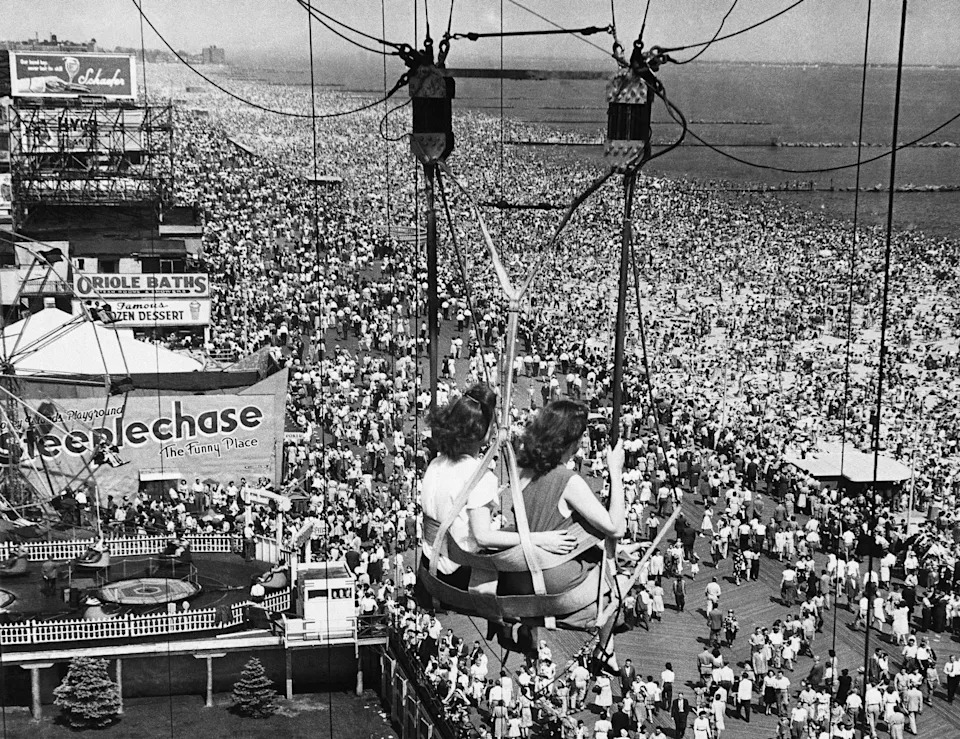
Passengers on the Parachute Jump ride see throngs of people on the boardwalk and beach at the Coney Island Amusement Park in Brooklyn, N.Y., in 1957.AP Photo
Enduring Consequences and Contemporary Echoes
Over time, public funding for municipal recreation declined, leaving many urban residents with limited access to pools and other leisure sites. Ironically, some blamed African Americans for the resulting decline, ignoring decades of exclusion and violence that had shaped those outcomes.
Although the crude stereotypes that once justified segregation are less often voiced today, the built environment still bears their imprint: closed pools, shuttered rinks and lost public spaces continue to weaken many urban neighborhoods. Contemporary incidents occasionally echo the past — for example, a private Philadelphia swim club that in 2009 refused Black children from a day-care center because they would change the club's 'complexion,' and a 2015 incident in a Dallas-area subdivision where police targeted Black teenagers at a pool party.
Why This History Matters
Understanding recreational segregation helps explain persistent disparities in access to safe, public leisure spaces. It also reminds us that policy choices — from municipal maintenance budgets to federal housing guidance — shape who belongs in public life. A frank reckoning with this history is essential to restoring equitable public recreation and healthier urban communities.
This article draws on research by Victoria W. Wolcott, University at Buffalo.
Help us improve.