A judge removed community-integration language from the Section 504 regulation after HHS joined conservative-led states in asking the court to strike the provisions in Texas v. Kennedy. The move — together with a June DOJ memo narrowing Olmstead’s scope — represents a federal retreat from actively enforcing community-based service requirements. Advocates warn the change reduces oversight, may make it harder for people with disabilities to secure home- and community-based supports, and could force more families to sue states to get services.
Federal Pullback From Community-First Disability Rule After States’ Lawsuit Could Weaken Access to Home-Based Services
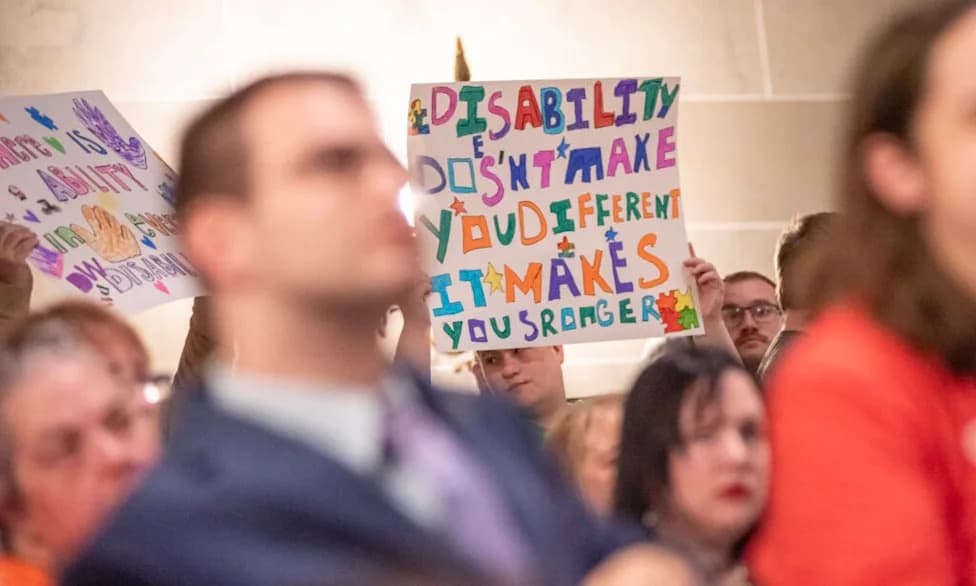
Disability rights advocates rally at the Missouri State Capitol to protest the state's participation in a lawsuit that began as an effort to block protections for transgender people but ended in a rollback of protections for people with disabilities. Missouri eventually withdrew from the suit, but five Republican-led states did not. (Photo by Annelise Hanshaw/Missouri Independent)
A federal judge has removed language requiring community-based services from the Section 504 regulation after the U.S. Department of Health and Human Services joined conservative-led states in asking the court to strike the provisions. Disability advocates warn the decision — together with a June Justice Department memo narrowing the federal interpretation of Olmstead v. L.C. — could reduce federal oversight and make it harder for people with disabilities to obtain services that allow them to live in their communities rather than institutions.
What Happened
In the case Texas v. Kennedy, the court this month expunged references to "community integration" from the Section 504 regulation, effectively removing an explicit federal directive that states prioritize serving people with disabilities in community settings (such as home- and community-based services) whenever feasible instead of in nursing homes or state hospitals. The change followed HHS joining several Republican-led states in asking the court to strike the integration provisions.
How The Case Evolved
The litigation began in 2024, when 17 Republican-led states sued the Biden administration over its inclusion of gender dysphoria as a protected disability under Section 504. After the Trump administration signaled it would not enforce the Biden-era rule, most states withdrew, but five states — Alaska, Florida, Louisiana, Montana and Texas — remained and amended their complaint to challenge the integration language. HHS later joined those states in requesting removal of the contested provisions.
Reactions And Concerns
"This affects children, this affects adults, it affects your elderly parents. It affects everyone," said Charlotte Cravins, an attorney from Baton Rouge whose toddler son, Landry, has Down syndrome and receives publicly funded therapies that enable him to live at home with his family.
Advocates say the ruling does not erase other disability protections — including the Americans with Disabilities Act and the Olmstead precedent — but they warn that removing a clear federal integration mandate weakens enforcement. ‘‘These rights still exist, and people need to understand that,’’ said Alison Barkoff of George Washington University’s Milken Institute School of Public Health. Still, she and other advocates stress that legal rights are meaningful only when federal agencies actively enforce them.
"It’s part of this bigger effort from the federal government to walk away from their longstanding commitment to the right to community living," Barkoff said.
Government And State Positions
An HHS spokesperson told Stateline the department "remains firmly committed to protecting the civil rights of individuals with disabilities" and to ensuring access to community services. The Justice Department said the court's order responded to an "ordinary-course request" to clarify the proper scope of Olmstead v. L.C.
State officials who stayed in the lawsuit argued the Biden-era updates to Section 504 restricted how they could spend Medicaid and other funds and limited state flexibility amid budget pressures and workforce shortages. "Florida joined this lawsuit to serve as a check on federal power, not to deny care," said Jae Williams, a press secretary for Florida’s attorney general. Alaska’s officials said the decision preserves historical protections while striking provisions they viewed as unlawful additions.
Practical Consequences
Legal experts say one likely consequence is that individuals and families may need to bring lawsuits against states to secure community-based supports when those services are denied — a costly and time-consuming path. The Justice Department has already retreated from some enforcement actions, including cases alleging Florida and Texas kept people unnecessarily institutionalized. In one 2023 ruling, a federal court found Florida had placed children with complex medical needs in nursing facilities in violation of federal law; the Biden DOJ had filed that suit but later shifted positions.
Congressional responses include a bipartisan resolution to reaffirm Olmstead and a July letter from roughly 100 House Democrats urging the Justice Department to rescind its memo narrowing the federal interpretation of Olmstead.
What This Means For Families
Families who rely on home- and community-based services worry the rollback will limit state accountability and reduce access to supports that enable community living. As advocates noted, federal rights on paper do not always translate into accessible services without active enforcement and oversight.
Stateline reporter: Anna Claire Vollers ([email protected])
Help us improve.