
The Aug. 12 total solar eclipse will sweep across mainland Spain with parts of Iceland and Greenland also in the path, producing up to 2 minutes and 18 seconds of totality as the moon's umbra races south. Hundreds of millions beyond the path will see a partial eclipse across Europe, North America and West Africa. Major science campaigns include 60+ high-altitude balloons, ESA space telescopes, and a NASA jet chasing the corona; ESA and NASA will provide live web coverage. Longer eclipses follow in 2027 and 2028, making this a rare multi-year spectacle for the region.
Total Solar Eclipse to Sweep Mainland Spain, Iceland and Greenland on Aug. 12 — Meteor Shower and Six-Planet Parade Add to the Spectacle
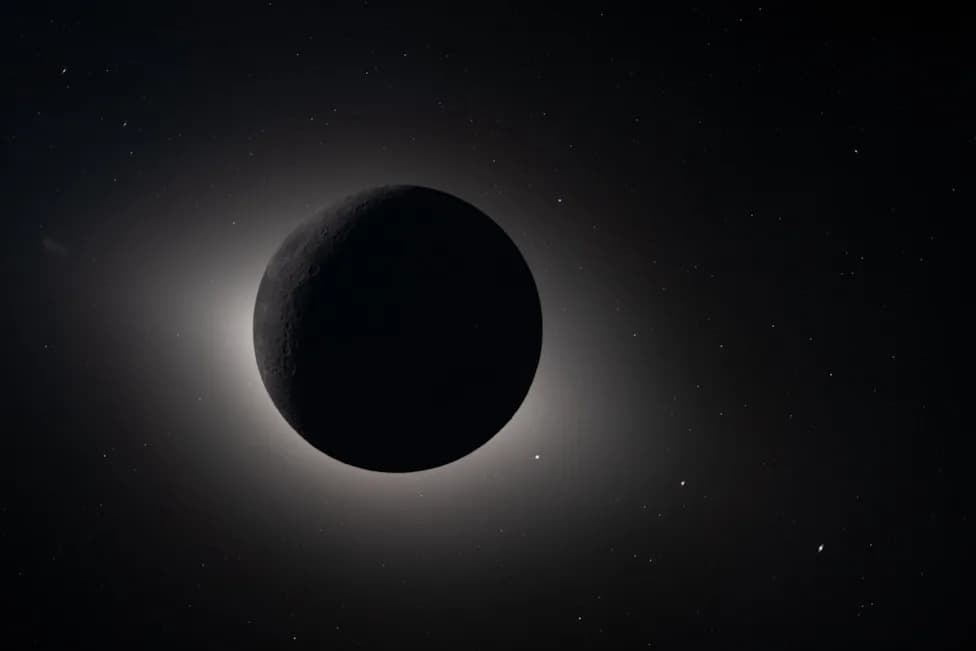
FILE - This image provided by NASA and captured by the Artemis II crew from lunar orbit, April 6, 2026, shows the Moon eclipsing the Sun. (NASA via AP, File)(NASA via AP)
For the first time in more than a century, a total solar eclipse will cross mainland Spain on Aug. 12, plunging portions of the Iberian Peninsula — along with slivers of Greenland and Iceland — into daytime darkness near sunset. The event will be followed next year by an even longer eclipse that will sweep from Spain into North Africa and the Middle East.
Path, Timing and Where to Watch
The moon's central shadow, or umbra, begins near the North Pole and races south, tracing a roughly 5,130-mile (8,260-kilometer) corridor in about 1½ hours. Totality along the path will last up to 2 minutes and 18 seconds, with the longest moment occurring off Iceland's west coast. By the time the shadow reaches small parts of Portugal and then mainland Spain — where large crowds are expected — totality will diminish to about a minute before the eclipse ends over the Mediterranean.
Partial Eclipse Will Be Widely Visible
Hundreds of millions of people outside the path will still witness a partial eclipse. The phenomenon will be visible as far afield as Alaska and Siberia and will envelop Canada, much of the northern United States, most of Europe and parts of West Africa. Local coverage examples include roughly 94% obscuration in Dublin, about 83% in Oslo, approximately 18% in Montreal, 9% in New York City and 2% in Norfolk, Virginia.
Safety First
Do not look at the sun without certified eclipse glasses whenever any portion of the solar disk remains visible. Proper eye protection is essential to prevent permanent eye damage.
Celestial Extras: Planets, Meteors and Auroras
The day will begin with six planets forming an arc before dawn and conclude with the peak of the Perseid meteor shower after nightfall under a new moon, raising the chance that bright meteors could streak through photographs taken during totality. Eclipse cartographer Michael Zeiler plans to be aboard a cruise ship in a Greenland fjord, hoping to capture both totality and any northern lights that might appear to the north during the brief darkness.
Science Programs and Live Coverage
Major science and outreach efforts are lined up: the European Space Agency will host a live webcast from Spain's Astrophysical Observatory of Javalambre and stage a public celebration in León. NASA, the Italian-based Virtual Telescope Project and others will provide streaming coverage.
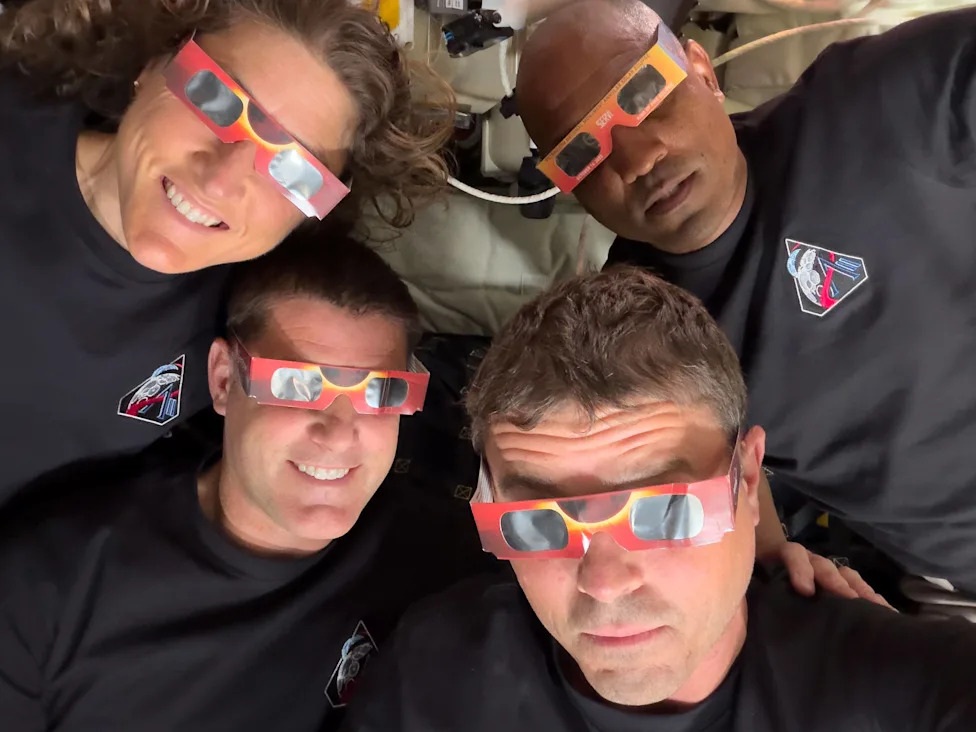
FILE - In this image provided by NASA the Artemis II crew, counterclockwise from top left, Mission Specialist Christina Koch, Mission Specialist Jeremy Hansen, Commander Reid Wiseman and Pilot Victor Glover pose with eclipse viewers during a lunar flyby on April 6, 2026. (NASA via AP, File)(NASA via AP)
Two ESA space telescopes will study the eclipsed sun and its corona. Proba-3 — a two-satellite formation-flown mission designed to create an artificial eclipse in space — will be out of position for Earth's view of totality but aims to collect before-and-after imagery.
U.S. university teams plan to launch more than 60 high-altitude balloons from Spain and Iceland to study rapid atmospheric changes caused by the moon's shadow. Montana State University's Angela Des Jardins, who leads the NASA-funded balloon project, noted that "a couple of minutes isn't a lot of time, but it's still plenty to affect the atmosphere and to make that cold, dark shadow of the moon on Earth."
Southwest Research Institute's Amir Caspi will fly aboard a NASA high-altitude research jet that will chase the eclipse at about 460 mph (740 kph), stretching airborne totality to nearly three minutes. Four cameras aboard the plane will record the corona in nine wavelengths, yielding thousands of images during the extended window.
What's Next
An exceptionally long total eclipse is due on Aug. 2, 2027, when up to 6 minutes and 23 seconds of totality will cross the southern tip of Spain and continue through Morocco, Algeria, Libya, Egypt, Saudi Arabia, Yemen and Somalia. A Jan. 26, 2028 annular "ring-of-fire" eclipse will follow, completing a rare multi-year sequence of notable solar events for the region.
Spain's last full mainland solar eclipse—excluding the Canary Islands—occurred around the time of the Titanic in 1912, making this coming series of eclipses particularly special for observers and scientists alike.
"What gets me excited is viewing rare phenomena," Michael Zeiler said. Andrei Zhukov of the Royal Observatory of Belgium added that Proba-3 simulations have already produced more than 60 artificial-eclipse scenarios, underscoring the scientific appetite for both natural and engineered eclipses.
Note: Check local timing and visibility maps before making travel plans. Always use certified solar-viewing glasses when any part of the sun is visible.
Help us improve.





















