
A car bomb detonated in Cúcuta, Colombia, injuring 11 people — eight police officers and three civilians — six days before President-elect Abelardo de la Espriella's inauguration. No group has claimed responsibility, though the ELN, FARC dissidents and Clan del Golfo are active in the area. De la Espriella condemned the attack and has pledged a tougher security approach, marking a clear break from outgoing President Gustavo Petro's dialogue-focused policies. Security for the August 7 inauguration will be heightened, with about 11,000 personnel expected to be deployed.
Car Bomb in Cúcuta Injures 11 Days Before Colombia's Presidential Inauguration
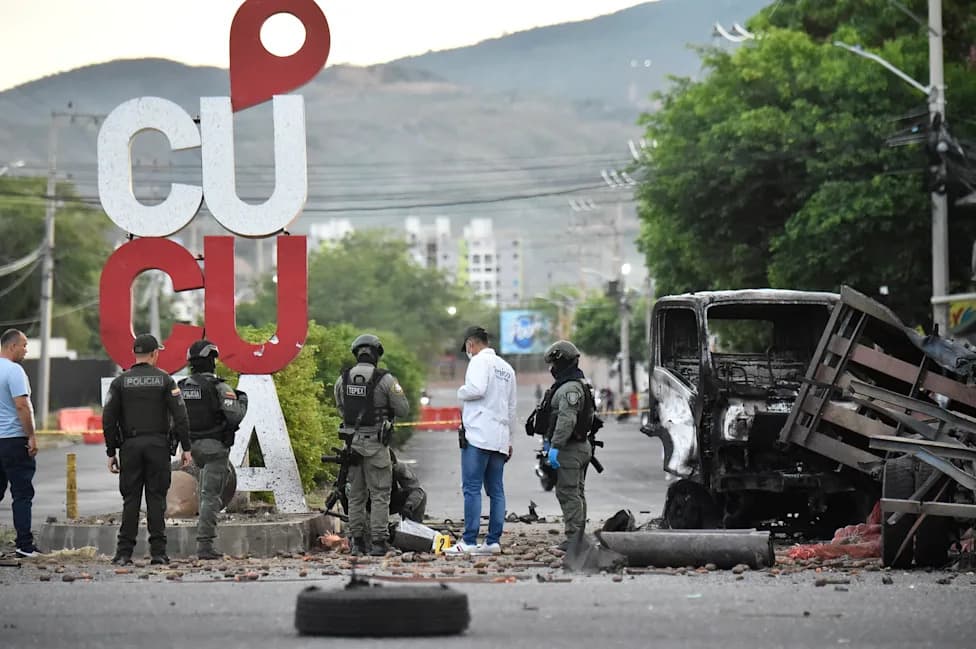
Forensic investigators and police officers examine debris at the site of a car bomb explosion near a police station in Cucuta, Colombia [AFP]
A car bomb exploded in Cúcuta, a city on Colombia's border with Venezuela, injuring 11 people — eight police officers and three civilians — in an attack that occurred six days before President-elect Abelardo de la Espriella is due to take office.
Attack and Immediate Response
The explosion occurred on Saturday in the Norte de Santander department. George Quintero, the department's security secretary, told reporters: 'At this time, we have eight police officers and three civilians who have been injured.' Authorities said no group immediately claimed responsibility.
Security Context
Several armed groups remain active in the region, including the National Liberation Army (ELN), dissident factions of the Revolutionary Armed Forces of Colombia (FARC), and the criminal organisation Clan del Golfo. The area has seen renewed violence in recent years amid ongoing disputes over territory and the cocaine trade.
President-Elect's Reaction and Planned Measures
De la Espriella posted on X condemning the 'cowardly terrorist attack carried out in Cucuta against our National Police' and vowed that 'terrorism will not intimidate Colombia or break Colombians' determination to live in peace and security.'
De la Espriella, a millionaire lawyer and businessman with no prior public office experience, has campaigned on a hardline security platform, promising to intensify operations against rebel groups and criminal organisations involved in drug trafficking. He is due to be sworn in on August 7.
Wider Political Background
The attack comes at the end of an election season marked by political violence. Colombia has endured more than six decades of internal armed conflict involving leftist rebels, right-wing paramilitaries, government forces and criminal networks. The country is also the world's largest producer of cocaine, an issue that dominated the presidential campaign.
De la Espriella's victory marks a sharp ideological shift from outgoing President Gustavo Petro, who emphasised dialogue-based peace processes and sought changes to traditional 'war on drugs' policies. De la Espriella has signalled closer security cooperation with the United States and has endorsed aggressive tactics aimed at disrupting drug shipments.
Security at the Inauguration
Following the attack and amid reported threats against the president-elect, the inauguration ceremony in Bogotá is expected to include a heavy security presence, with roughly 11,000 soldiers and police officers scheduled to be deployed.
Investigations into the Cúcuta bombing are ongoing. Authorities continue to search for suspects and assess whether the attack is linked to any of the armed groups active in the region.
Help us improve.





















