Overview: The BBC has reviewed a four-page plan — linked to a 15-point Board of Peace roadmap — that outlines phased disarmament of Hamas and a gradual Israeli withdrawal tied to verified compliance. Key measures include inventorying and storing heavy weapons, oversight by a Palestinian National Committee, and deployment of an International Stabilisation Force. Hamas conditions disarmament on an end to Israeli attacks; Israel demands verifiable surrender before pulling back to the Yellow Line. The humanitarian crisis and disputes over territory and verification make rapid progress uncertain.
Gaza Roadmap: Hamas Agrees To Phased Disarmament — What It Would Mean
[BBC]
Hamas says it has accepted a phased plan to inventory and store heavy weapons in Gaza, a move U.S. President Donald Trump called "a monumental step toward lasting peace and security." The group says its decision followed "responsible and positive" negotiations and reflected "national consensus" among Palestinian factions. Israel, however, has expressed deep scepticism and says it will not withdraw forces until disarmament is verified.
What the plan proposes
The BBC reviewed a four-page disarmament plan linked to a separate 15-point roadmap published by the U.S.-led Board of Peace. Key elements include:
- Inventory and secure storage: A process to identify and store heavy weapons, military production sites, weapons depots and tunnels. The document states this will be conditional on Israel meeting its commitments under the October ceasefire.
- Oversight and administration: Responsibility would shift to a Palestinian National Committee of independent technocrats to whom Hamas has agreed to transfer power, with an International Stabilisation Force (ISF) deployed to support implementation.
- Phased Israeli withdrawal: The weapons-inventory process is explicitly linked to a phased Israeli pullback. An annex says Israeli forces should withdraw to the agreed "Yellow Line" within 24 hours of the Israeli government's approval of the plan and should not return as long as Hamas complies.
Timetable and conditions
The document calls for an implementation schedule to be prepared within 14 days and for the process to proceed "in a gradual, sequential, and time-bound manner." Hamas says relinquishing heavy arms will be conditional on Israel ending "all forms of aggression" and withdrawing forces from Gaza; Israel insists on verified disarmament before any withdrawal.
Security measures and policing
Underground tunnels, weapons stores and manufacturing sites would be mapped and dismantled. Remaining personal firearms and police weapons would be registered and handed over in stages to a reconstituted Palestinian police force operating under ISF supervision. Hundreds of Palestinian police recruits have reportedly been trained in Egypt and Jordan. Israel's cabinet has approved the entry of roughly 200 international troops from "friendly countries" as part of the ISF, although those forces had not deployed at the time of reporting.
Political and humanitarian context
Hamas said it had dissolved its Gaza government to transfer authority to the National Committee and has sought protections and fair treatment for tens of thousands of former public servants employed by its administration. The plan pledges to treat public employees "lawfully, fairly, and with dignity regarding their rights," though details of security vetting remain unclear.
Reactions in Gaza have been muted. Many residents remain sceptical after repeated ceasefire failures. Israel's far-right National Security Minister Itamar Ben-Gvir described the plan as "not acceptable," and other officials emphasised that control of territory and verifiable disarmament are preconditions for any withdrawal.
Human cost and current situation
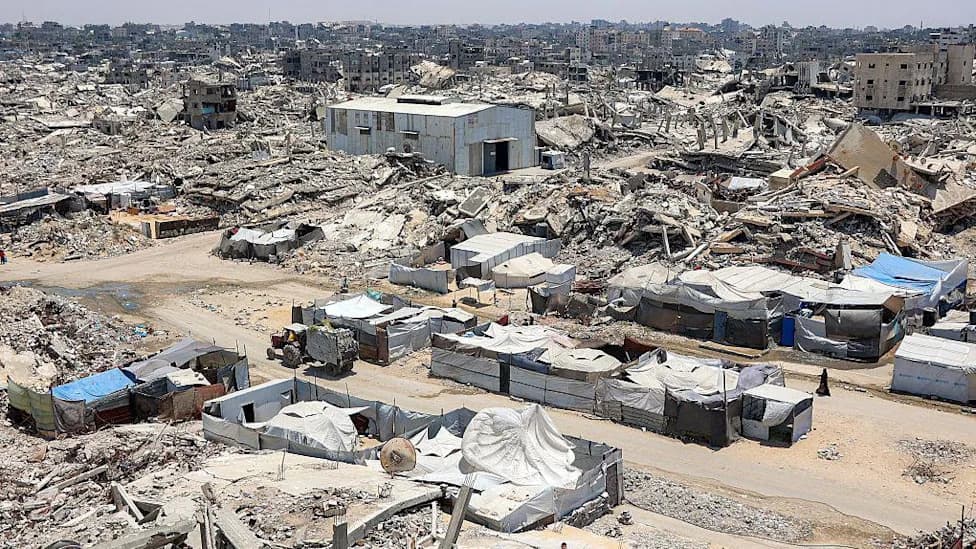
The humanitarian situation in Gaza remains dire. According to figures cited by the United Nations from the Hamas health ministry, at least 1,168 Palestinians — including children — have been killed since the ceasefire took effect; four Israeli soldiers have been killed in that period. BBC Verify reported satellite imagery showing more than 1,500 buildings destroyed in areas Israel controlled after the ceasefire, and the UN estimates roughly 60 million tonnes of debris have accumulated since October 2023.
If implemented and verified, the disarmament plan could represent a substantive first step toward ending the Gaza war. Significant practical, political and verification challenges remain.
Sources: BBC reporting and the four-page plan reviewed by the BBC; statements from Hamas, Israeli officials and the Board of Peace. Casualty and damage figures cited from the Hamas health ministry, UN reports and BBC Verify imagery.
Help us improve.