
August offers an exceptional set of sky events: a six‑planet alignment and a total solar eclipse on August 12, the Perseids meteor shower peaking the night of August 12–13, a deep partial lunar eclipse on August 27–28 (96.2% coverage at maximum), and the Full Sturgeon Moon on August 28. The article also highlights the Summer Triangle and explains Deneb’s vast distance and extreme luminosity. Practical viewing tips include avoiding light pollution, allowing eyes to adjust, and checking local times and NASA maps for eclipse details.
August Stargazing Guide: Planet Parade, Two Eclipses, the Perseids, and a Giant Star
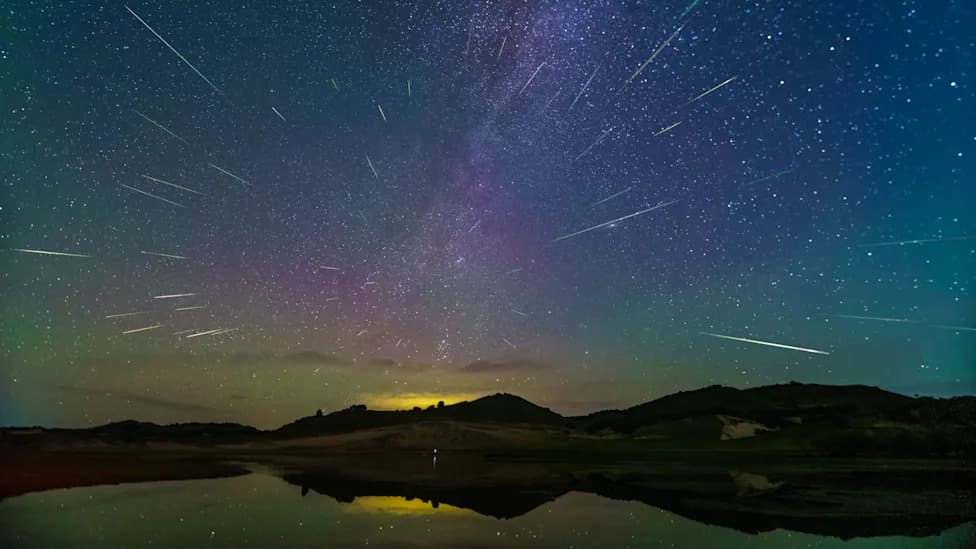
The Perseid meteor shower over the Ulanbum grassland in Chifeng city, Inner Mongolia, China, on August 14, 2023.
August brings one of the richest lineups of sky events of the year: a six‑planet alignment, a total solar eclipse visible from parts of Europe, the peak of the Perseids meteor shower, a deep partial lunar eclipse, and the Full Sturgeon Moon. Whether you're able to travel into the eclipse path or simply step into your backyard, there are plenty of celestial sights to enjoy.
The Summer Triangle
On warm summer nights look south to spot the Summer Triangle, formed by the bright stars Vega, Deneb and Altair. The pattern is a familiar marker of the season and a good starting point for orienting yourself in the night sky.
Although the three stars appear close together, they lie at very different distances. Altair is about 17 light‑years away; Vega is roughly 25 light‑years from Earth. Deneb, by contrast, is vastly farther — current estimates place it between about 1,400 and 2,600 light‑years away.
Deneb shines so prominently despite its distance because it is an enormous blue‑white supergiant. Estimates suggest Deneb’s luminosity is roughly 55,000 to 196,000 times that of the Sun (luminosity, not mass). If Deneb replaced the Sun, its outer layers would extend past the orbits of the inner planets at the upper end of those estimates; in any case, it would render Earth uninhabitable. Fortunately, Deneb is extremely far away.
Six Planets in Alignment — August 12
On the morning of August 12, six planets — Mercury, Mars, Jupiter, Saturn, Neptune and Uranus — will form a loose line across the eastern to southwestern sky. Venus will not participate in this grouping.
Star Walk and other skywatching guides recommend looking about an hour before local dawn on August 12. Mars and Saturn should be the easiest to spot with the naked eye; the outer gas giants may require binoculars or a small telescope for clearer views.
Total Solar Eclipse — August 12
Parts of Greenland, Iceland, northern Russia and northern Spain lie in the path of totality for a total solar eclipse on August 12. Observers within the path will witness the Moon fully cover the Sun, revealing the solar corona, a pronounced drop in temperature, and an eerie twilight as daytime briefly turns to night. NASA provides detailed maps and timing for the path of totality; check local times before you travel.
Perseids Meteor Shower Peak — Night of August 12–13
The Perseids are expected to peak on the night of August 12 into the early hours of August 13. This year’s peak benefits from a moonless sky in many regions, improving visibility. Face generally northeast toward the constellation Perseus, but allow your eyes to adapt to the dark and scan a wide patch of sky — meteors can appear anywhere.
Partial Lunar Eclipse — Night of August 27–28
For many North American observers, a deep partial lunar eclipse on the night of August 27 into the early morning of August 28 offers a dramatic spectacle. The eclipse is expected to begin around 10:30 p.m. ET, with maximum eclipse at about 12:12 a.m. EDT on August 28, when roughly 96.2% of the Moon’s surface will be immersed in Earth’s shadow. The event will be visible across the contiguous United States and Hawaii; western Alaska will largely miss it.
Full Sturgeon Moon — August 28
About a day after the lunar eclipse, the Moon reaches full phase. The Full Sturgeon Moon peaks at approximately 12:18 a.m. EDT on August 28. The name comes from the lake sturgeon that were once abundant in the Great Lakes; the species has since declined and is considered threatened in many areas.
Viewing Tips
- Away From Lights: Seek a dark site away from streetlights and urban glare.
- Give Your Eyes Time: Allow at least 20–30 minutes for your eyes to adapt to the dark.
- Bring Binoculars: Binoculars or a small telescope improve views of planets, meteors and lunar detail.
- Check Local Times: Event times are given in EDT/ET in this guide — verify local timing and weather before heading out.
- Use Reputable Sources: For eclipse maps and exact timings, consult NASA or other professional astronomy resources.
With a little planning and clear skies, August promises memorable nights under the stars.
Help us improve.





















