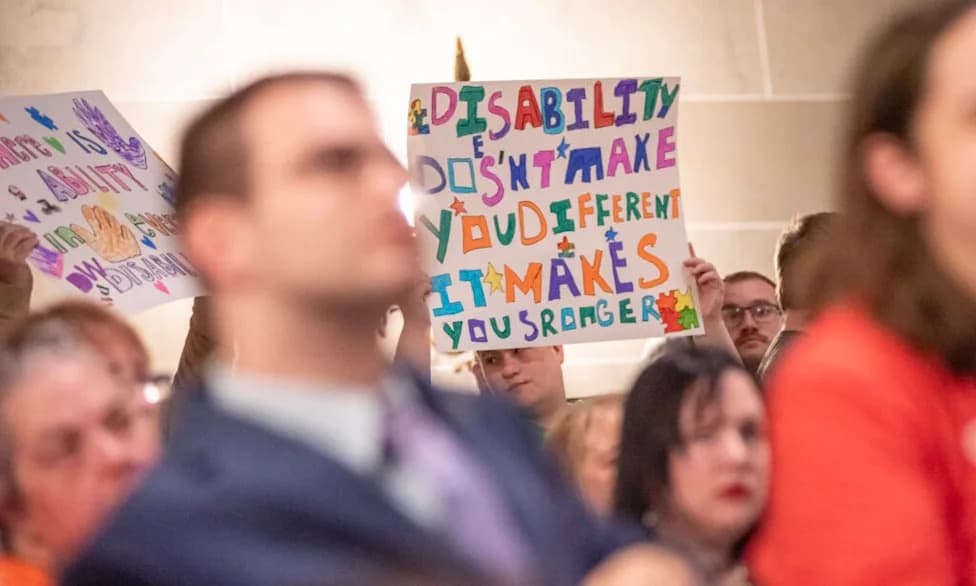
The Justice Department’s June opinion questions the long-standing interpretation of Olmstead v. L.C., arguing federal disability laws may not require states to provide services that keep people with disabilities living in community settings rather than institutions. Advocates warn the memo could undermine protections for millions, trigger Medicaid service cutbacks, and encourage renewed institutionalization. HHS says it remains committed to enforcing civil-rights protections, but states and courts are already citing the memo in active lawsuits. Personal stories underscore the human stakes of the policy debate.
DOJ Memo Challenges Olmstead, Sparking Fears of Medicaid Cuts and Renewed Institutionalization

People with disabilities fear service cuts as DOJ questions legal protections
Amanda DeSimone-Shabrack relies on a home health aide to care for her 12-year-old son Mason, who needs high levels of support for autism. Virginia’s Medicaid program covers that care, enabling DeSimone-Shabrack to work as an education-technology specialist and a professor, run errands, and keep Mason living at home.
That arrangement is now at risk after a June Justice Department legal opinion concluded that federal disability civil-rights laws do not necessarily require states to provide services that let people with disabilities live in community settings instead of institutions. The opinion departs from the long-held interpretation of the Supreme Court’s 1999 Olmstead v. L.C. decision, which found that unjustified institutionalization can constitute discrimination under the Americans With Disabilities Act.
What the Opinion Means
The DOJ memo asserts that regulations requiring states to offer certain community-based services — such as help with bathing, mental-health counseling, and budgeting — may exceed federal authority. Although the opinion does not itself change the law, advocates warn it could prompt the Justice Department and the Department of Health and Human Services to rescind guidance and enforcement practices that have supported community integration for decades.
Legal and Political Fallout
The memo has already become part of ongoing litigation. Several Republican-led states challenging federal disability-integration rules have cited the DOJ opinion in court filings, including a 2024 lawsuit in the Northern District of Texas. After advocacy pressure narrowed the number of plaintiffs, Texas, Alaska, and Florida remain in that case and have submitted the memo to the court as a recent development. Similar citations have appeared in cases in Florida and New Hampshire.
“I'm worried. Am I going to have to put him in an institution, and what's that going to be like for him?” — Amanda DeSimone-Shabrack
Advocates' Concerns
Advocacy groups say the opinion could weaken protections for tens of millions of adults and children with disabilities. They fear agencies may stop enforcing rules or honoring voluntary settlement agreements that require states to provide community-based supports, and that financially strained states may cut optional Medicaid benefits like home health aides.
Democrats in Congress have denounced the memo. Sen. Tammy Duckworth and other senators introduced a resolution urging the DOJ to withdraw the opinion. The Department of Health and Human Services has publicly reiterated its commitment to enforcing federal civil-rights laws. DOJ did not respond to requests for comment for this story.
Historical Context and Human Impact
Deinstitutionalization in the United States followed decades of documented abuse, segregation, and forced sterilizations tied to eugenics-era policies. That shift, aided by legal battles and an independent-living movement, dramatically reduced the share of people with intellectual and developmental disabilities in state-run facilities — from nearly 30% in 1967 to under 1% in 2021, according to the University of Minnesota’s Residential Information Systems Project.
For many advocates and people with disabilities, forced institutionalization represents loss of autonomy and greater risk of neglect or abuse. Jennifer Kucera of Cleveland, who has spinal muscular atrophy, spent two years in a nursing home early in life and calls the experience traumatic. With Medicaid-funded caregivers, she now lives independently and works for a disability-rights organization.
Nuanced Evidence and Ongoing Debate
Research complicates the debate: a September 2024 review in Psychiatry, Psychology and Law found that involuntarily admitted psychiatric patients sometimes showed greater symptom and functional improvements than voluntary admissions. At the same time, deinstitutionalization has produced new challenges, including psychiatric patients boarding in emergency departments because of bed shortages and gaps in outpatient care.
Advocates caution that, even if the DOJ memo does not immediately change the law, it could accelerate policy shifts — through litigation, agency guidance changes, and state-level Medicaid cuts — that make community-based living harder to secure.
Data and Credits: Advocates estimate roughly 40 million adults and 5 million children have disabilities that could be affected by changes in enforcement and guidance. This article is based on reporting by KFF Health News.
Help us improve.