New research in Nature Food finds that expanding food-waste recycling across the U.S. could cut the climate impact of food waste by up to 99% by avoiding methane emissions from landfills. However, the study warns that without better packaging and improved sorting, contaminated compost could deposit as much as 20,000 tons of plastic on farmland each year. Authors stress the benefits of diversion while calling for stronger sorting systems, public education, and redesigned packaging to prevent plastic contamination.
U.S. Food-Waste Recycling Could Cut Emissions 99% — But May Put 20,000 Tons Of Plastic On Farmland
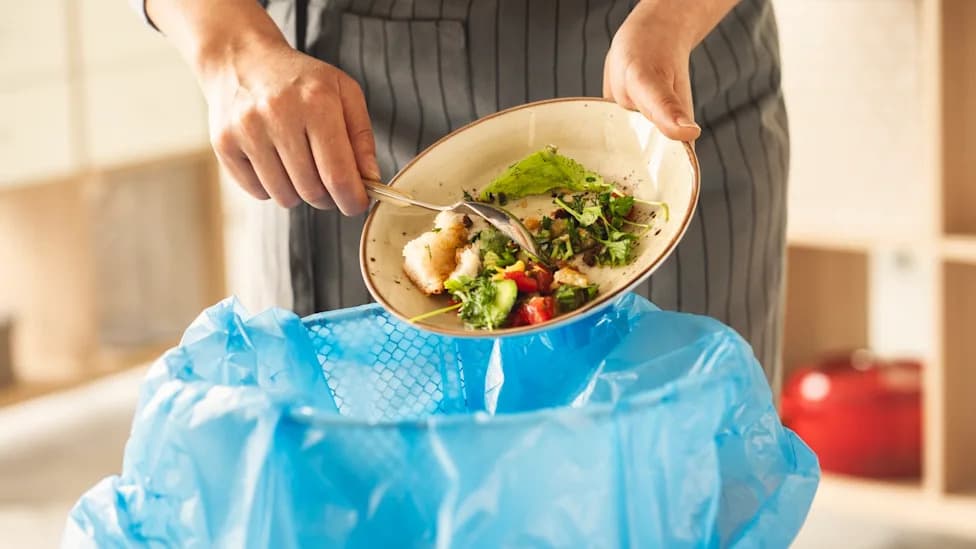
Photo Credit: iStock
Recycling food scraps instead of sending them to landfills could deliver a major climate win in the United States — but new research warns that benefit may be undermined if plastic packaging continues to slip into the compost stream.
Published in Nature Food, the study modeled what would happen if food-waste policies like those in Massachusetts and Vermont were adopted nationwide. The authors found a striking trade-off: diverting food scraps to composting and anaerobic digestion could reduce the overall climate impact of food waste by up to 99% in some scenarios, largely by avoiding methane released from landfills. At the same time, without improved packaging design and better sorting, contaminated compost could deposit an estimated up to 20,000 tons of plastic on U.S. farmland each year.
Why Recycling Helps — And Where The Risk Comes From
Food left to decompose in landfills produces methane, a potent greenhouse gas. The Environmental Protection Agency has set a goal to halve U.S. food waste by 2030, reflecting the scale of the problem: roughly one-third of the country’s produced food is never eaten.
Massachusetts already requires businesses that generate more than half a ton of food waste per week to divert it from disposal sites and incinerators; edible food goes to recovery programs and remaining scraps are routed to composting or anaerobic digestion. Vermont’s law is broader, prohibiting households and businesses from putting food scraps and yard waste in the trash.
Plastic Contamination: A Growing Concern
Lead author Katherine Porterfield, a postdoctoral fellow at the University of Vermont, said the climate benefits are clear: "There are huge climate benefits to diverting food waste away from landfills. And a lot of that benefit is coming from avoiding methane emissions when the food waste breaks down." But she and colleagues warn that even with human and mechanical sorting, "a small amount sneaks through. And if you're talking about very, very large amounts of food waste, that can add up."
"Packaging is designed to package food, not to be de-packaged," said senior author Eric Roy, director of UVM’s Casella Center for Circular Economy and Sustainability. "Conventional plastics tend not to disappear, but to just break into tinier and tinier fragments over time."
Scientists are still investigating how plastics in agricultural soils may affect crop health, soil biology, and food safety. Plastics already reach soil through multiple pathways — air and water transport, runoff, plastic mulch, and food-waste systems themselves — so compost contamination would add to an existing source.
Policy Implications And Next Steps
The researchers emphasize that their findings are not an argument against food-waste recycling. Rather, the study highlights the need to pair recycling policies with improved sorting technology, public education to reduce contamination, and upstream changes in packaging design to eliminate or reduce plastics that can enter compost streams.
Advocates also call for stronger regulations and incentives to encourage compostable packaging where appropriate and to redesign packaging so it can be properly separated and recycled. As Laura Orlando of the nonprofit Just Zero put it: "Plastic doesn't belong in compost — full stop."
If implemented carefully, nationwide food-waste recycling could deliver large climate and water-quality benefits while minimizing the risk of spreading plastic across farmland — but that will require coordinated action from policymakers, industry and communities.
Help us improve.