
The total solar eclipse on August 12 will cast a narrow path of totality across parts of Greenland, Iceland, northeastern Portugal and northern Spain, with partial views across wider regions of Europe, Africa and North America. Totality will last from about 20 seconds to just over two minutes depending on location, and clouds remain the biggest risk to viewing. Use certified eclipse glasses (ISO 12312-2) whenever the Sun is not fully covered, and consider livestreams or local visualizers if you cannot travel to the path. Scientists will launch high-altitude balloons and invite citizen-science projects to study the event.
Total Solar Eclipse on August 12 — Where to Watch, Safety Tips and What Scientists Will Do
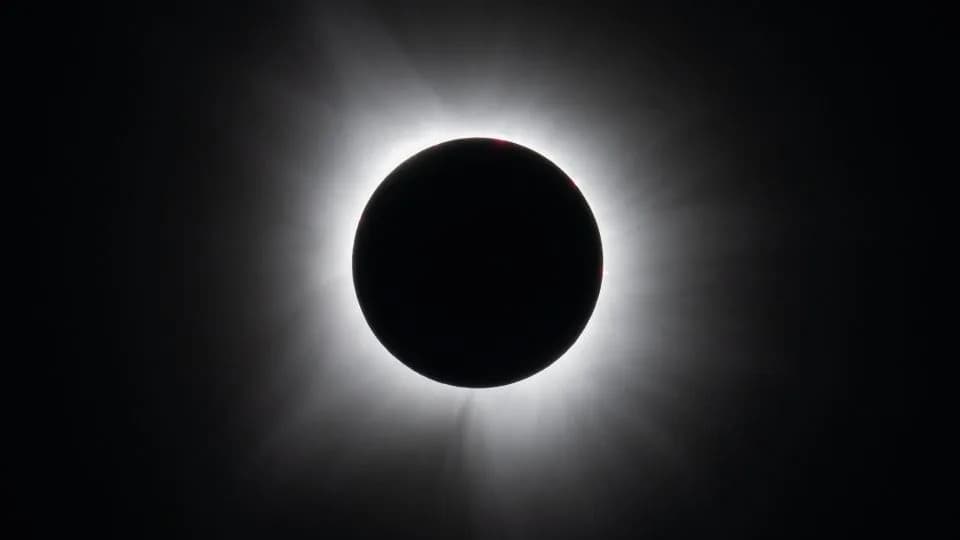
A total solar eclipse is visible in Dallas on April 8, 2024. - Keegan Barber/NASA
A total solar eclipse will sweep across parts of the northern hemisphere on August 12, offering the first opportunity in more than two years for some observers to see the Sun briefly vanish. Totality occurs when the Moon moves directly between Earth and the Sun, casting a shadow that completely blocks sunlight for observers along a narrow track, according to NASA.
Where and When to See It
The narrow path of totality will stretch about 5,157 miles (8,300 km). It will begin near the Arctic coastline at roughly 1 p.m. ET, pass close to the North Pole, then cross Greenland, Iceland, northeastern Portugal and northern Spain. Outside that corridor a much wider area across parts of Europe, Africa and North America will see a partial eclipse.
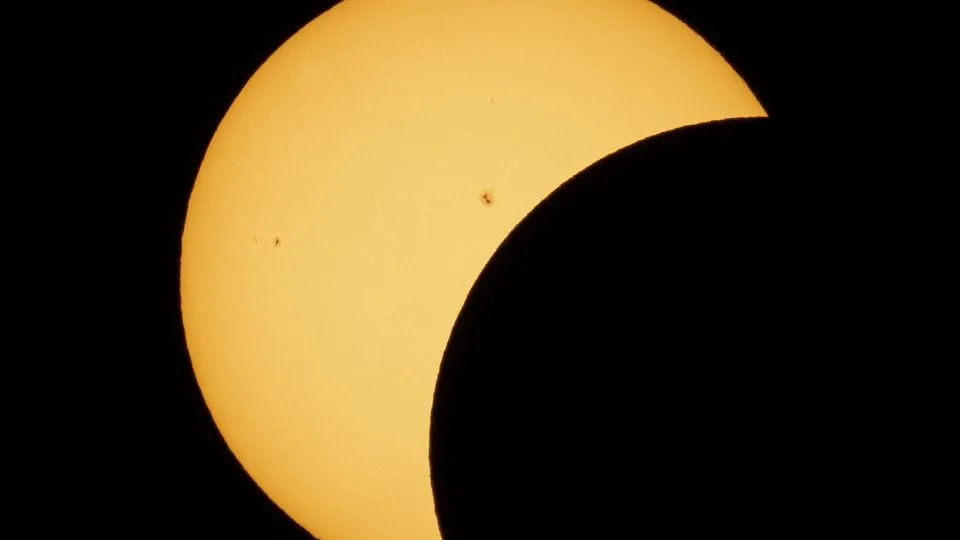
A partial solar eclipse appears in the sky over Dallas on April 8, 2024. - Keegan Barber/NASA
Duration of totality varies by location: observers in parts of Greenland could experience just over two minutes of darkness, while those in northern Spain might see as little as around 20 seconds, weather permitting. The shadow will reach Galicia and then the Balearic Islands in Spain near local sunset, which can make the darkening feel especially dramatic.
Viewers Who Can’t Travel
Residents outside the path of totality can check local timing and visualizations on TimeandDate's website. The European Space Agency (ESA) will also provide a livestream of totality from the Astrophysical Observatory of Javalambre in Teruel, Spain, for people who cannot travel to the path.
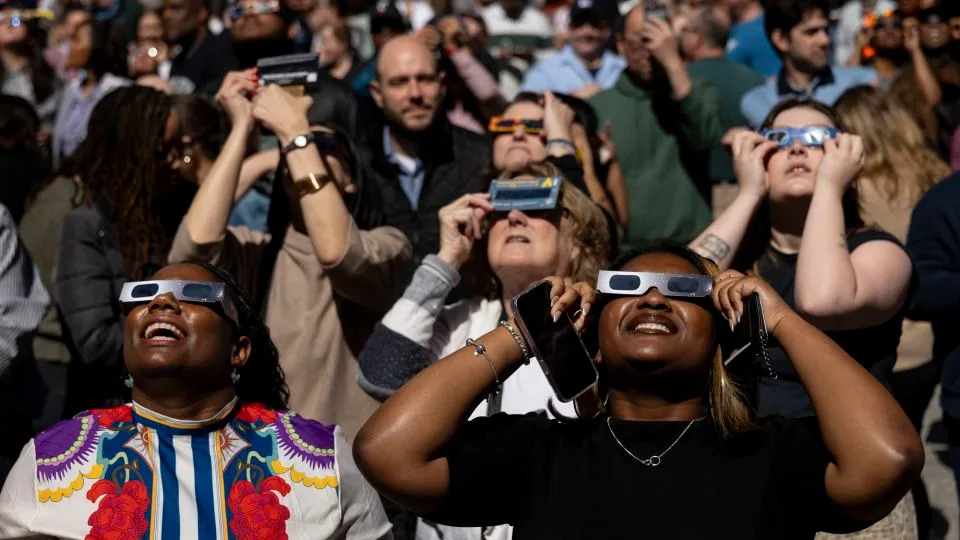
People look up to watch a partial solar eclipse in Chicago on April 8, 2024. - Brian Cassella/Chicago Tribune/Tribune News Service/Getty Images
Safety: How To Look (And How Not To)
It is never safe to look directly at the Sun without proper protection — except during the brief phase of totality when the Sun is fully covered. Use certified eclipse glasses (look for compliance with the ISO 12312-2 standard) or a handheld solar viewer whenever any part of the visible solar disk remains uncovered. At the first sign of the Sun reappearing, immediately put protection back on.
Do not substitute ordinary sunglasses for eclipse glasses — they are far too dim and provide no adequate protection. Likewise, never look at the Sun through an optical device (camera lens, binoculars or telescope) while wearing eclipse glasses: those instruments concentrate sunlight and can burn through filters, causing severe eye damage. If you plan to use a camera, binoculars or telescope to observe the eclipse, use a proper solar filter mounted on the front of the instrument.
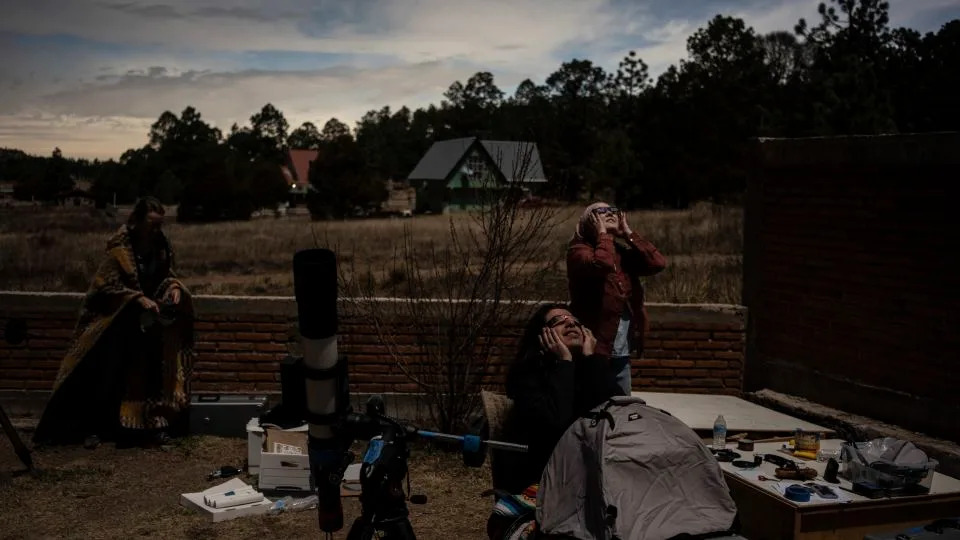
Researchers watch the total solar eclipse in Mexico on April 8, 2026. - Cesar Rodriguez for The Washington Post/Getty Images
Science Opportunities and Citizen Science
Solar eclipses give scientists a rare chance to study the Sun's outer atmosphere, the corona, and to run experiments that are difficult or impossible at other times. For this eclipse, researchers plan to launch high-altitude balloons to photograph the lunar shadow and produce wide-field imagery of totality. Teams also hope to repeat measurements like those made during the famous 1919 eclipse that tested how the Sun's gravity bends starlight — a key early confirmation of Einstein’s general relativity.
Members of the public are encouraged to participate in citizen-science projects by building simple instruments to record atmospheric changes, measure light levels, or gather image data from multiple locations. These contributions help researchers map short-term effects and extend scientific reach beyond professional observatories.
What Comes Next
NASA notes several upcoming total solar eclipses: August 2, 2027 (crossing southern Spain, North Africa, Saudi Arabia and Yemen); March 30, 2033 (visible only from parts of Alaska in the U.S.); August 22, 2044 (totality over parts of North Dakota and Montana in the contiguous U.S.); and a coast-to-coast total eclipse across the contiguous United States on August 12, 2045.
“A total solar eclipse is one of those rare moments when millions of people can look up together and feel both wonder and curiosity,” said Carole Mundell, Director of Science at the European Space Agency. “It is a shared moment that connects us to the Universe and reminds us that the desire to explore and understand is one of humanity’s greatest strengths.”
Whether you travel to the path of totality or watch a livestream, planning ahead — including checking local weather forecasts, arrival times, and acquiring certified eye protection — will help you make the most of this brief but unforgettable celestial event.
Help us improve.





















