
Researchers applied a new genealogical technique to more than 500 whole human genomes and discovered DNA from two previously unknown extinct human lineages. One archaic source contributed about 0.5%–1% of DNA across all modern humans and split from our ancestors around ~800,000 years ago. A second, much older "super-archaic" signal (~1.8 million years) appears at very low levels in Oceanians, likely entering modern humans via Denisovan admixture. The archaic segments are enriched in immune and metabolic regions, suggesting adaptive impact.
New Study Finds DNA From Two Previously Unknown 'Ghost' Human Lineages Hidden in Modern Genomes
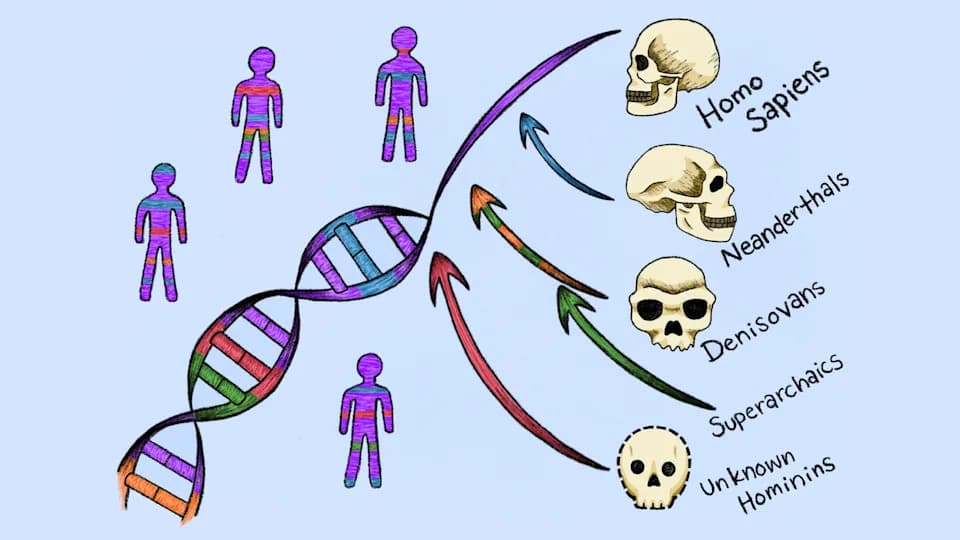
Researchers used a new method to uncover hidden DNA contributions from extinct human groups in modern genomes. | Credit: Meaghan Marohn, https://meaghanmarohn.wordpress.com/
Researchers have uncovered genetic traces of two previously unidentified extinct human lineages preserved in the genomes of living people, a study published in Science reports. Using an innovative genealogical method applied to more than 500 whole genomes, the team reconstructed local family trees across the genome to spot stretches of DNA that diverged far earlier than typical modern-human ancestry.
The Method: Reading History from Living Genomes
Because ancient DNA survives only under rare conditions, many deep chapters of human evolution—especially in warm regions such as Africa—remain inaccessible from fossils alone. To work around this limitation, the researchers developed a technique that reconstructs the genealogical history at each genomic position in present-day genomes. This approach detects segments whose most recent common ancestor predates the usual timeframe for modern humans, allowing investigators to infer introgression from divergent, now-extinct lineages without needing matching fossil DNA.
Key Findings
Validated by correctly identifying known Neanderthal and Denisovan sequences, the method also revealed two previously unknown archaic signals:
- Pervasive Ghost Lineage: A lineage that split from ancestors of modern humans around ~800,000 years ago left DNA present in all examined modern humans. This contribution amounts to roughly 0.5%–1% of individual genomes and likely entered the gene pool in Africa before the most recent widespread human migration out of Africa (~50,000 years ago). The authors suggest Homo heidelbergensis as a possible source.
- Super-Archaic Signal in Oceanians: A much older lineage, diverging about ~1.8 million years ago, appears at very low frequency (approximately 0.002% on average) in genomes from Oceania. These segments are most often embedded within regions of Denisovan ancestry, implying the sequence passed into modern humans via Denisovan interbreeding. Homo erectus is a plausible candidate for this super-archaic source, though direct fossil DNA is limited.
Functional Patterns and Evolutionary Implications
The archaic segments are distributed across the genome but show enrichment in regions tied to immune response and metabolic function. That pattern supports a long-standing idea: interbreeding with other human groups helped Homo sapiens acquire genetic variants that aided adaptation to new pathogens and diets encountered during migrations and environmental change.
Limitations and Future Directions
Although the genealogical approach opens a powerful window onto hidden ancestry, it provides indirect inferences rather than direct sequences from fossils. The identities of the ghost sources remain tentative pending more ancient DNA or additional lines of evidence. The authors plan to apply their method to more and more diverse genomes—especially from underrepresented regions such as Africa and South Asia—and to other species where fossil DNA is scarce.
“Rather than a simple branching tree, human history is increasingly emerging as a complex web of populations connected by repeated episodes of divergence, migration and mixing,” said Priya Moorjani, a co-author and human evolutionary geneticist at UC Berkeley.
This study reinforces a growing view that hybridization was common in human evolution and provides new tools to reconstruct archaic genomic contributions even when fossil DNA is absent or rare.
Help us improve.





















