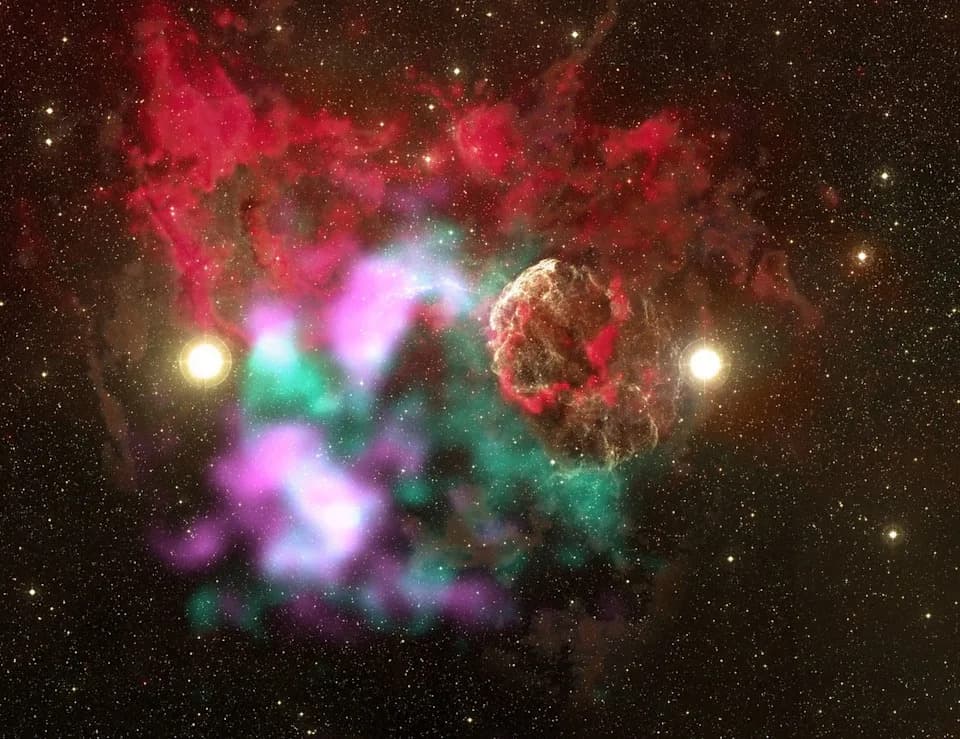
Astronomers report the first confirmed case of two supernova remnants that likely came from a pair of stars that once orbited each other. The faint remnant G189.6+3.3 sits adjacent to the well-known IC 443 (the Jellyfish Nebula), and a fresh multiwavelength analysis — anchored by 16 years of data from NASA's Fermi Gamma-ray Space Telescope — shows the two remnants are probably linked rather than a chance alignment.
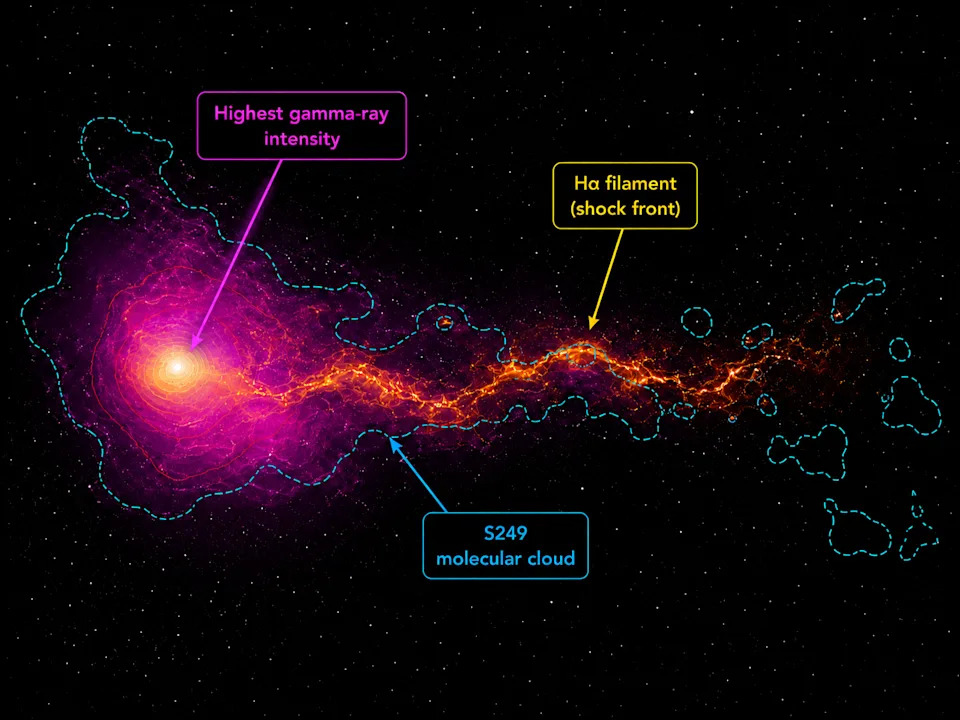
Key evidence comes from the distinct emission patterns within G189.6+3.3: its northern half is dominated by proton-driven gamma-ray signatures produced when shocks slam into a dense hydrogen cloud, while the southern half shows electron-driven emission. Ultraviolet observations indicate the northern shock has slowed after colliding with the cloud, supporting this environmental explanation.
IC 443 also interacts with the same hydrogen cloud, implying both remnants lie at roughly the same distance from Earth. To test whether this proximity could be coincidental, the research team simulated one million hypothetical binary configurations and calculated how often two unrelated remnants would appear this close on the sky. Depending on the method, the odds ranged between about 1 in 1,000 and 1 in 100, strongly favoring a common origin.
A dense cloud of hydrogen gas helped astronomers uncover clues that two neighboring supernova remnants may share the same origin. | Credit: M. Michailidis et al. 2026
The researchers estimate the two explosions were separated by tens of thousands of years — a timeline consistent with one massive star in a binary exploding first and its companion following much later. The findings were published on July 21 in Nature Communications. Miltiadis Michailidis, a postdoctoral fellow at Stanford University and the study's lead author, said the team had originally aimed to characterize the faint remnant G189.6+3.3 rather than discover a linked pair.
Why this matters
This rare, real-world example of a binary-origin double remnant creates a new laboratory for testing theories of massive-star evolution and binary interaction. Unlike models alone, astronomers can now compare observations against predictions about explosion timing, energy release and how supernovae shape their surroundings. In particular, measuring the separation between the two remnants' explosion centers offers a more direct way to constrain how much energy each supernova released.
“Now we can actually test it,” Michailidis said, referring to direct constraints on supernova energetics.
The team plans to search the Milky Way for additional binary remnant pairs to understand why this system has stood out so far and to build a larger sample for testing models of binary stellar evolution and supernova physics.
Image credit: NASA Goddard Space Flight Center and M. Michailidis et al. 2026; radio: orange/brown (ESA/Planck and MWISP); optical: yellow (DSS); infrared: red (NASA/WISE); ultraviolet: violet (NASA/Swift); X-rays: teal (SRG/eROSITA).