
The LINK servicing spacecraft sent by Katalyst to rescue NASA's Neil Gehrels Swift Observatory began spinning in orbit after attitude-control issues were detected. Preliminary checks indicate two of three reaction wheels are offline and some cold-gas thruster capability is lost. LINK remains powered and communicative; teams plan to use electric propulsion thrusters to stop the spin, then assess whether a safe robotic rendezvous and capture of Swift is possible.
Rescue Mission for NASA's Swift Observatory Hits Setback as LINK Servicer Spins in Orbit
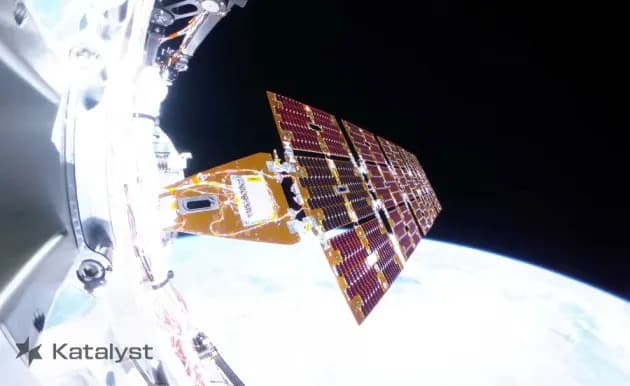
A solar panel extends from the side of Katalyst Space's LINK robotic servicing spacecraft in orbit in this image captured by one of LINK's cameras July 9, 2026. LINK will use the array to power systems as it attempts to boost the altitude of NASA's Neil Gehrels Swift Observatory this summer. (Image credit: Katalyst Space)
A pioneering mission to extend the life of NASA's Neil Gehrels Swift Observatory suffered a setback when Katalyst Space Technologies' LINK servicing spacecraft began spinning in orbit after attitude-control problems were detected.
What Happened
Over the weekend LINK experienced intermittent communications and unexpected rotation, NASA said in a blog post. A preliminary investigation found that two of the vehicle's three reaction wheels are not operating, and engineers also report a partial loss of capability in LINK's cold-gas thruster system. Reaction wheels typically maintain spacecraft orientation without consuming propellant.
An image captured by one of LINK's cameras on July 9, 2026, shows a solar panel deployed on the servicer. LINK will use that array to power onboard systems during the planned rendezvous and orbital boost of Swift. (Image credit: Katalyst Space)
Current Status
The spacecraft remains powered and is communicating with Katalyst's operations team, and other major systems appear nominal. NASA said the operations team plans to use LINK's electric propulsion thrusters to stop the spin over the next few days.
The team is working to stop LINK's spin over the next few days, using the spacecraft's electric propulsion thrusters.
After stabilizing the vehicle, engineers will assess whether LINK's guidance, navigation and control software can be adapted to operate reliably with the remaining hardware. Only after that evaluation will NASA and Katalyst decide whether LINK can safely approach and grapple the Neil Gehrels Swift Observatory using its robotic arms.
Why This Matters
NASA launched the roughly $30 million rescue mission on July 3 in response to increased solar activity that accelerated Swift's orbital decay. Solar storms heat and expand Earth's upper atmosphere, increasing drag on satellites in low Earth orbit. Swift, launched in 2004, has no onboard propulsion to correct its altitude and was placed in a preservation mode with scientific operations paused while teams awaited LINK's arrival.
If successful, LINK was designed to capture Swift and boost it into a higher orbit, potentially extending the observatory's operational life by several years. Katalyst and NASA say they have not abandoned the rescue attempt; any revised plan will depend on LINK's condition and a determination that a close approach to Swift can be made safely.
Help us improve.





















