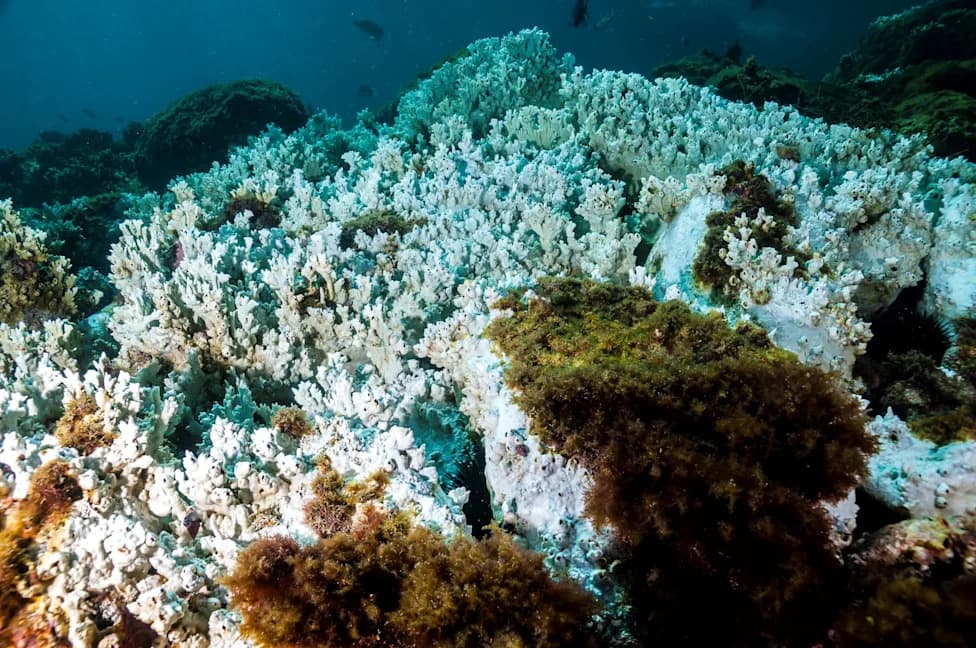
The Stanford-led study finds that the end-Permian 'Great Dying' was driven in large part by combined ocean warming and oxygen loss, and that slow-metabolism Paleozoic species were far more vulnerable than modern faunas. Experimental and literature data for 38 species (9 Paleozoic, 29 modern) show that temperature increases and reduced oxygen together heightened extinction risk. While ancient warming rose ~8–12 °C over thousands of years, modern warming is faster and human-driven, meaning cutting emissions can still reduce future ecological damage.
Ancient 'Great Dying' Mirrors Modern Climate Risks, New Study Shows
(Dawid Adam Iurino/PaleoFactory/Sapienza University of Rome)
For roughly the first 280 million years of animal life on Earth, seafloor communities were dominated by slow-moving organisms such as brachiopods and crinoid sea lilies. Then, in a geologic instant, conditions shifted dramatically.
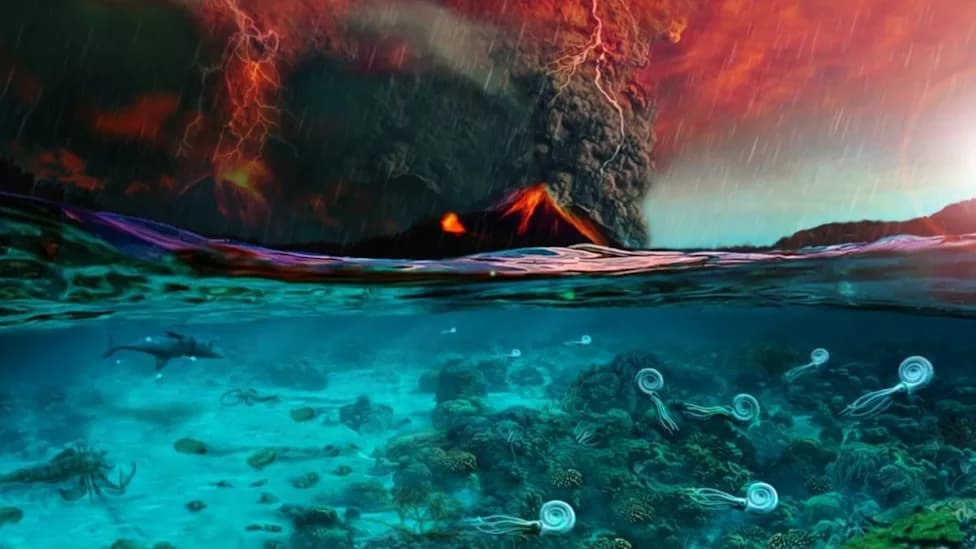
Massive volcanic eruptions injected enormous volumes of greenhouse gases into the atmosphere, driving the event known as the Great Dying at the end of the Permian period — the largest mass extinction in Earth's recorded history. New research led by Stanford University scientists links that die-off to the combined stresses of elevated temperature and reduced oxygen in end-Permian oceans.
Earth scientist Jose Andres Marquez and colleagues asked why some marine groups vanished while others persisted. Their analysis shows extinction rates were substantially higher among organisms that were more vulnerable to rising water temperatures and declining oxygen availability.
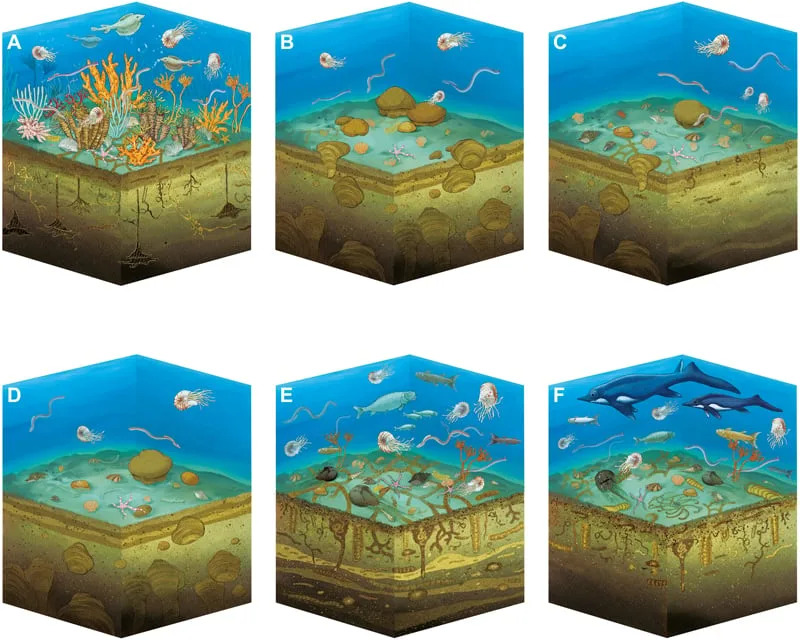
How the oceans may have looked before (A) and after (B-F) the extinction. (X.Feng/Z.-Q.Chen/M.J. Benton/Y. Jiang)
How the researchers tested the idea
The team compiled tolerance data for 38 marine species representing both Paleozoic and modern groups: nine species characterized as Paleozoic fauna (including some lineages that did survive beyond the Great Dying) and 29 species representing modern faunas. For several species the authors collected new experimental measurements of temperature sensitivity and hypoxia tolerance; for others they drew on published data. Combining these data revealed a consistent pattern: Paleozoic taxa were generally far more sensitive to increasing temperature and decreasing oxygen than their modern counterparts.
'The aerobic metabolisms of Paleozoic organisms are more rapidly limited by oxygen as water temperatures increase,' the authors write, 'constraining their biogeographic ranges and elevating extinction risk compared with modern faunas.'
Why metabolism mattered
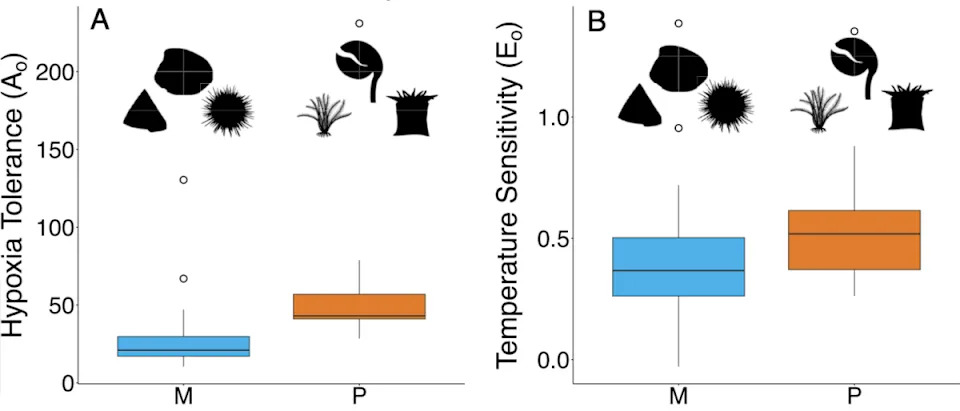
Results of the experimental data comparing the hypoxia tolerance and temperature sensitivity of 29 modern and 9 Paleozoic marine faunas. (Marquez et al.,PNAS, 2026)
Many Paleozoic animals had comparatively slow metabolisms. That physiology allowed them to tolerate low-oxygen conditions while inactive or resting, but the advantage vanished during activity — leaving them unable to cope when warming reduced oxygen availability. By contrast, modern faunas such as molluscs, fish, starfish and sea urchins are generally less constrained by oxygen at higher temperatures and therefore were more likely to persist and later dominate seafloor ecosystems.
Caveats and other stressors
The study focuses on interactions between temperature and oxygen. The authors note other environmental stressors — for example, ocean acidification or food-web disruption — may also have contributed to the Permian extinctions, but the temperature–oxygen link alone explains many of the major patterns in which groups declined or survived.

Subscribe to ScienceAlert's free fact-checked newsletter
What this means for us
The implications are sobering. During the Great Dying, global temperatures rose by roughly 8–12 °C (about 14–22 °F) over thousands of years. Current projections for the 21st century estimate 1.5–4 °C (2.7–7.2 °F) above pre-industrial levels by 2100 under high-emissions scenarios, but the modern rise is much faster because humans are driving the greenhouse-gas release.
Stanford earth scientist Erik Sperling warns that worst-case scenarios could approach Permian-Triassic levels of warming in magnitude, though over different timescales. The key distinction: volcanic eruptions cannot be stopped, but society can reduce fossil-fuel emissions. Understanding how life responded to ancient rapid warming and ocean deoxygenation can help inform expectations and policy choices for the coming decades.
The study appears in Proceedings of the National Academy of Sciences (PNAS, 2026).
Fact-checked and edited by Clare Watson. If you spot an error, please report it to the publisher.
Help us improve.