
Luca Parmitano, an ESA astronaut, will join NASA's Artemis III mission in 2027, flying aboard Orion with three US crewmates to rendezvous with lunar landers from SpaceX and Blue Origin. Parmitano highlighted the mission's technical complexity—three launches in close sequence, precise orbital manoeuvres, and limited living space inside Orion (about 8–9 m³). He praised EU–US cooperation in space, noted ESA's key contribution via the European Service Module, and acknowledged the challenge posed by NASA's pause on the Lunar Gateway.
Luca Parmitano: Europe Seeks to Be a Strong US Partner in Return-to-Moon Artemis III Mission

Europe wants to be a strong partner of the US in the Moon race, ESA astronaut says
Italian ESA astronaut Luca Parmitano has been selected by NASA to fly on the Artemis III mission, underscoring Europe's intent to be a strong partner in the next phase of human return to the Moon. Parmitano spoke to Euronews about his selection, the mission's technical challenges and the transatlantic cooperation that underpins the programme.
Parmitano Joins Artemis III
Planned for 2027, Artemis III will carry three NASA astronauts and Parmitano into low-Earth orbit aboard the Orion spacecraft. From there, the crew will rendezvous with two separate lunar landers—one developed by SpaceX and another by Blue Origin—for the mission's lunar operations. NASA has presented Artemis III as one of the most complex human spaceflights attempted in recent decades.
Experience and Reaction
Parmitano brings extensive long-duration spaceflight experience to the crew. He was the first Italian commander of the International Space Station and has spent more than 366 days in space across two missions (Volare, 2013; Beyond, 2019–2020). He was also the first Italian to conduct a spacewalk. Announcing the crew on June 9 at NASA's Johnson Space Center, Parmitano delivered an emotional speech, calling Italy his "launch pad" and the European Space Agency his "launch tower."
"The mission was not at all on my horizon. I was speechless, which is quite unusual for me, and I was really grateful," Parmitano said.
Technical Challenges and Training
Parmitano emphasized the mission's complexity: "We have three launches that have to happen in close proximity and from very different spacecrafts." Success depends on the readiness and safe launches of the two lunar landers and the Orion spacecraft, plus precise orbital manoeuvres to link the vehicles.
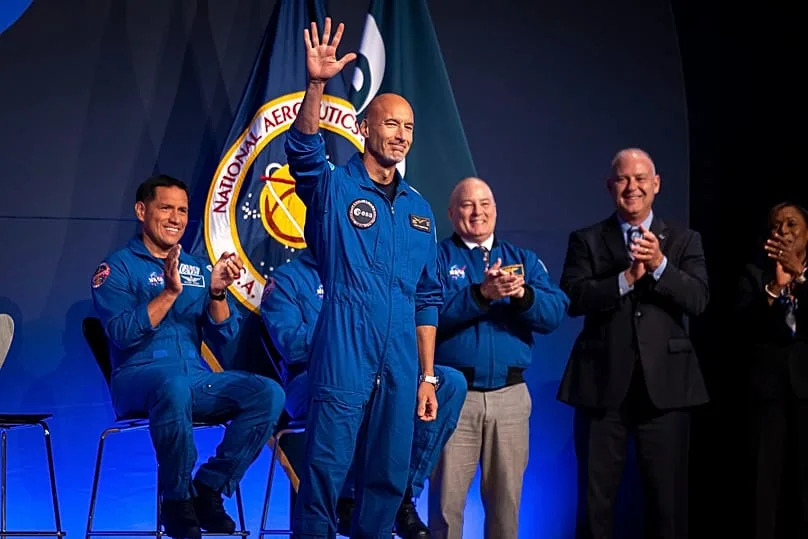
Artemis III crew member Luca Parmitano greets the crowd during a press conference at Johnson Space Center on Tuesday, June 9, 2026, in Houston. (AP Photo/Annie Mulligan) - Copyright 2026 The Associated Press. All rights reserved.
Crew life will be constrained: Orion will provide roughly 8 to 9 cubic metres of habitable volume configured for deep-space operations, a different environment than typical low-Earth-orbit missions. To prepare, Parmitano and his NASA crewmates—Randy Bresnik, Frank Rubio and Andre Douglas—are undergoing an intensive training regimen of simulations, rehearsals and contingency exercises.
Europe's Role and Geopolitical Context
The European Space Agency (ESA) has played a critical role in the Artemis architecture. ESA built the European Service Module that supplies Orion with power, thermal control and life-support commodities (oxygen, nitrogen and water). However, ESA's plans were affected earlier this year when NASA paused work on the Lunar Gateway, the planned Moon-orbiting outpost for which Europe had been preparing key modules.
On transatlantic relations, Parmitano drew a deliberate distinction between politics on Earth and cooperation in space: "If lately on Earth, relations between the EU and the US have been tense, in space, this is not the case. We don't look at what's happening at the political level; we are operators." He added that European determination and shared goals—advancing human welfare through space exploration—remain powerful drivers of collaboration.
Outlook
While some experts consider the 2027 timeline optimistic, Parmitano argued for ambition: "To achieve complex objectives, you have to be ambitious and push hard." As he moves from a celebrated ISS commander's record to becoming the first European astronaut to fly on an Artemis orbital mission, he aims to represent European commitment and drive on the international stage.
Help us improve.





















