The administration's July 27 rule lets USCIS skip traditional in-person asylum interviews and refer many affirmative asylum claims straight to immigration court. Officials say the change will reduce an estimated 1.4 million-case USCIS backlog; critics warn it risks sending credible claimants into a crowded, adversarial court system with over 3.5 million pending cases. Experts call for narrow, targeted use of expedited referrals and stronger safeguards to avoid wrongful deportations.
New USCIS Rule Could Send Hundreds Of Thousands Of Asylum Claims Directly To Deportation Court

Cars move towards the border crossing on the Mexico-U.S. border as the U.S. Supreme Court handed U.S. President Donald Trump a victory by backing the federal government's authority to turn away asylum seekers when officials deem U.S.-Mexico border crossings too overburdened to handle additional claims, in Mexicali, Mexico June 25, 2026.
The administration implemented a rule effective July 27 that allows U.S. Citizenship and Immigration Services (USCIS) to refer many affirmative asylum claims directly to immigration court without the traditional in-person interview by a trained asylum officer. Officials say the change is intended to reduce a mounting backlog, but advocates and legal experts warn it could push vulnerable people into a more adversarial removal system and increase the risk of wrongful deportations.

U.S. President Donald Trump listens to a reporter's question as he holds a bilateral meeting with President of Lebanon Joseph Aoun in the Oval Office of the White House on July 21, 2026, in Washington, DC.
What the Rule Changes
Previously: Many applicants who entered the U.S. lawfully or who had not been charged with immigration violations were eligible for the affirmative asylum process. That process typically began with a non-adversarial, in-person interview by a USCIS asylum officer who could resolve discrepancies, assess credibility and sometimes grant asylum without court involvement.

A person walks into an Immigrations and Customs Enforcement office to turn himself in, in Burlington, Massachusetts, U.S., Oct. 20, 2025.
Under the new rule: USCIS can bypass those interviews for a large group of applicants and refer their cases directly to immigration court for removal proceedings, where applicants face government attorneys and an adversarial process overseen by immigration judges.
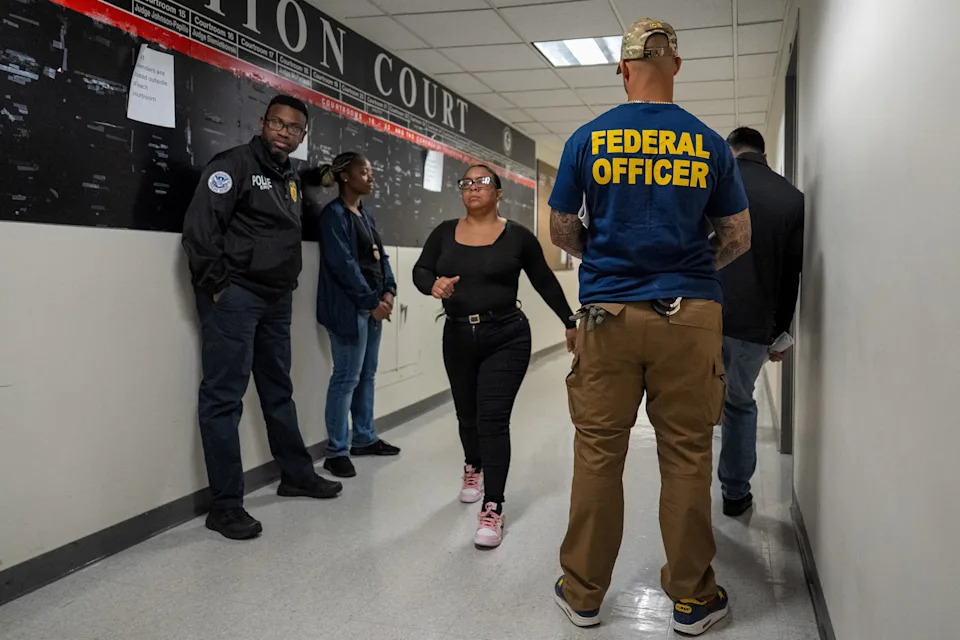
Immigration Customs Enforcement officers wait to make detainments at immigration court in Manhattan, New York City, U.S., June 24, 2026.
Government Position
The Department of Homeland Security and USCIS frame the rule as a tool to address delays and alleged abuse of the asylum system. USCIS Director Joseph Edlow said the change responds to what the agency describes as exploitation of the asylum process for delay and work authorization rather than legitimate protection claims. DHS General Counsel James Percival said the rule would improve efficiency and support enforcement priorities.
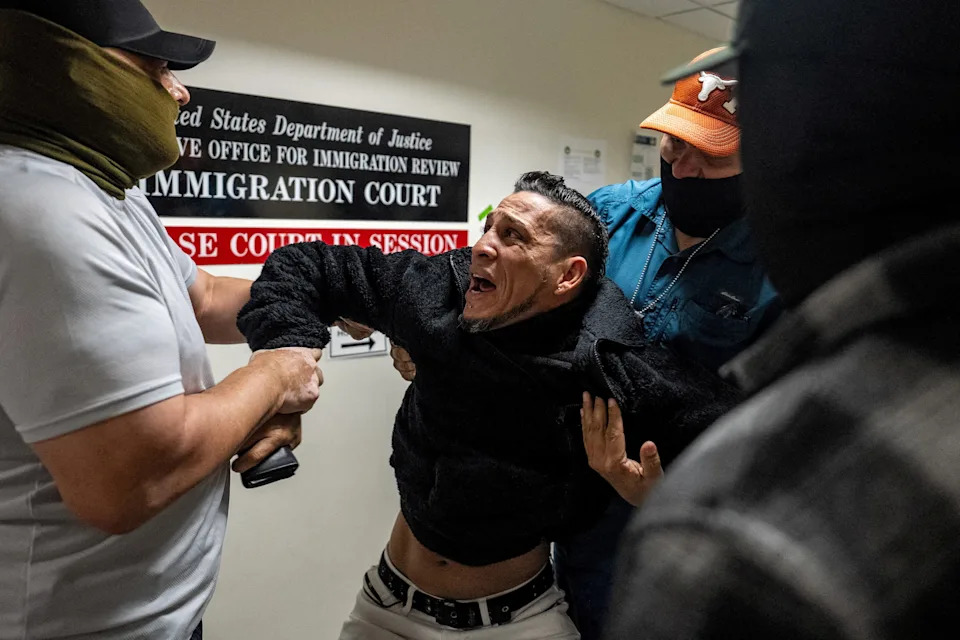
U.S. Immigration and Customs Enforcement (ICE) agents and federal officers detain a migrant as he walks out from a hearing at a U.S. immigration court in Manhattan, in New York City, U.S., Oct. 27, 2025.
Concerns From Experts and Advocates
Immigration law scholars, advocates and many former agency officials argue the policy risks denying people a meaningful, equitable review of their claims. Ingrid Eagly, a UCLA law professor, warned the rule could "prevent people from having a meaningful review of their asylum claims" and funnel credible claimants into a court system that has been granting asylum less frequently.

People wait in a queue to attend their immigration appointments outside the U.S. Immigration Court building in San Francisco, California, on October 24, 2025.
"This is a massive shift away from a program built around specialized interviews that assess credibility and resolve questions," said Michael Valverde, a former senior USCIS official.
Impact On Immigration Courts
Immigration courts already face a large backlog—official counts show more than 3.5 million pending cases—and have adopted tactics such as "mega master" hearings that consolidate many cases into a single session. Critics say those expedited procedures and rapid hiring of judges with varying experience levels can undermine individualized review.
Human Consequences
Immigration attorneys say the stakes are high: minor inconsistencies that could be clarified in a USCIS interview may carry far heavier consequences in removal proceedings. Detained applicants are particularly vulnerable because transfers between facilities, limited access to counsel and compressed hearing schedules make mounting a defense difficult.
A recent tragic example cited by advocates involved a Guatemalan woman, Glendy Marisol Gonzalez, who reportedly had an active asylum case before being returned to Guatemala; she and her husband were later found dead. Advocates use such cases to underscore the potential consequences of expedited referrals.
Context And Options
Experts broadly acknowledge the backlog is a real problem—estimates place average asylum-case waits at four to seven years—but many suggest targeted, narrow use of expedited referrals (for example, where an applicant is statutorily ineligible for asylum due to serious criminal convictions) rather than a broad bypass of screening interviews. They urge safeguards to protect legitimate claimants while improving case-processing efficiency.
Source: This report summarizes reporting by USA TODAY and includes commentary from USCIS officials, immigration law experts and advocates.
Help us improve.