
Using JWST’s high‑precision infrared spectra, astronomers report the likely detection of semi‑heavy water (HDO) in the atmosphere of WASP‑39b, about 700 light‑years away. The inferred deuterium‑to‑hydrogen (D/H) ratio is elevated compared with Solar System gas giants, which could reflect preferential loss of lighter H2O from the planet’s hot, low‑gravity atmosphere or formation beyond the protoplanetary snow line followed by inward migration. While WASP‑39b is far too hot for life, the result highlights JWST’s ability to measure isotopic signatures that could become useful habitability tracers on temperate exoplanets.
JWST Detects Semi‑Heavy Water on WASP‑39b — A Clue to the Planet’s Origins and Habitability Signals

The exoplanet WASP-39b being blasted by its Sun-like star.(NASA, ESA, CSA, Joseph Olmsted/STScI)
The James Webb Space Telescope (JWST) has revealed a new clue about the atmosphere of the distant exoplanet WASP‑39b: the likely presence of semi‑heavy water (HDO). This detection, reported by a team analyzing JWST’s exceptionally detailed infrared transmission spectrum for this benchmark exoplanet, offers fresh insight into how the planet formed and how atmospheric processes can alter isotopic abundances.
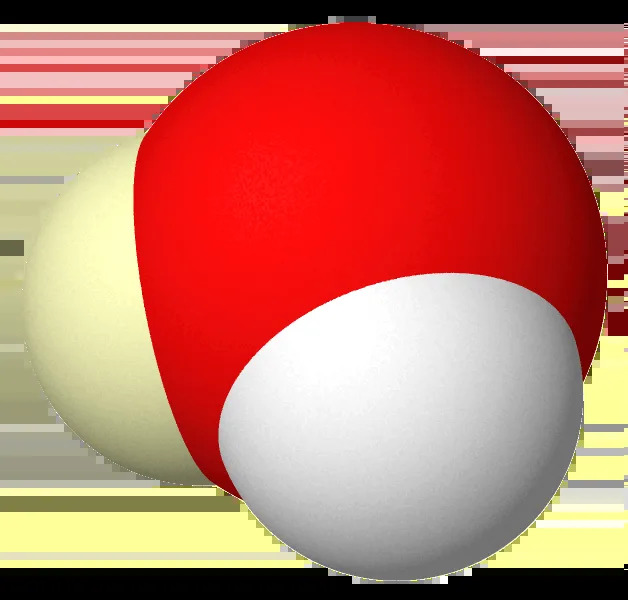
A semi-heavy water molecule consists of a hydrogen atom, a deuterium atom, and an oxygen atom (in red).(Hoa112008/Wikimedia Commons)
What the Researchers Looked For
The team searched JWST spectra for water isotopologues—variants of H2O that differ in neutron content. Semi‑heavy water (HDO) replaces one hydrogen atom with deuterium, a hydrogen isotope that contains an extra neutron, and so is slightly heavier than ordinary H2O. Measuring the deuterium‑to‑hydrogen (D/H) ratio in atmospheric water helps scientists reconstruct a planet’s chemical environment and formation history.
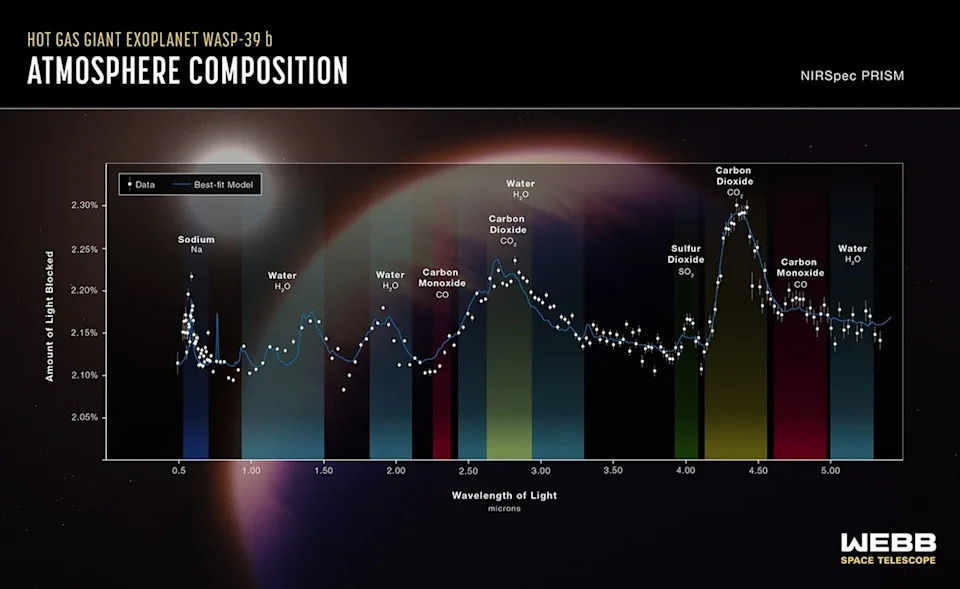
The transmission spectrum of WASP-39b, which allows astronomers to ascertain an exoplanet's atmosphere. The y-axis displays the amount of light blocked by WASP-39b and absorbed by its atmosphere, with particular wavelengths (x-axis) corresponding to different molecules.(NASA/ESA/CSA/J. Olmsted/STScI)
How the Measurement Was Made
WASP‑39b was an ideal target because JWST has observed it extensively using all four of the telescope’s primary infrared instruments, producing what the authors call the most detailed transmission spectrum available for any exoplanet. The researchers compared precomputed atmospheric models to the JWST data while accounting for temperature structure, clouds, molecular abundances, photochemistry, and wavelength‑dependent opacity.
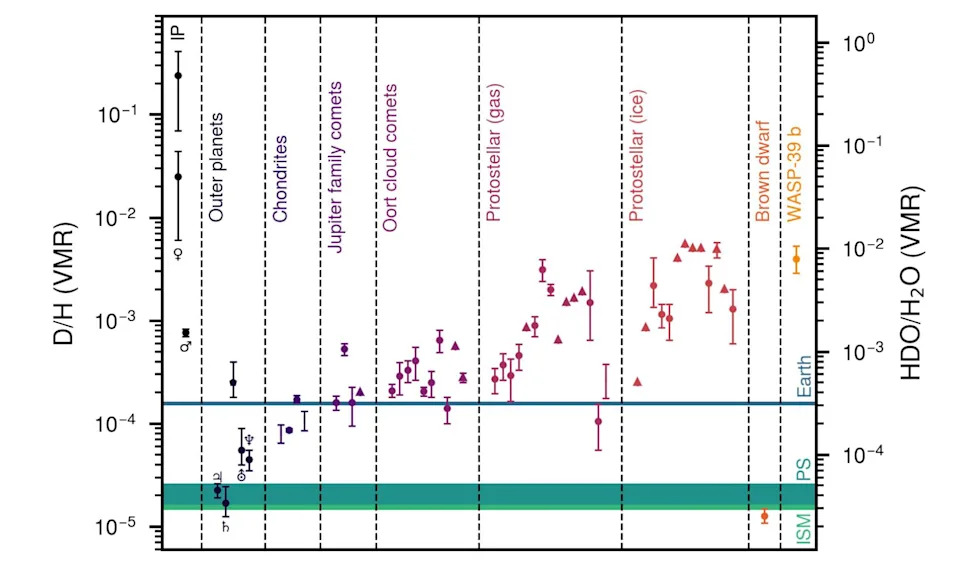
A comparison of the D/H ratio and HDO to H2O ratios of various celestial bodies and components.(Grübel et al., arXiv, 2026)
Possible Explanations for Elevated D/H
The analysis indicates WASP‑39b’s inferred D/H ratio is significantly higher than the values measured for the Solar System’s gas giants. The team proposes two plausible explanations:
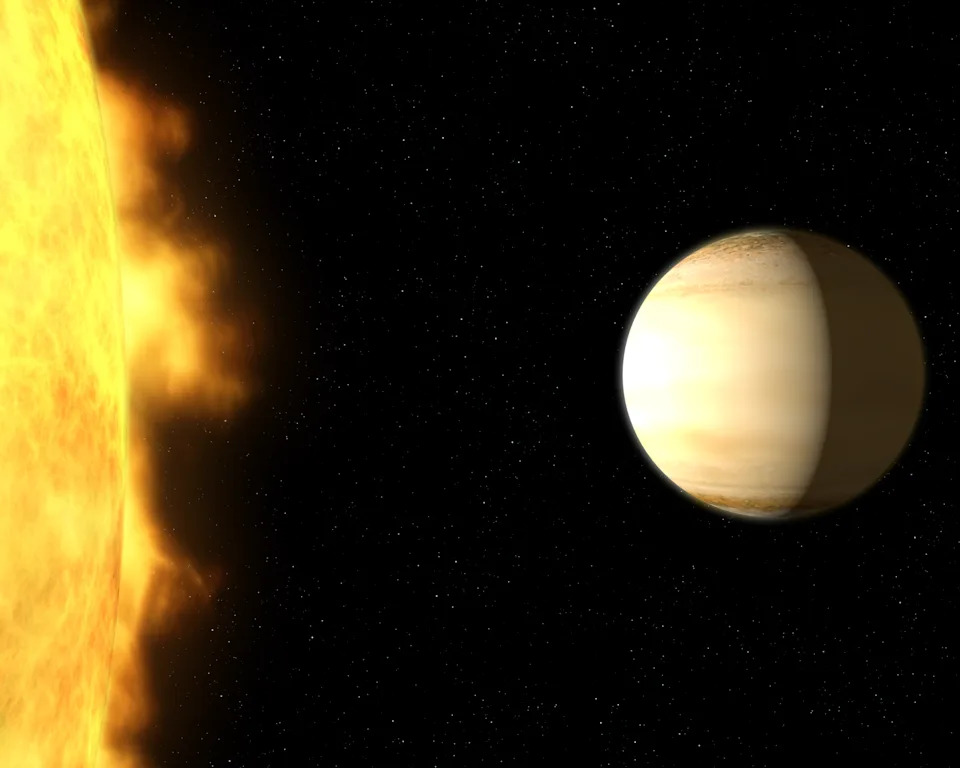
WASP-39b, discovered in 2011, swirls more than 20 times closer to its Sun-like star than we do around our own Sun-like star. Despite this proximity, it may havethree times more waterthan our much-colderSaturn.(NASA/ESA/G. Bacon/STScI)
- Preferential Atmospheric Escape: Lighter H2O molecules are easier to lose to space from a hot, low‑gravity, strongly irradiated planet. Over time, preferential loss of ordinary water could leave a higher relative abundance of heavier HDO.
- Primordial Enrichment: WASP‑39b may have formed farther from its star, beyond the protoplanetary disk’s snow line where ices are abundant and deuterium enrichment is common, and later migrated inward. Protostellar ices in such regions show deuterium enrichments that could match the inferred D/H, though detailed chemical modeling is needed to confirm this pathway.
Implications and Caveats
WASP‑39b is a hot, puffy gas giant roughly 700 light‑years away that orbits much closer to its Sun‑like star than Earth orbits the Sun and approaches temperatures of about 1,000 °C (≈1,832 °F). It is therefore inhospitable to life as we know it. Nevertheless, the study demonstrates JWST’s ability to measure isotopic signatures in exoplanet atmospheres—a capability that could extend to temperate rocky worlds in the future.
HDO remains the most accessible tracer of D/H in exoplanet atmospheres because its spectral features are relatively distinct. Other processes—photochemistry, atmospheric mixing, and observational uncertainties—could also affect the inferred ratio, so the authors emphasize that the result, published as a preprint on arXiv, will benefit from further modeling and additional observations.
Bottom line: JWST’s detection of semi‑heavy water on WASP‑39b opens a new window on planetary origins and atmospheric evolution, and shows how isotopic measurements may one day inform assessments of habitability on more temperate worlds.
Help us improve.





















