
New VLT images provide the clearest direct evidence yet that Betelgeuse has a close companion. Two independent teams traced a roughly six-year brightness cycle to a hidden star orbiting near the red supergiant. December 2024 observations with the Very Large Telescope, led by Miguel Montargès, revealed a candidate—nicknamed Betelgeuse B—estimated at about 2–3 times the Sun’s mass. A follow-up image in roughly one year is required to confirm the companion and refine its orbit and mass.
Stunning VLT Images Give Strongest Evidence Yet That Betelgeuse Has a Close Companion
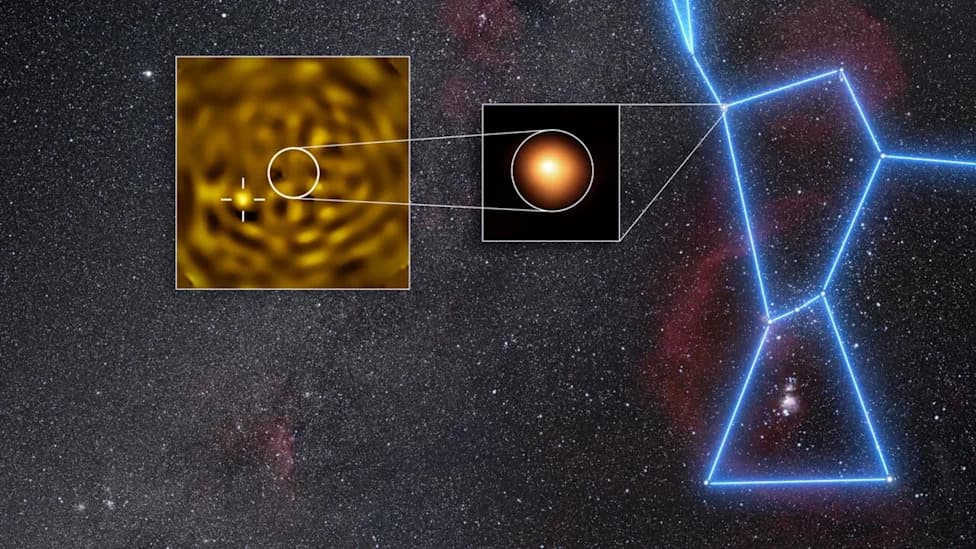
Figures of stars boxed among a starry sky.
Betelgeuse, the famous reddish star that marks Orion’s shoulder, may not be traveling alone. New observations from the European Southern Observatory’s (ESO) Very Large Telescope (VLT) offer the clearest direct image so far of a faint star orbiting extremely close to the red supergiant, strengthening the case that Betelgeuse hosts a companion.
ESO announced the result on July 28 and the discovery is described in a paper published in Astronomy & Astrophysics. The candidate companion was imaged after two independent research teams — one led by Morgan MacLeod (Harvard) and another by Jared Goldberg (City University of New York) — analyzed decades of photometric and radial-velocity data. Both teams concluded that a longer-term, roughly six-year brightness cycle superimposed on Betelgeuse’s well-known ~400-day pulsation could be explained by a close, orbiting companion.
The models predicted a favorable viewing geometry in December 2024, when the companion would be temporarily separated far enough from Betelgeuse’s swollen surface to be resolved. Acting on that prediction, a team led by Miguel Montargès (Paris Observatory) used the VLT in Chile that month, processed several months of high-resolution data, and identified a faint object now nicknamed Betelgeuse B.
“The fact that we can still discover a nearby companion, more massive and brighter than the Sun, around such a well-studied star is remarkable,” Montargès said in the ESO statement.
Contrary to earlier estimates that placed the companion near one solar mass, the VLT images suggest the object is likely about two to three times the mass of the Sun. That higher mass would make it intrinsically brighter and easier to detect than first predicted, helping explain the successful imaging.
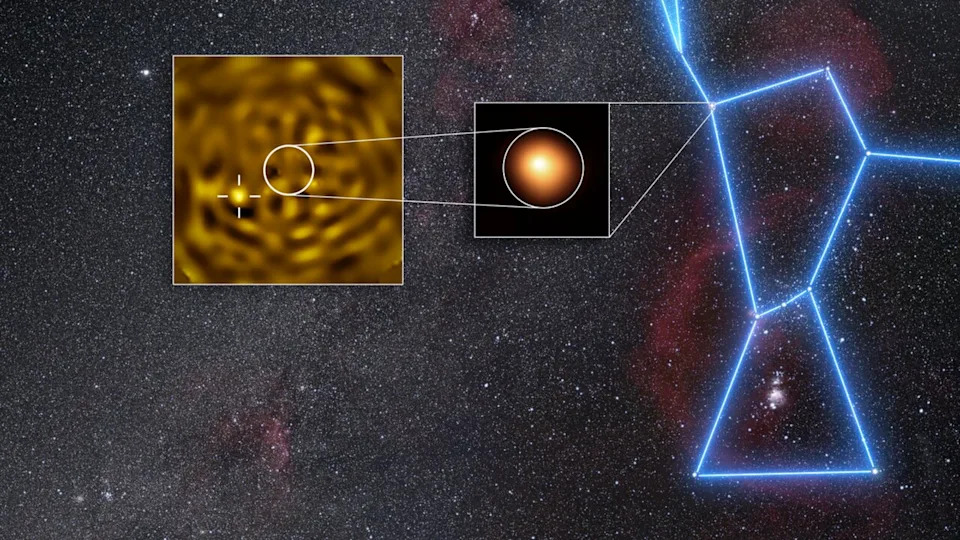
A composite view of Betelgeuse and its companion, captured with the European Southern Observatory's Very Large Telescope in Chile. . | Credit: ESO/M. Montargès et al. Background: N. Rissinger (skysurvey.org)
The team emphasizes that one more observation — roughly one year after the December 2024 image, when the candidate should appear on the opposite side of Betelgeuse — is needed to confirm the object's orbital motion and secure the discovery. Montargès said there is now very little room left for doubt, but follow-up imaging will provide definitive proof and allow astronomers to refine the orbit and mass estimates.
Why This Matters
If confirmed, a close, relatively massive companion could change how astronomers model Betelgeuse’s late-stage evolution. As a red supergiant, Betelgeuse is in the final phases of stellar life and will eventually explode as a supernova, though the timing is uncertain. A close companion can influence mass loss, angular momentum, and the structure of the star’s outer layers — factors that can affect how and when the supernova occurs.
For now, the candidate detection is a major observational milestone: it links long-term brightness and velocity variations to a physically plausible companion and demonstrates how predictive modeling, combined with targeted high-resolution imaging, can reveal hidden neighbors around even the best-studied stars.
Key Facts: Observation: VLT (December 2024); Announcement: ESO, July 28; Paper: Astronomy & Astrophysics; Candidate Name: Betelgeuse B; Estimated Mass: ~2–3 M⊙; Next Step: follow-up imaging about one year after detection to confirm orbital motion.
Help us improve.





















