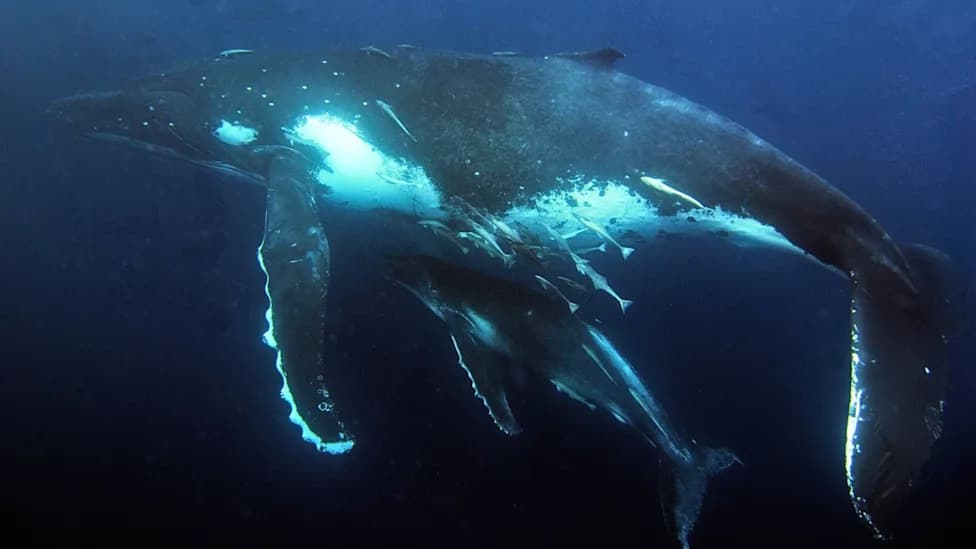
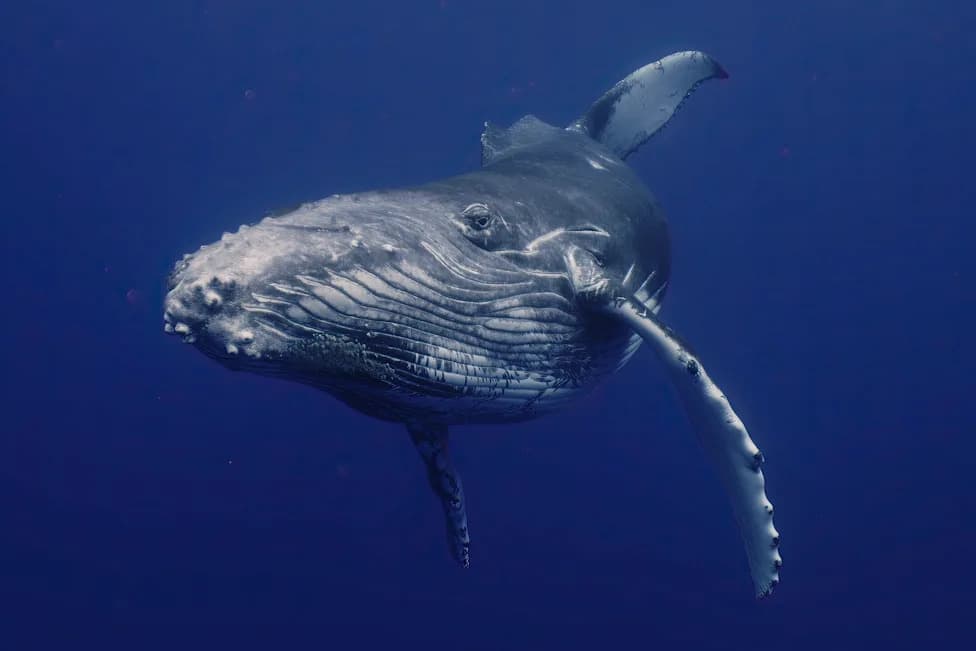
A drone recorded a humpback whale giving birth off Kingscliff, New South Wales — the first time a birth has been filmed by drone and only the fourth time overall. The clip, taken from more than 100 metres away in line with regulations, will be analysed by scientists. Experts say the sighting could challenge assumptions that humpbacks give birth exclusively in tropical waters and may offer new insight into migration and calving behaviour.
World First: Drone Captures Humpback Whale Giving Birth Off New South Wales
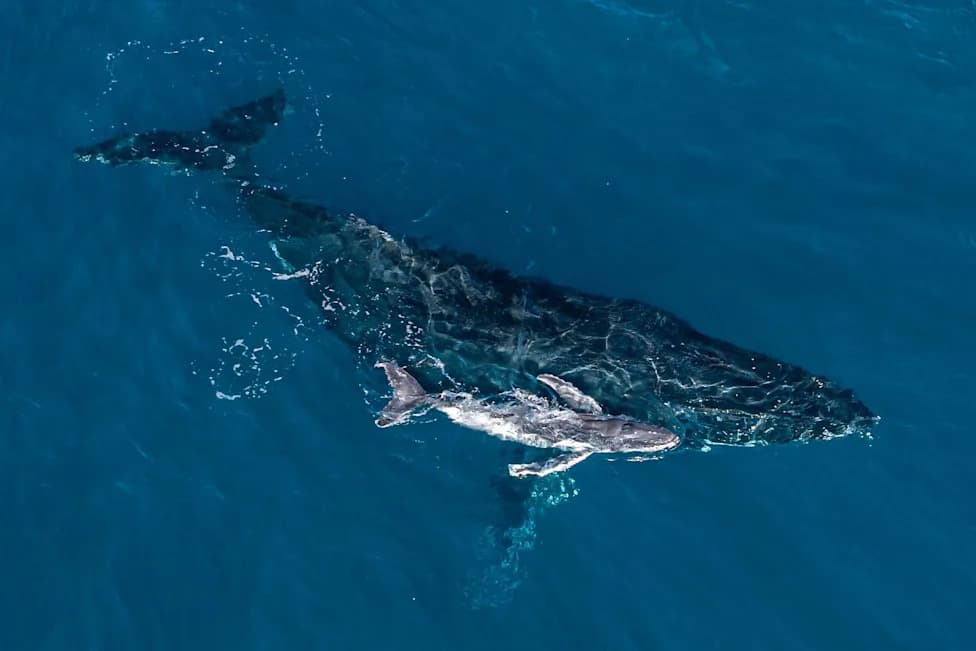
A humpback whale gives birth off the North Coast of New South Wales on July 28, 2026. Alexander Forrest witnessed an adult female give birth in calm sea conditions, capturing the newborn calf's first moments of life, including its first breath and union with its mother. Alexander Forrest/Organisation for the Rescue and Research of Cetaceans in Australia (ORRCA)/dpa
Researchers say a drone has recorded a humpback whale (Megaptera novaeangliae) giving birth off the east coast of Australia — the first time such an event has been filmed by drone and only the fourth time it has ever been captured on video.
The rare footage was taken on Tuesday off Kingscliff, New South Wales. Drone pilot Alex Forrest, working with the whale protection group ORRCA (Organisation for the Rescue and Research of Cetaceans in Australia), had been monitoring a female humpback that was moving noticeably slower than the rest of her group. Forrest reported seeing a red cloud in the water and initially feared a predator attack before realizing a calf had been born and surfaced.
"I hope this footage can contribute to the very little known about humpback whale birthing," Forrest said.
ORRCA says this is only the fourth recorded humpback birth and the first to be documented using drone technology. The clip was filmed from more than 100 metres away to comply with Australian wildlife protection regulations.
Scientific Significance
Marine biologist Vanessa Pirotta of Macquarie University described the recording as a "magical moment" and noted how instinctively the newborn rose to the surface. Scientists plan to analyse the footage to learn more about birthing behaviour and neonatal survival. The observation may also prompt a reassessment of the long-held belief that humpback whales give birth exclusively in tropical waters, since this delivery occurred off temperate New South Wales.
Context: Migration and Sightings
Thousands of humpbacks migrate along Australia’s east coast each year toward warmer northern waters to mate and calf. These animals can reach up to 17 metres in length and weigh as much as 40 tonnes. In Sydney, the best period to spot mothers and calves is typically mid-August through November: calves rest often, slow the group’s pace, and stay closer to shore, which increases the likelihood of sightings.
While many observers watch from beaches, boat tours from Circular Quay and Darling Harbour (generally two-and-a-half-hour trips) operate daily and often guarantee a return trip if no whales are seen. Observers and operators must follow strict distance regulations to minimise disturbance to the animals.
The drone footage will now be examined by researchers to deepen understanding of humpback reproductive behaviour and neonatal responses, and to inform future conservation guidelines.
Help us improve.