DF9, a dwarf galaxy in a linear chain of roughly a dozen faint galaxies in the NGC 1052 field, appears to lack dark matter: its total mass (~1×10⁸ Suns) matches the mass in stars rather than the >1×10¹⁰ Suns expected with a normal dark halo. Observations with the Keck Cosmic Web Imager support a "Bullet Dwarf" scenario in which a high-speed collision stripped gas from dark matter. Follow-up observations — including deeper mapping with the MOTHRA array — aim to detect leftover gas as decisive evidence.
Astronomers Find Third Dwarf Galaxy Lacking Dark Matter in a Strange Cosmic Chain
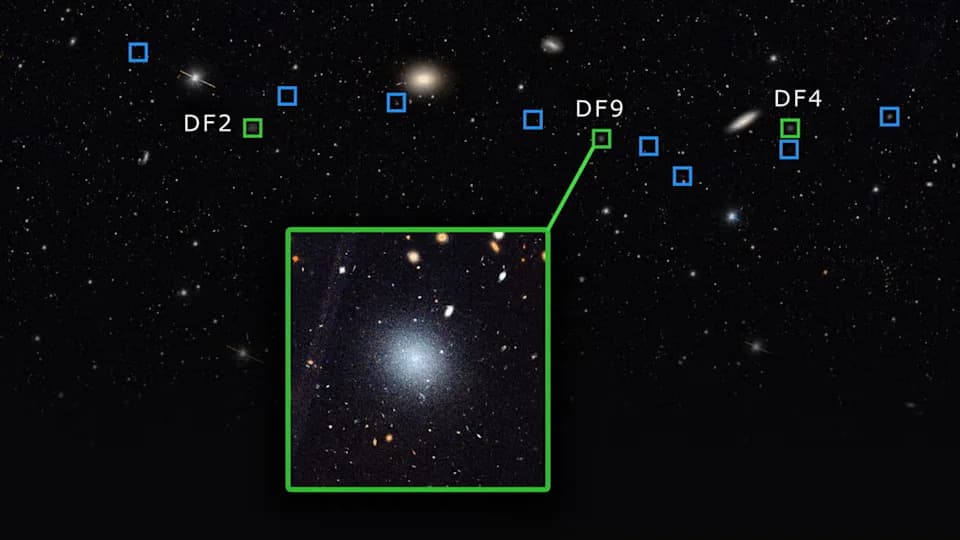
A dozen dwarf galaxies line up in a row in this odd corner of the sky. Inset, a Hubble Space Telescope image shows the newly studied galaxy DF9, the third known galaxy in the string found to lack dark matter. | Credit: DECaLS
A tightly aligned chain of about a dozen faint dwarf galaxies in the NGC 1052 field has yielded another surprising result: DF9, a small, ghostly galaxy in the string, appears to contain virtually no dark matter. The finding bolsters the idea that high-speed galactic collisions can separate visible matter from the invisible dark matter halos that normally surround galaxies.
What the Team Found
Using the Keck Cosmic Web Imager at the W. M. Keck Observatory on Mauna Kea, researchers measured the motions of stars in DF9 by tracking tiny shifts in their spectral lines. Those measurements indicate DF9 has a total mass of roughly 1 × 10⁸ solar masses — essentially the same mass as its stars alone. If DF9 retained a normal dark-matter halo, its total mass would be orders of magnitude larger (more than 1 × 10¹⁰ solar masses), the team reports.
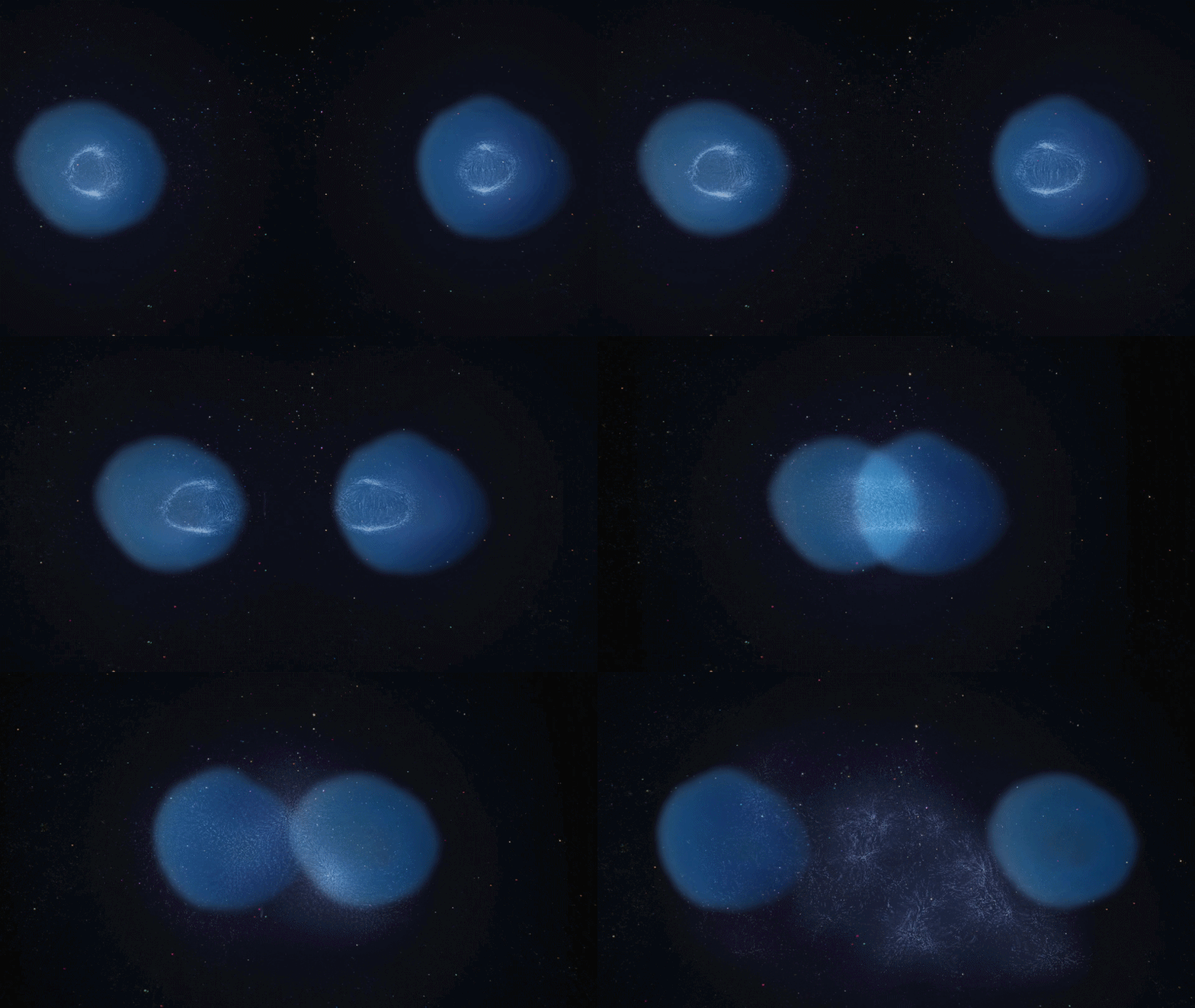
A video showing the galactic collision that resulted in this string of dwarf galaxies. | Credit: Video courtesy of W. M Keck Observatory / Adam Makarenko
Why This Is Unusual
Dark matter is thought to make up about 85% of the universe's matter and typically forms extended halos that dominate the mass of galaxies, especially low-mass dwarfs. Because dwarf galaxies have shallow gravitational wells, feedback processes such as supernovae and strong winds can expel gas while leaving dark-matter-dominated halos behind. That makes the apparent lack of dark matter in DF9 — and in previously reported neighbors DF2 and DF4 — highly unexpected.
Bullet Dwarf: A Possible Origin
The authors propose a "Bullet Dwarf" scenario: a high-speed, violent encounter that stripped the gas (and subsequent star-forming material) away from the dark matter, leaving star-dominated remnants aligned along a trail. The team likens the event to a miniature version of the Bullet Cluster, a famous collision in which hot gas was separated from dark matter on much larger scales.
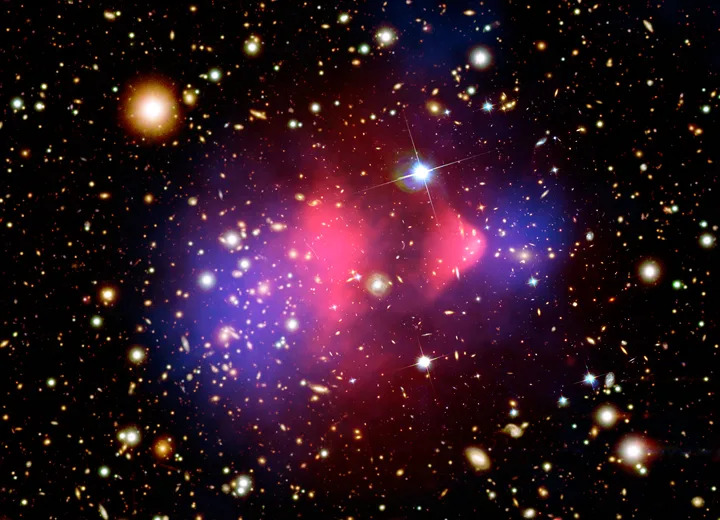
The Bullet Cluster seen by the Chandra Telescope | Credit: (X-ray: NASA/CXC/CfA/M.Markevitch et al.; Optical: NASA/STScI; Magellan/U.Arizona/D.Clowe et al.; Lensing Map: NASA/STScI; ESO WFI; Magellan/U.Arizona/D.Clowe et al.)
"The most surprising aspect is that this finding indicates that an entire trail of galaxies including DF2, DF4, and DF9 formed together in an extreme event producing galaxies not alike any we've ever seen before — the first of its kind," said Michael Keim, lead author and astrophysicist at Yale.
Next Steps
Finding residual gas in the trail would serve as a "smoking gun" for the collisional origin hypothesis, so the team is pursuing follow-up observations with other facilities. Planned and future campaigns include deeper mapping with instruments such as the MOTHRA array under construction in Chile, which aims to reach substantially greater sensitivity for faint, extended features.
While high-speed collisions that produce such dark-matter-poor remnants are expected to be rare, cosmological simulations suggest a handful of similar events could exist within the local tens-of-millions-of-light-years volume. Continued searches and observations will test whether DF2, DF4 and DF9 are exceptional curiosities or representatives of a broader population forged by extreme interactions.
Help us improve.