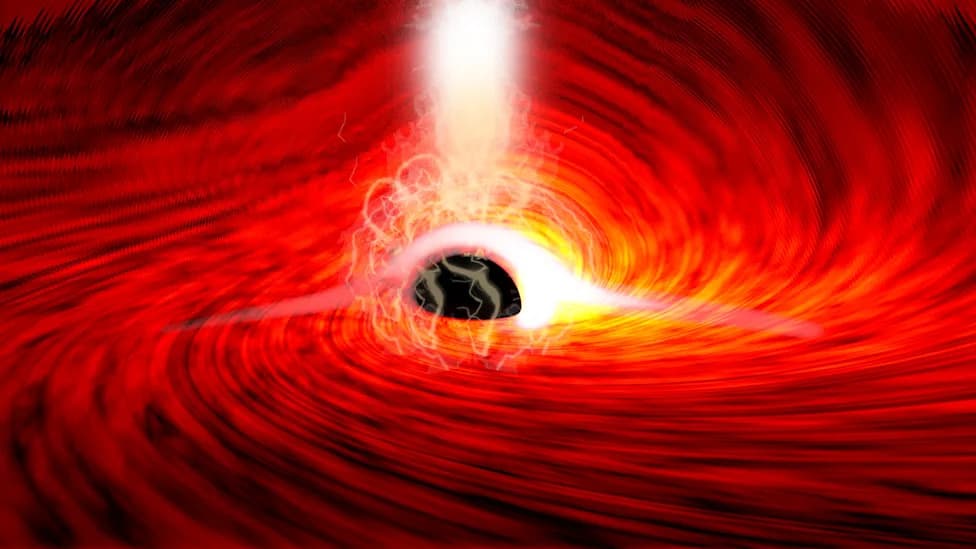
Einstein’s special and general relativity show that time is not absolute: motion and gravity change the rate at which clocks tick. Special relativity predicts significant time dilation for near-light-speed travel, while general relativity explains slower time near massive objects. Some exact solutions to Einstein’s equations (e.g., the Kerr metric) admit closed timelike curves that mathematically loop into the past, but those regions are unstable and likely ruled out by realistic physics.
How Einstein’s Relativity Makes (Theoretical) Time Travel Possible
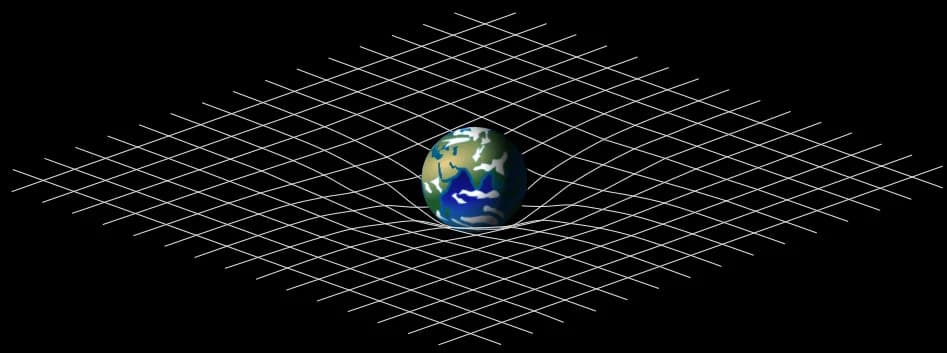
Einstein's general theory of relativity develops a geometric picture of gravity: mass curves spacetime, thus providing the known forces.© Mysid (CC BY-SA 3.0)
Albert Einstein's two theories of relativity—special (1905) and general (1915)—changed how we understand space and time. Rather than fixed backgrounds, space and time form a flexible four-dimensional fabric (spacetime) that can stretch, squeeze and bend depending on motion, mass and energy.
Time Dilation: Traveling Forward
Special relativity shows that the rate at which clocks tick depends on motion. A clock carried on a fast-moving spaceship runs slower compared with a clock left behind on Earth. For example, at about 97% of the speed of light a five-year round trip would correspond to roughly 20 years passing on Earth. Practical, tiny versions of this effect are already measurable: after 11 months aboard the International Space Station, astronaut Scott Kelly was about 13 milliseconds younger than his identical twin who stayed on Earth.
Gravity, Acceleration and Curved Spacetime
General relativity explains gravity as the curvature of spacetime produced by mass and energy (via E = mc²). The deeper you sit in a gravitational well, the more slowly time passes relative to a distant observer. This is why clocks near massive bodies run marginally slower than ones far away—a prediction confirmed by experiments and used in GPS satellite timing. Popular culture has dramatized the effect: in the film Interstellar, a character visiting a black hole’s vicinity experiences months while decades pass for people on Earth.
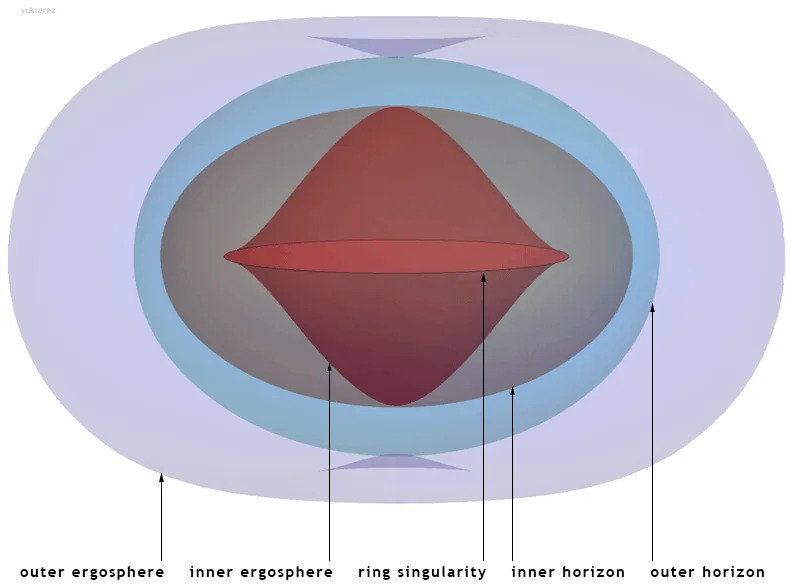
Within the "inner horizon," travel into the past could at least theoretically be possible.© Yukterez / Kerr Universe / CC BY-SA 4.0 (excerpt)
Can We Travel Backward in Time?
Mathematically, some exact solutions of Einstein’s field equations admit closed timelike curves (CTCs)—worldlines through spacetime that loop back to an earlier event. The possibility of such curves was first noted by Willem Jacob van Stockum in 1937 for certain rotating dust solutions. Later, Roy Kerr’s 1963 solution for a rotating (uncharged) black hole revealed regions where CTCs can exist: in principle, a path could lead an object into its own past.
Physical Hurdles and Open Questions
However, these time-loop regions are typically hidden behind horizons and lie in areas that are classically unstable. Small perturbations or realistic matter distributions tend to destroy the delicate structure needed for CTCs (for example, instabilities near the black hole’s inner horizon). Stephen Hawking’s chronology protection conjecture further suggests that the laws of physics (likely including quantum effects) prevent macroscopic violations of causality. In short: general relativity permits theoretical time-loops in certain idealized solutions, but whether any of these survive when realistic physics (stability, quantum gravity, energy conditions) is included remains an open and active area of research.
Why It Matters
Studying these solutions helps physicists probe the limits of general relativity and points toward where new physics (such as a successful quantum theory of gravity) will be needed. Whether time travel to the past is a physical possibility or a mathematical curiosity, the investigation deepens our understanding of spacetime, causality and the universe.
Key equation: Gμν + Λ gμν = (8πG/c⁴) Tμν — the Einstein field equations relate spacetime geometry (left) to matter and energy (right).
Help us improve.