
NASA completed fueling the Nancy Grace Roman Space Telescope on July 25 and confirmed the milestone on July 28. The observatory is scheduled to launch on Aug. 30 aboard a SpaceX Falcon Heavy and is expected to produce more than 500 TB of data per year. Roman's Wide Field Instrument will image areas roughly 50 times wider than JWST, enabling large surveys, transient detection and advances in studies of dark matter, dark energy, supernovae and exoplanets. After launch it will travel to Lagrange Point 2 and use onboard propellant for stationkeeping and solar-array pointing.
NASA Fuels Nancy Grace Roman Space Telescope Ahead of Aug. 30 Falcon Heavy Launch
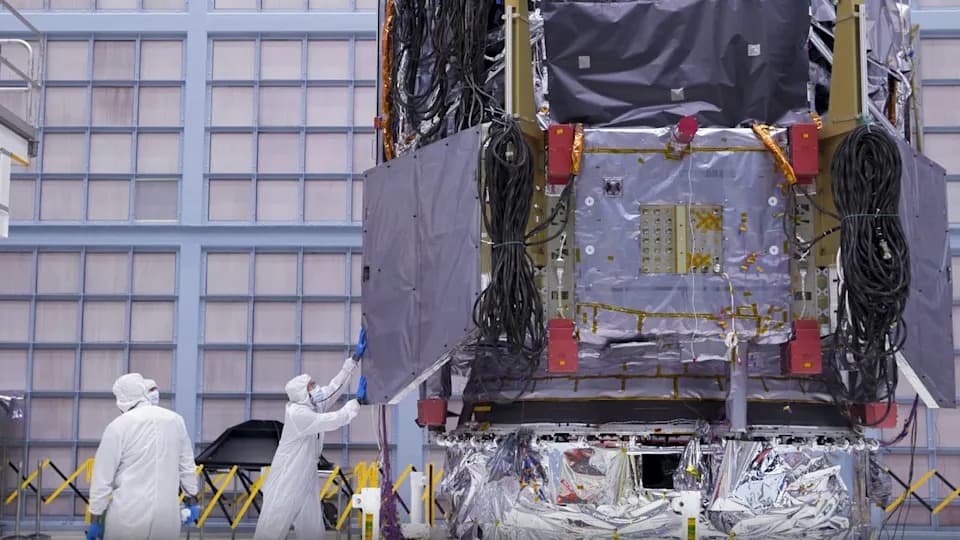
Scientists work on the Roman Space Telescope. | Credit: NASA/Sophia Roberts
NASA confirmed that engineers completed fueling the Nancy Grace Roman Space Telescope on July 25, a major step ahead of its planned launch on Aug. 30. The next-generation observatory is expected to generate more than 500 terabytes of astronomical data per year — a staggering figure compared with Hubble's roughly 400 terabytes collected over 35 years.
Fueling and Launch Schedule
Technicians loaded the observatory with hydrazine propellant on Saturday, July 25, and the agency publicly announced the completion on July 28. Roman is scheduled to launch on Aug. 30 at 7:26 a.m. EDT (11:26 GMT) aboard a SpaceX Falcon Heavy rocket. Project managers say the mission is running about nine months ahead of schedule and remains under budget, increasing confidence that the target launch date will hold.
Why Hydrazine and Safety Notes
Hydrazine is a long-established spacecraft propellant prized for its performance, but it is highly toxic and chemically unstable. Because of these hazards, the space industry continues to research safer alternatives for future missions. For Roman, strict safety and handling protocols were followed during fueling operations to protect personnel and the spacecraft.
What Roman Will Do
The Roman Space Telescope will expand NASA's fleet of space observatories and accelerate research on several central astrophysics questions. With its high data throughput, Roman is expected to substantially advance studies of dark matter, dark energy, supernovae and the search for potentially habitable exoplanets.
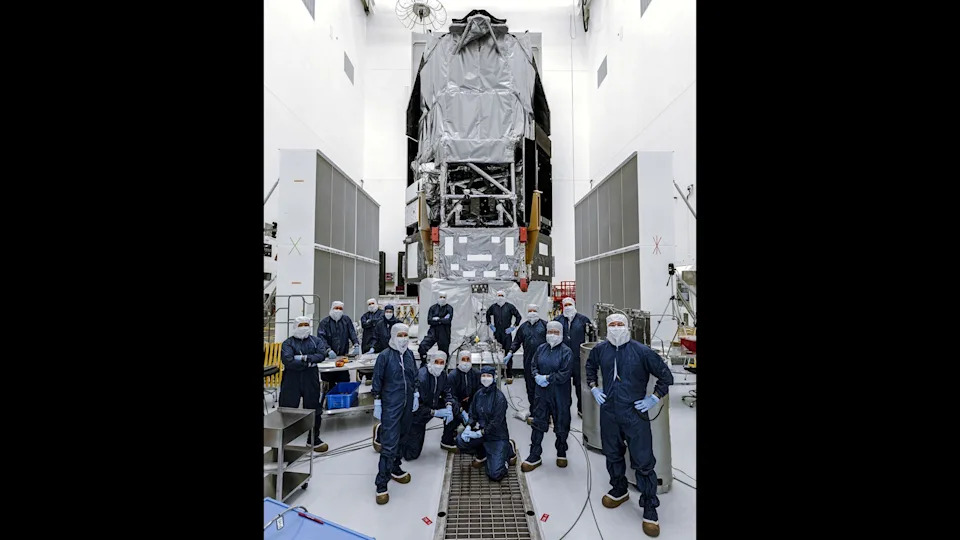
Members of NASA's Nancy Grace Roman Space Telescope propellant, safety, and quality assurance team pose for a photo on July 20 prior to technicians loading propellant into the observatory. | Credit: NASA/Sydney Rohde (Rocz)
Wide Field Instrument (WFI)
One of Roman's primary instruments, the Wide Field Instrument (WFI), will capture infrared images about 50 times wider than the James Webb Space Telescope's fields of view. That wide-angle capability lets Roman survey broad regions of the sky quickly, identify targets for JWST follow-up, and catch short-lived transient events that narrow-field observatories might miss.
"So we're going to see thousands of supernovae, and some of these are going to be further away than any supernovae we've ever seen before," said Dominic Benford, program scientist for the Nancy Grace Roman Telescope.
L2, Stationkeeping, and Thrusters
After launch, Roman will use its onboard propellant to travel to and maintain position at the Sun-Earth Lagrange Point 2 (L2), a gravitationally advantageous location roughly one million miles (about 1.5 million km) from Earth. That relative stability reduces fuel requirements for stationkeeping. NASA explains that Roman's propellant will power two types of thrusters: those that maintain the spacecraft's orbit around L2 and those that precisely point the observatory so its solar arrays remain sun-facing and provide power.
Working With JWST
Roman was designed to complement flagship observatories such as the James Webb Space Telescope. While JWST excels at deep, high-resolution observations of individual targets, Roman's wide-field infrared imaging will help build surveys, discover targets, and monitor large areas for transient phenomena — creating a natural partnership between the two observatories at L2.
Credit: NASA/Sophia Roberts
Help us improve.





















