Summary: The article argues that Hongik Ingan—"to broadly benefit all humanity"—has been a durable moral principle shaping Korean identity from ancient Gojoseon through the 1919 independence movement. It suggests that modern socioeconomic changes have weakened communal bonds and that reunification, grounded in shared history and ethical responsibility, could help heal generational trauma. The piece calls for practical, phased cooperation combining South Korea's democratic experience with sincere dialogue and engagement from the North.
5,000 Years of Hongik Ingan: How a Shared Ethic Shapes the Case for Korean Reunification
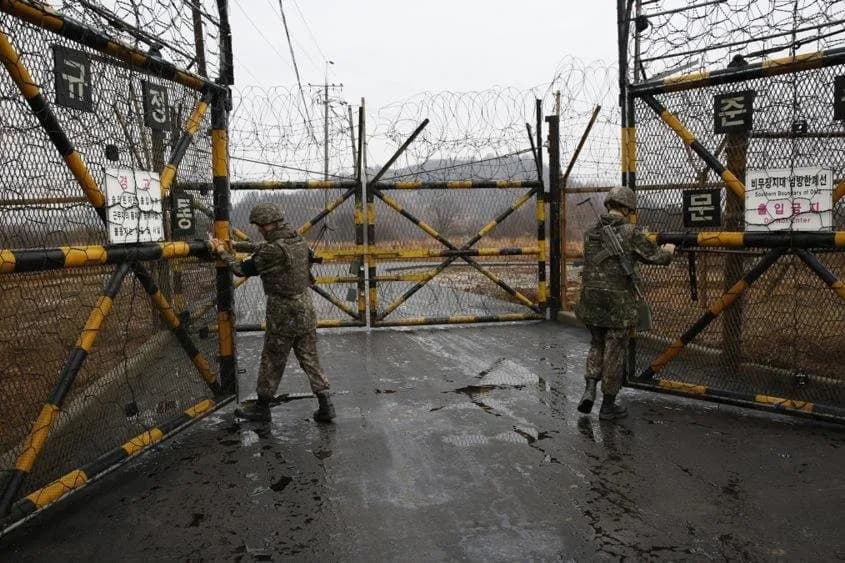
South Korean soldiers open the gate of the Demilitarized Zone, a site of fierce battles in the 1950-53 Korean War, in the central section of the inter-Korean border in Cheorwon, Gangwon Province, South Korea, in December 2018. File Photo by Jeon Heon-kyun/EPA
"What's your background?" Across the Korean Peninsula and among the diaspora, that simple question often carries heavy political and historical meaning. Whether asked of someone from South Korea, North Korea or overseas Korean communities, the common reply—"I'm Korean"—reflects a shared identity shaped as much by history and culture as by statehood.
Hongik Ingan—often translated as "to broadly benefit all humanity"—is a moral principle that emphasizes the common good over individual gain. For many Koreans, it has functioned as an ethical compass in times when formal institutions failed to protect communities. This article traces how that ethic has informed responses to invasion, displacement and colonial rule, and how it factors into contemporary debates about reunification.
From Gojoseon to Cultural Survival
One early expression of Korean unity was the kingdom of Gojoseon, which served as a political and cultural center for ancient Korean communities. Around 107 B.C., the Han dynasty seized Gojoseon's territory, prompting migrations southward into the Jin state. Rather than letting Gojoseon disappear, descendants preserved its memory: northerners who settled in the south combined new technologies and cultural elements with local customs, maintaining a sense of shared identity rooted in mutual support.
Hongik Ingan in Resistance and Reform
Centuries later, the spirit of Hongik Ingan resurfaced in responses to Japanese colonial rule. Many Korean activists in the early 20th century framed independence not merely as national liberation, but as a moral renewal. The 1919 Declaration of Independence envisioned sovereignty as a way for Koreans to live with dignity and to model a peaceful, ethical presence in East Asia—aiming to break cycles of domination rather than deepen them.
Modern Challenges: Individualism, Inequality, Division
Economic modernization and global integration shifted social priorities toward individual achievement. South Korea's rapid rise from postwar poverty to global economic power demonstrates tremendous resilience, yet it has also produced persistent inequality, social isolation and mental-health challenges for some segments of society. Meanwhile, North Korea remains isolated under a different political model. The peninsula's division has left institutions on both sides incomplete in addressing shared social and psychological burdens.
Reunification as Healing—and as Complexity
Proponents argue that reunification could help heal generational trauma by restoring a sense of shared purpose and responsibility rooted in Hongik Ingan. They call on South Korea—because of its democratic institutions and resources—to share civic knowledge about human rights and governance, and on North Korea to engage in sincere dialogue that draws people out of isolation. At the same time, meaningful progress requires pragmatic planning: economic integration, transitional justice, health and welfare coordination, and confidence-building measures.
Practical Steps Toward Mutual Repair
Forgiveness and shared spiritual commitments can open doors, but successful reunification would depend on concrete policies and long-term cooperation. Steps might include family reunions, humanitarian assistance, phased economic cooperation, cultural exchanges, and joint efforts to address mental-health and social-welfare needs.
Conclusion
Korean heritage is not defined solely by borders or a single government. It is shaped by a long tradition of cultural solidarity and an ethic that privileges the common good. If reunification is to be pursued, it should combine the moral vision of Hongik Ingan with careful, inclusive policies that address economic, social and political realities.
About the author: Kayleen Tran graduated from the University of California, Los Angeles with a degree in global studies. She interned with Alliance for Korea United and the Committee for Human Rights in North Korea, and served as external vice president of UCLA's Liberty in North Korea chapter. Tran is currently teaching English in Japan and is writing a historical fiction novel inspired by the lives and experiences of North Korean people.
Help us improve.