New modelling in Science suggests the world may once have hosted tens of thousands of languages, with diversity peaking around 1,000–3,000 years ago. Using ethnographic data from 171 mobile societies, researchers estimate an early Holocene baseline of roughly 4,500–6,200 languages and find a rapid decline linked to the rise of states and empires. The results imply that modern linguistic commonalities could partly reflect this recent bottleneck and highlight the urgency of supporting endangered language lineages.
A Lost Linguistic World: Models Suggest Tens Of Thousands Of Languages Vanished 1,000–3,000 Years Ago

Examples of ancient languages. Image sources and credits are included in the article text. (Yale University/Wikimedia)
Around 7,500 spoken and signed languages are used worldwide today. New computational modelling published in Science suggests that this remarkable diversity may be only a fraction of what once existed: between about 1,000 and 3,000 years ago, tens of thousands of distinct languages might have coexisted.
The research team, led by Yale historical linguist Claire Bowern and evolutionary anthropologist Damián Blasi, built simulation models of long-term language diversification and loss. They drew on ethnographic data from 171 mobile hunter‑gatherer and fishing societies to infer typical community sizes and then estimated how many ethnolinguistic groups could have existed at the start of the Holocene, roughly 12,000 years ago.
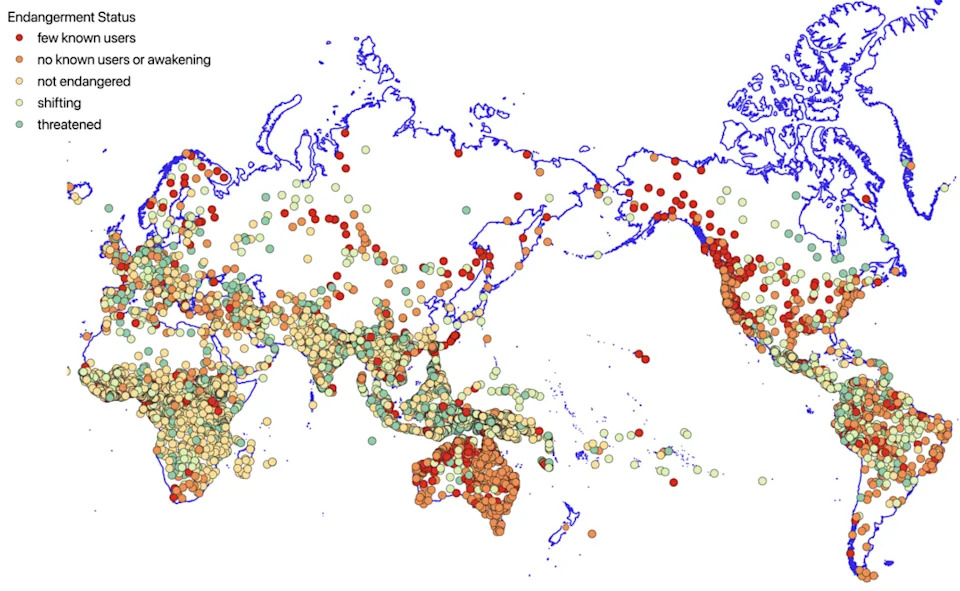
Map of currently spoken and signed languages of the world, colored by endangerment status. (Claire Bowern/Yale University)
Assuming each ethnolinguistic group generally corresponded to a distinct language, the models produced an early Holocene estimate centered near 4,500–6,200 languages. The simulations then modelled language splitting driven by population growth (for example, following the adoption of agriculture) alongside forces that reduce diversity, such as the spread of larger political entities and shared regional languages.
Running thousands of simulations returned a consistent trajectory: language diversity rose through much of the Holocene, broadly peaked around 2,000 years ago, and then underwent a rapid decline. The timing of this decline points to the expansion of early states and empires as a major driver, long before the era of European colonialism.

A collage of ancient language examples. Top to bottom, left to right:1. A rollout of the San Andrés cylinder seal, showing the bird possibly "speaking" the name "3 Ajaw" in Olmec hieroglyphs. (Madman2001/Wikimedia Commons/CC BY-SA 3.0)2. Lemnian language inscription. (Giovanni Dall'Orto/Wikimedia Commons)3. Tartessian language. (Vitor Oliveira from Torres Vedras, PORTUGAL/Wikimedia Commons/CC BY-SA 2.0)4. Urartian text. (EvgenyGenkin/Public Domain/Wikimedia Commons)5. Rhaetic inscription on bronze: Large Sanzeno alphabet. (Andreas Blaickner/CC BY-SA 3.0/Wikimedia Commons)6. Proto-Elamite tablet found at Tepe Yahya. (Jerónimo Roure Pérez/CC BY-SA 4.0/Wikimedia Commons)7. The Pyrgi Tablets, sheets of gold with a bilingual treatise in Etruscan (center and right) and Phoenician, at theEtruscan Museum in Rome. (Sailko/CC BY-SA 4.0/Wikimedia Commons)8. The Drosten Stone (Pictish). (Edward Williams Byron Nicholson/Public Domain/Wikimedia Commons)9. Uxama tessera, Celtiberian script (Omsa, Soria). (Carlosblh/CC BY-SA 3.0/Wikimedia Commons)10. The Phaistos disc (side B). (Gleb Simonov/Public Domain/Wikimedia Commons)11. The hand of Irulegi. (Nafarroako Gobernua//CC BY-SA 3.0/Wikimedia Commons)
“We cannot rely on the extremely patchy records from antiquity,” said Claire Bowern, explaining the need for modelling. “Each assumption makes the modelling more tractable, but there’s a lot we can’t know.”
The authors stress important caveats. The models do not explicitly include many local or regional factors that would affect language richness, such as the timing and pattern of agricultural transitions, large-scale population replacements, migration events, or contact-driven convergence. Those processes vary widely by region and would change local trajectories of language loss or survival.
Beyond reconstructing the past, the findings carry implications for how linguists interpret widespread structural features in languages. If a substantial proportion of global linguistic diversity was lost recently, the features that remain most common worldwide could reflect this historical bottleneck rather than innate cognitive preferences. As Blasi puts it, what appears to be “natural” in language may partly be an accident of survival.

Subscribe to ScienceAlert's free fact-checked newsletter
Many languages that trace their lineages back before these historical spreads are now endangered. A 2022 study in Nature Ecology & Evolution, analysing 6,511 spoken languages, warned that without intervention language loss could triple within 40 years, potentially erasing more than 1,500 languages by 2100.
While the model cannot produce exact counts, it provides a testable framework and a reminder: the linguistic map we see today is shaped by deep, uneven history. The authors argue that modern tools and community-led efforts offer real ways to support endangered languages whose genealogies reach far into the past.
What This Means
- Language diversity likely rose for millennia before falling sharply during the past few thousand years.
- State formation and the spread of regional lingua francas are strong candidate causes for much historical language loss.
- Contemporary linguistic commonalities may be biased by a relatively recent loss of diversity, complicating claims about universal cognitive preferences.
The study opens new avenues for regional and archaeological refinements, and it underscores the urgency of documenting and supporting endangered languages today.
Help us improve.