
Lebanon's army has deployed to the severely damaged village of Zawtar al-Gharbiya, reassuring some residents and allowing limited returns after search-and-sweep operations. The move is part of a US-backed plan to create 'pilot zones' where Hezbollah would be disarmed after Israeli withdrawals. Observers say the deployment's success depends on unique local conditions and warn scaling it to larger areas faces political, legal and operational hurdles. Residents report widespread destruction, no basic services and ongoing security risks.
Lebanese Army Moves Into Devastated Zawtar al-Gharbiya, Residents Hope For Wider Israeli Pullback
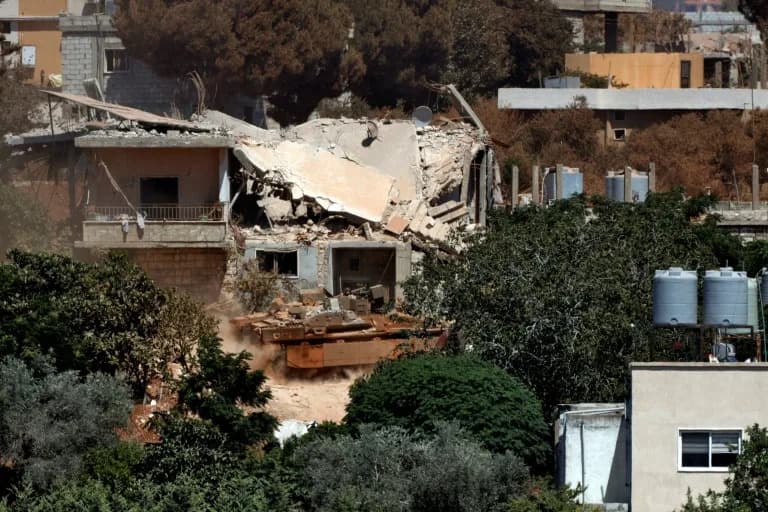
A photograph taken from Zawtar al-Gharbiyah shows Israeli armoured vehicles manoeuvering in the nearby village of Zawtar al-Charkiyah (Ammar Ammar)
Lebanon's army has moved into the battered southern village of Zawtar al-Gharbiya, offering reassurance to residents and prompting some to return after months away. The deployment, part of a US-sponsored framework to create limited 'pilot zones' for disarming Hezbollah after Israeli withdrawals, comes amid widespread destruction and ongoing security concerns.
'I think the army has proved its success because people have started to return and they are comfortable with its presence in the village,' said 62-year-old Hassan Sbeih as he waited at a bakery. Sbeih is originally from Zawtar al-Gharbiya but cannot reach his home in a neighbouring village where Israeli soldiers remain. 'We can't reach our homes... We come here, breathe in the air of our village, then leave.'
An anonymous Lebanese soldier in Zawtar al-Gharbiya told reporters that since the deployment units had seized weapons and dismantled explosive devices and other military equipment. After initial search-and-sweep operations that temporarily restricted civilian access, the army recently permitted residents to inspect their properties.
Damage, Tension And Signs Of Israeli Presence
Mayor Abed Ezzeddine said roughly three-quarters of Zawtar al-Gharbiya's buildings were destroyed and that there is no electricity or running water. An AFP team in the village observed Israeli military vehicles operating on a nearby hill; tank tracks and Hebrew writing were still visible on the ground and on a home's wall.
Explosions echoed from neighbouring areas as Lebanese officials say Israeli troops have continued to detonate or demolish buildings in zones under their control. Lebanese authorities say more than 4,300 people have been killed since the wider conflict escalated following Hezbollah rocket fire at Israel on March 2 and Israel's subsequent military response.
Policy Test And Practical Limits
The deployment in Zawtar al-Gharbiya is intended as a limited test: under the US-backed framework, the Lebanese army would take responsibility for security and disarm any armed groups in designated pilot zones once Israeli forces withdraw. Military analyst Fadi Daoud, a retired Lebanese army general, said the apparent success here rests on a 'particular equation' — a small area, relative calm, strong political symbolism and direct US pressure — and warned the model may not scale to larger, contested areas.
Daoud and other observers highlighted practical and legal challenges: the army may face hard decisions if it receives intelligence about tunnels or weapons caches and must search private properties, while lacking clear legal authority to conduct inspections in private homes.
For many residents, the army's presence has delivered a fragile sense of safety. 'We feel safe with the army presence... the important thing is that it stays here,' said 65-year-old Ayad Shoucair. Others remain skeptical about the army's mandate and the feasibility of disarming Hezbollah across broader parts of southern Lebanon.
Help us improve.





















