
Astronomers have published the first direct image of a faint companion orbiting Betelgeuse, based on observations from the European Southern Observatory's Very Large Telescope. The companion, nicknamed Betelgeuse B, was imaged in December 2024 and is now estimated to be about 2–3 times the mass of the Sun, up from earlier estimates of ~1.5 solar masses. The finding, reported in Astronomy & Astrophysics, supports theories that a companion may help explain historical brightness variations; further observations will refine its orbit and properties.
Astronomers Capture First Direct Image of Betelgeuse's Hidden Companion
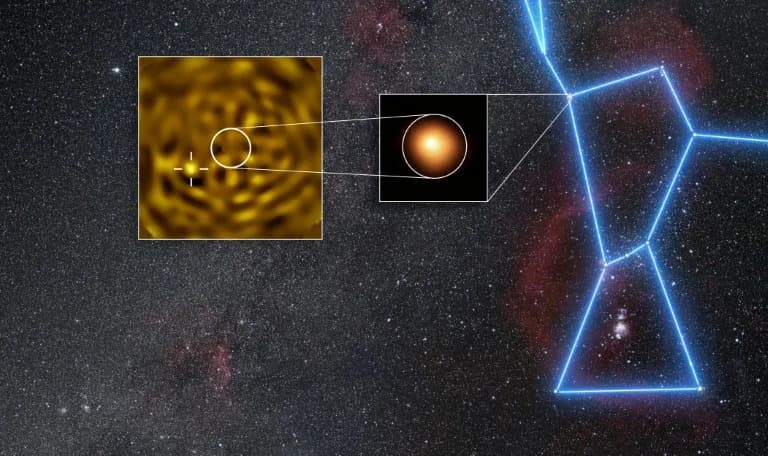
The image is the first ever captured of an elusive companion star orbiting Betelgeuse (-)
Astronomers on Tuesday released the first direct image of a faint companion star orbiting Betelgeuse, one of the brightest and most famous stars in the night sky.
For millennia, people have admired Betelgeuse, a red supergiant that marks the hunter's shoulder in the Orion constellation. Historical records suggest that ancient observers, including Egyptians and Indigenous Australians, noted regular variations in the star's brightness.
In 2024 astronomers proposed that those cyclical changes could be caused by a smaller companion periodically crossing or perturbing Betelgeuse. The strongest evidence to date supporting this idea was published Tuesday, based on observations with the European Southern Observatory's Very Large Telescope (VLT) in Chile.
"This is the conclusion of a century-long quest," said lead author Miguel Montargès of the Paris Observatory. "We have shown that Betelgeuse is not single; it is accompanied by a faint stellar companion."
Detecting the companion was challenging because Betelgeuse is enormous and extremely bright — roughly a thousand times the Sun in radius — which can overwhelm nearby, dimmer objects. The companion, nicknamed Betelgeuse B, had previously been estimated at about 1.5 solar masses.
New analysis of VLT data taken in December 2024 shows the companion is likely heavier than earlier estimates, at roughly 2–3 times the mass of the Sun. Its greater mass and the timing of the observations, when the companion was at maximum apparent separation from Betelgeuse, made it possible to resolve the faint object from the glare of the primary star.
"I jumped from my chair when I saw the processed images," Montargès recalled. The data required careful processing and analysis before the team could be confident enough to publish the results in the journal Astronomy & Astrophysics.
While additional observations are needed to fully characterise the companion's orbit and properties, Montargès said there is "very little space left for doubt" about its existence. Future monitoring will refine the companion's mass estimate and orbital parameters.
Why This Matters
The discovery helps explain historical brightness variations of Betelgeuse and sheds light on the behaviour of massive evolved stars. Betelgeuse previously startled astronomers when it dimmed dramatically for five months between 2019 and 2020. At the time some scientists feared the star was about to explode as a supernova. Subsequent studies showed that the dimming resulted from a large amount of material ejected from the star that formed a dust cloud and temporarily blocked its light, not an imminent explosion.
Continued observations with the VLT and other facilities will test how the companion interacts with Betelgeuse and whether it influences surface activity or mass loss on the red supergiant.
Help us improve.





















