Archer and Anduril revealed Thunder and Halo, a shared autonomous hybrid‑electric VTOL platform aimed at defense and commercial markets. Thunder is described as an autonomous attack rotorcraft and potential "loyal wingman" for crewed fighters, while Halo targets cargo, medical logistics and offshore operations. Both use dual tiltrotors with variable rpm, are container‑transportable, and are designed for low‑cost production; a first flight is targeted for 2027.
Archer and Anduril Unveil Dual‑Use Autonomous Hybrid‑Electric VTOL: Thunder (Defense) and Halo (Commercial)
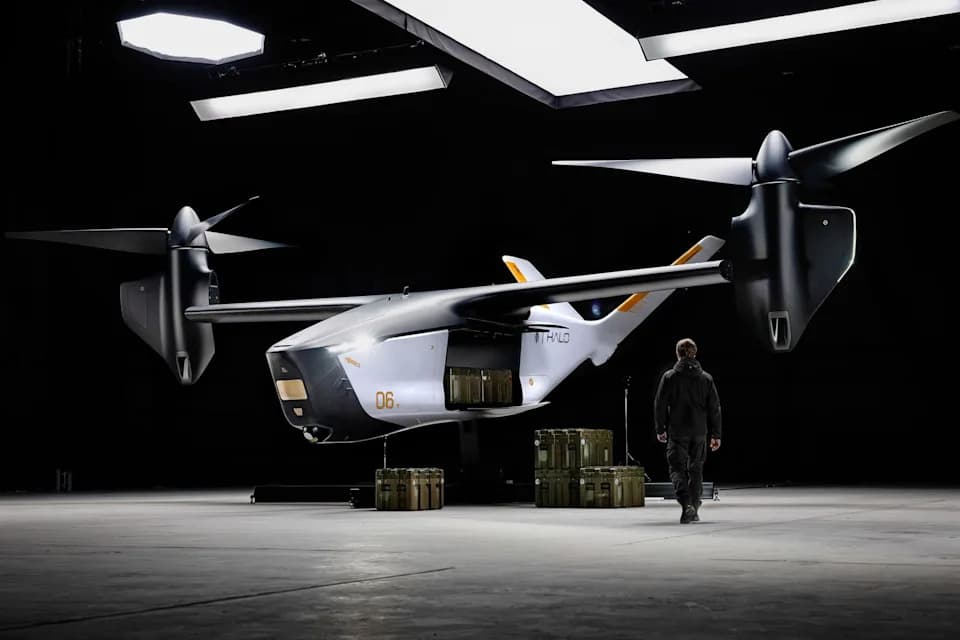
Halo is the commercial variant of the autonomous, hybrid-electric, runway-independent aircraft platform jointly developed by Archer and Anduril. [Credit: Archer Aviation]
California-based Archer Aviation and defense firm Anduril this week revealed a joint autonomous, hybrid-electric, runway-independent vertical takeoff and landing (VTOL) platform. The partners showcased two variants — Thunder for defense and Halo for commercial missions — at the Farnborough International Airshow in the U.K.
Overview
Archer CEO and founder Adam Goldstein described the new design as "the most sophisticated vertical lift aircraft ever made," saying the platform combines Archer's powertrain and VTOL expertise with Anduril's autonomy and defense systems. The companies say both variants share an airframe, powertrain and core systems while remaining modular enough to accept different payloads and mission packages.
Thunder — The Defense Variant
Anduril bills Thunder as an "autonomous attack rotorcraft" and a potential "loyal wingman" that can operate independently or join autonomous formations alongside crewed fighters. Anduril's materials claim Thunder will match the speed of legacy attack helicopters such as the AH-64 Apache or the Bell MV-75 Cheyenne II. The company also says Thunder will be classed as a Group 5 uncrewed aircraft system (UAS), covering platforms with maximum takeoff weight above 1,320 pounds and typical operating altitudes above 18,000 ft AGL.
According to Anduril, Thunder will be capable of carrying mixed munitions loads, enabling what the company describes as "more stowed kills per sortie" than current attack helicopters. Autonomy will reportedly let the platform maneuver in formation, share sensor and targeting data, coordinate effects and act on pilot intent. Potential missions include effects delivery and intelligence, surveillance and reconnaissance (ISR).
Halo — The Commercial Variant
Halo is pitched at freight, medical logistics, offshore energy support, maritime security and other remote operations that require runway independence and high payload capability. Archer says Halo will feature a modular payload bay, sufficient range to reach offshore facilities and the ability to deliver higher speed when necessary. The company also highlights lower noise and operating costs from improved energy efficiency and the removal of an onboard pilot.
At Farnborough, Archer named Japan's Marubeni Aerospace as Halo's strategic launch partner for the Japanese market; Marubeni will act as a sales and market representative rather than an operator.
Design, Production And Capabilities
Both variants are built around dual tiltrotors with variable rotor rpm, a design claimed to optimize power use, reduce fuel burn in cruise, and lower acoustic signature for urban or low-observability operations. The partners say each aircraft is compact enough to fit inside a standard shipping container and is being designed for low-cost, high-volume production. Archer and Anduril have performed multiple flights with "full-scale surrogate" aircraft to validate concepts and subsystems.
Neither company released detailed performance figures at Farnborough; public claims about speed and payload have not yet been backed by full specifications or independent verification.
Timeline, Partnerships And Market Context
The partners plan a first flight in 2027. Anduril was recently awarded a production contract for the YFQ-44A Fury, a candidate for early U.S. Air Force collaborative combat aircraft (CCA) programs; Archer and Anduril did not explicitly tie Thunder to the CCA initiative but framed it as a platform that can multiply the combat power of crewed attack and assault aircraft.
The announcement comes amid broader industry moves toward hybrid-electric and autonomous designs. Rivals such as Joby Aviation, Beta Technologies and Electra have teamed with defense contractors to explore hybrid or autonomous variants of electric aircraft.
What Remains Unclear
Key technical details — including range, exact payload capacities, endurance, fuel or energy specifics, and certification pathways for both civil and military operations — were not published. Regulatory approval, integration with existing military systems, and export controls will be important next steps before large-scale deployment.
Bottom line: Archer and Anduril presented an ambitious, dual-use VTOL concept that blends autonomy, hybrid-electric propulsion and modular design. The platform could influence both commercial logistics to remote sites and the development of uncrewed combat support aircraft if claimed capabilities are validated.
Help us improve.