Noosignatures are proposed traces of intelligence that lie between biosignatures and technosignatures. Julia DeMarines suggests using Assembly Theory—which counts the steps needed to build an object—to quantify culturally produced complexity; bread is offered as a vivid thought experiment. While remote detection is challenging, persistent planetary alterations (for example, long‑term agricultural impacts on nitrogen cycles) might serve as observable noosignatures, expanding how SETI searches for intelligence.
Noosignatures: Could Bread—and Other Non‑Technological Traces—Reveal Alien Minds?
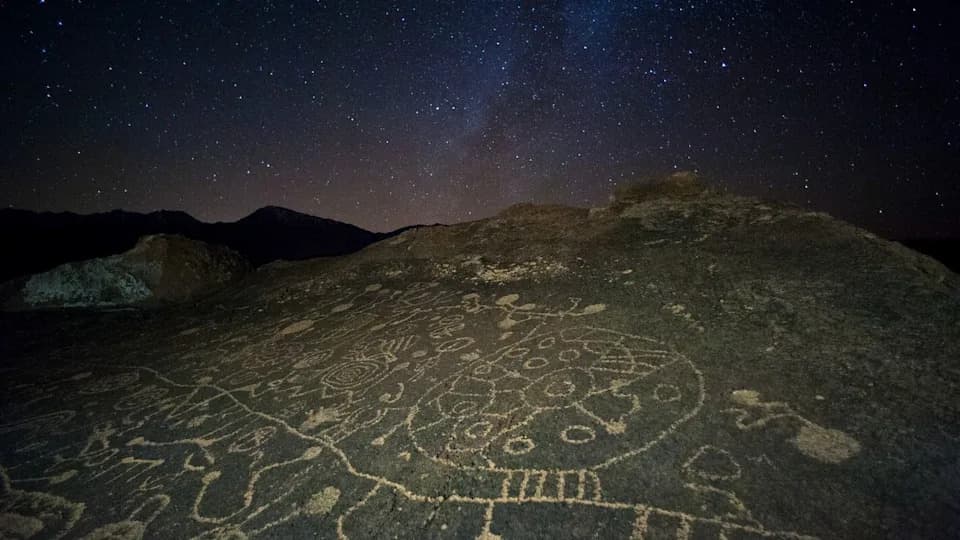
Between biosignatures and technosignatures lie noosignatures, and some scientists think they could help us find alien life someday. | Credit: Tony Rowell/Getty Images
The search for extraterrestrial life has long focused on two things: biosignatures (chemical signs of life) and technosignatures (detectable markers of advanced technology). But a growing discussion among astrobiologists suggests a third category deserves attention: noosignatures — measurable imprints of intelligence that are not necessarily technological, yet indicate minds at work.
What Are Noosignatures?
Noosignatures arise from the idea of a noosphere — a planetary layer shaped by thought and collective intelligence. The term builds on the work of thinkers such as Pierre Teilhard de Chardin and the Soviet scientist Vladimir Vernadsky, and more recent SETI discussions by Adam Frank, David Grinspoon and Sara Imari Walker that treat a planet’s combined cognitive activity as a kind of planetary‑scale mind.

There is archaeological evidence that humans have been making bread for nearly 14,000 years. | Credit: Olga Seifutdinova/Getty Images
Assembly Theory: Counting Steps Toward Complexity
Julia DeMarines and colleagues propose using Assembly Theory to search for noosignatures. Developed by Sara Imari Walker and Lee Cronin, Assembly Theory estimates the minimum number of steps required to build an object or pattern; that count is called the Assembly Index. In chemistry, this helps distinguish simple molecules from those that require many coordinated steps—potentially an indicator of life or cumulative intelligent activity.
Bread as a Thought Experiment
As a concrete illustration, DeMarines applied Assembly Theory to bread. Bread does not form spontaneously in nature; it represents a sequence of technological and cultural steps—harvesting and processing grains, fermentation, baking techniques, and later mechanized production. Archaeological evidence suggests humans made breadlike foods for nearly 14,000 years. Measuring how the Assembly Index of bread changes through time—from wild‑grain flatbreads to modern mass‑produced sliced loaves—can trace cumulative cultural knowledge and shifts in collective intelligence.
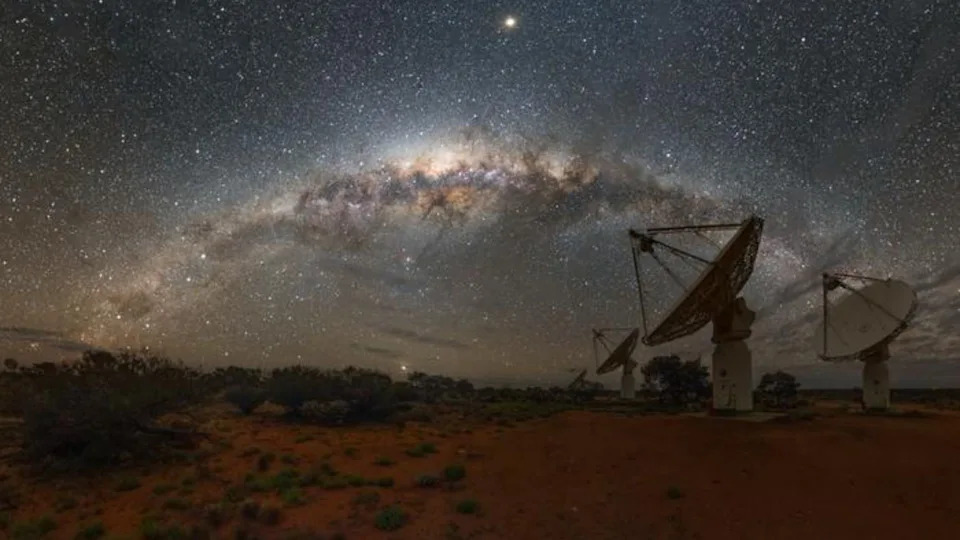
Radio telescopes of the Square Kilometer Array (SKA) in Australia beneath the Milky Way. | Credit: Alex Cherney/CSIRO
From Stone Tools to Planetary Cycles
Noosignatures can include physical artifacts (stone tools, ceramics, built structures) and large‑scale, persistent changes to planetary systems. For example, long‑term agricultural activity alters a planet’s biogeochemical cycles. Human agriculture has historically contributed a significant portion of reactive nitrogen released into the environment through fertilizers, animal waste and soil microbiology; such persistent perturbations could produce disequilibria detectable from far away, in principle.
Detectability: The Key Challenge
Detecting noosignatures remotely is far harder than finding simple biosignature gases. Archaeology requires being on a world to excavate artifacts; remote sensing must rely on global‑scale signals or unusual spectroscopic signatures. DeMarines emphasizes that current work is primarily about developing robust metrics and thresholds—identifying what counts as a meaningful assembly‑based signal—rather than claiming ready‑made remote observables exist today.
Broader Implications
Expanding the search beyond strictly technological markers reframes how we define and seek intelligence. Some intelligent species might never develop radio or industrial tech (for example, cetacean‑like minds constrained by anatomy), yet could still leave detectable imprints on their environment. Noosemiotics offers a formal way to quantify and search for such imprints.
Conclusion
Noosignatures sit between biosignatures and technosignatures: they capture cumulative, mind‑driven complexity that may be observable on planetary scales. Assembly Theory provides one promising framework to quantify that complexity, and thought experiments like bread help illustrate the idea. While remote detection remains speculative, developing metrics and thresholds will broaden SETI’s toolkit and could reveal forms of intelligence we currently overlook. Details of DeMarines’ work and related discussions are available on the open‑access arXiv repository.
Note: Many aspects of noosignature research are exploratory. Claims about detectability or about historical emission fractions (e.g., nitrogen) are still active research topics and should be treated with appropriate caution.
Help us improve.