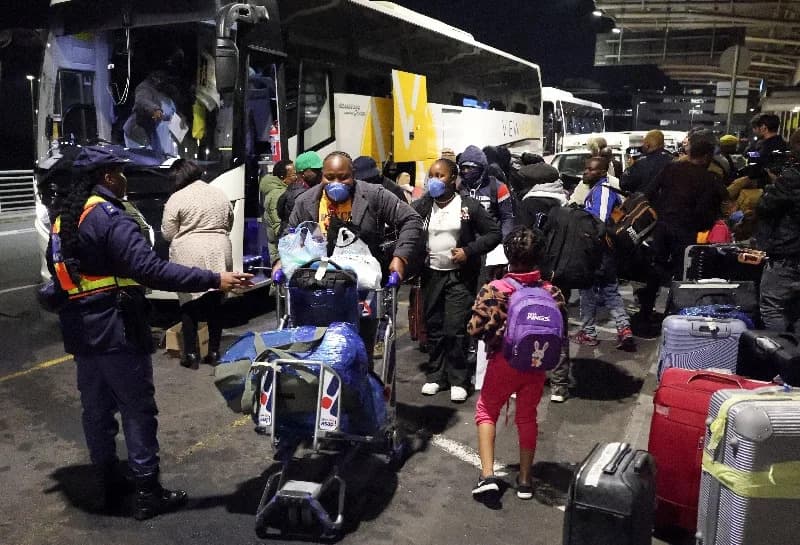
South African President Cyril Ramaphosa has called on African nations to cooperate on migration management as xenophobic violence forces a mass exodus of foreign nationals. He urged leaders at the Pan-African Parliament to address root causes such as conflict, poverty and governance failures. More than 160,000 people have left South Africa in recent weeks and at least four migrants have died amid unrest. Ghana has pushed for an AU debate and two citizens have petitioned the ICC to investigate repeated attacks.
Ramaphosa Urges Continental Action on Migration as Xenophobic Violence Forces Mass Departures
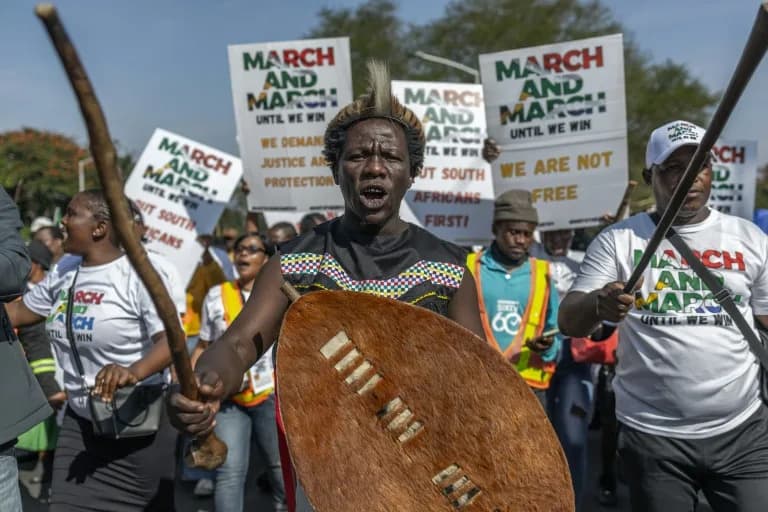
South Africa has experienced periodic outbreaks of anti-migrant violence (RAJESH JANTILAL)
South African President Cyril Ramaphosa on Monday urged African nations to cooperate on migration policy and tackle the root causes that push people to move, as his government confronts domestic and international criticism over a wave of attacks on foreign nationals.
Speaking to the Pan-African Parliament, the African Union's legislative body, Ramaphosa warned that "unmanaged cross-border movement" can undermine security and social order and that no single country can resolve the challenge alone. He called for collective action to address conflict, instability, governance failures, poverty and social discord — the factors that drive migration in the first place.
Weeks of anti-migrant demonstrations in South Africa, fuelled by xenophobic activists and fringe groups blaming undocumented migrants for crime, unemployment and pressure on public services, have escalated into one of the country's largest recent migrant outflows. An AFP tally based on figures from repatriating governments estimates that more than 160,000 foreign nationals have left South Africa in the past two months.
Ramaphosa described the attacks as "sad and abhorrent," saying "we in South Africa deeply regret and mourn" the lives lost. The president reaffirmed his government's stance against xenophobia and called for unity and lawful action to address social grievances.
At least four migrants have been killed in the recent unrest, though some foreign governments say the death toll is higher. The violence prompted several governments to organise coordinated voluntary repatriations for thousands of their nationals — a first in scale and simultaneity for recent episodes of xenophobic outbreaks in South Africa.
Context: South Africa, the continent's wealthiest nation, has long attracted migrants from across Africa but has experienced periodic waves of xenophobic violence for nearly two decades. In 2008 anti-immigrant riots left 62 people dead and thousands displaced; further outbreaks occurred in 2015 and 2016. Violence in 2019 claimed at least 12 lives, most of them South African citizens.
Ghana — one of the countries most vocal about the recent attacks — has requested an African Union debate. Two Ghanaian citizens have petitioned the International Criminal Court to investigate what they describe as "repeated xenophobic attacks," a move Pretoria has dismissed as "opportunistic."
Ramaphosa's appeal to the Pan-African Parliament frames the crisis as both a national emergency and a continental policy challenge, urging African states to combine diplomatic, humanitarian and development responses to reduce pressure on frontline host communities and safeguard migrants' rights.
Help us improve.