The Tehran Criminal Court sentenced Fatemeh Soltani’s father to eight years in prison and ordered payment of diyah after he fatally stabbed the 18-year-old outside a salon in April last year. The attack, captured on video, circulated online and prompted rumors about motive. Family testimony described years of domestic violence and said Fatemeh had discovered her father’s affair; the father denied an honor-motivated killing, saying he acted after being insulted.
Tehran Court Sentences Father to Eight Years After Public Stabbing of 18-Year-Old Nail Artist
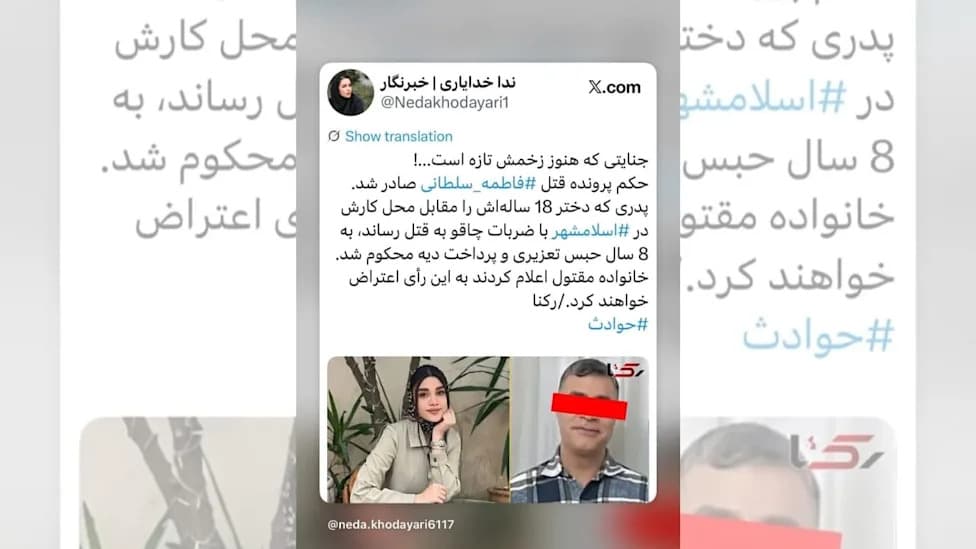
X post showing Fatemeh Soltani and her father, who stabbed her outside of her salon. (photo credit: INSTAGRAM SCREENSHOT)
The Tehran Criminal Court has sentenced the father of 18-year-old nail artist Fatemeh Soltani to eight years in prison and ordered payment of diyah (blood money) after he fatally stabbed her outside a salon in April last year, according to family-managed social media accounts, Iranian outlets and human rights groups.
The attack occurred on a public street and was captured by multiple passersby; video of the assault circulated rapidly online and provoked rumors about the motive, including false reports that Fatemeh had been beheaded. Witnesses and family members say the killing was filmed and that the victim died while being transported to hospital.
Family Testimony and Alleged Motive
Family members told the court and media that Fatemeh had discovered her father’s extramarital relationship. Her brother told Khabar Online that the discovery of the affair was the trigger for the confrontation. Conservative site Tabnak reported that the father initially told police the killing was motivated by so-called “moral issues.”

Fatemeh Soltani (credit: screenshot)
“I lived under the same roof as Fatemeh's father for 27 years. I endured every hardship to build a good life and raise two well-mannered children. But from the very beginning, my husband was an angry man,” Fatemeh’s mother testified, according to Tabnak. She described repeated physical abuse, saying he once broke her nose and teeth, held a knife to her throat and on another occasion stabbed her hand.
The mother also testified that after Fatemeh discovered the father’s messages with another woman in 2023, the father threatened the daughter and boasted about local beliefs that parents who kill their children would not face qisas (retributive punishment).
Defendant’s Account in Court
In court the father denied that the killing was premeditated for honor-related reasons. He described a pattern of blaming his wife for provoking him, complaining about her dress and alleging she “practiced spirit summoning,” while also saying the family faced financial strain. He told the court he stabbed Fatemeh after she insulted him and said he first stabbed her once with a knife that had been under the car seat since Sizdah Bedar, then stabbed her several more times after she exited the vehicle. He said he only realized what he had done when bystanders began screaming that he had killed his daughter.
Legal Outcome and Context
The court’s eight-year sentence, plus the order to pay diyah, falls short of the death penalty that qisas allows in some retributive cases; family members had feared the father might try to exploit cultural or legal loopholes. Human rights groups have highlighted the case amid broader concerns about gender-based violence and the treatment of women in domestic abuse cases in Iran.
While the full legal reasoning of the court has not been widely published, the case has already drawn international attention because of the public nature of the killing, the widely circulated video, and the family’s testimony about long-term domestic abuse.
Help us improve.