United Nations Secretary-General Antonio Guterres condemned new Israeli incursions into southwestern Syria during a rare visit, saying violations of the 1974 disengagement agreement were unacceptable. Syrian state media reported Israeli forces set up a checkpoint at Al-Ardah and dropped leaflets warning civilians not to obstruct movements. The UN will submit a comprehensive report to the Security Council at month-end, while Damascus pursues multilateral security talks and calls for an Israeli withdrawal and sanctions relief.
Guterres Condemns Israeli Incursions Into Syria as UN Prepares Report to Security Council
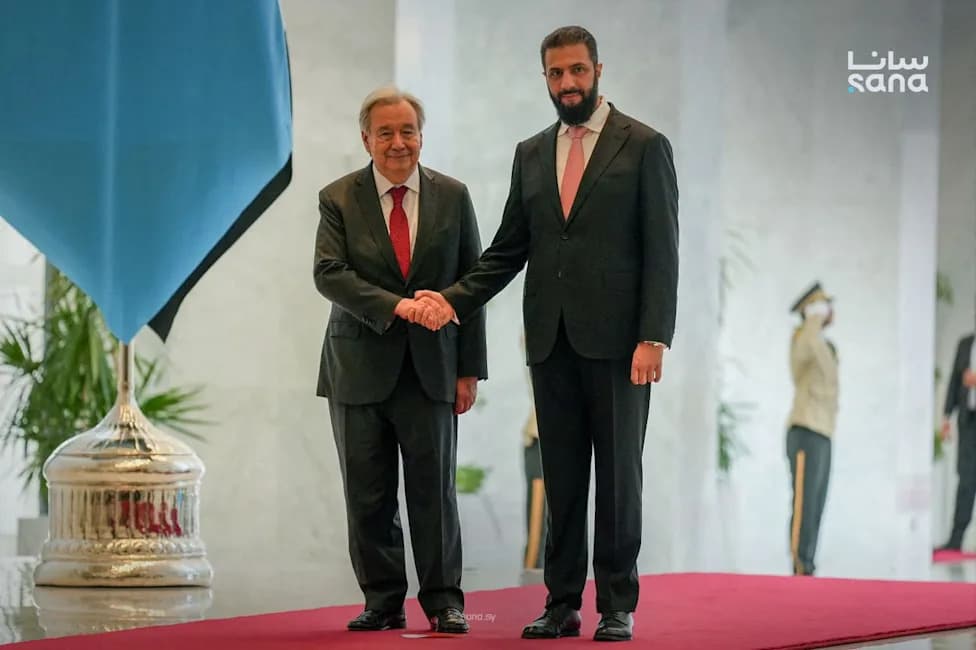
Syria's President Ahmed al-Sharaa (R) receiving UN Secretary-General Antonio Guterres at the People's Palace in Damascus. (AFP)
United Nations Secretary-General Antonio Guterres has strongly condemned fresh Israeli incursions into southwestern Syria while on a rare visit to the country, and said the UN will deliver a comprehensive report on the situation to the Security Council at the end of the month.
Incursion and Local Impact
On Sunday, Syria's state news agency SANA reported that Israeli forces advanced toward villages in the country's southwest, set up a checkpoint at Al-Ardah and that nearby shelling was heard. Leaflets were reportedly dropped urging residents not to obstruct the movement of Israeli vehicles.
UN Response
Guterres, visiting Syria for the first time as UN secretary-general since 2009, denounced what he called violations of Syrian sovereignty. In a social media post he wrote, "Syria's sovereignty, independence, unity & territorial integrity must be fully respected. Violations by Israel of the 1974 Disengagement of Forces Agreement are unacceptable & must stop."
At a press conference, he added that the UN will submit a comprehensive report to the UN Security Council at the end of the month and reiterated the need for de-escalation and respect for existing agreements. He is also expected to visit the United Nations Disengagement Observer Force (UNDOF), which has monitored the buffer zone since 1974.
Background: Changes Since 2024
According to reports and regional observers, Israel has stepped up operations inside southern Syria since the fall of the regime of ousted President Bashar al-Assad in December 2024. In the immediate aftermath, Israeli forces took control of the UN-controlled buffer zone that separates the Israeli-occupied Golan Heights from the rest of Syria, saying the 1974 disengagement agreement with Damascus had effectively collapsed.
Since then, Israel has carried out attacks, raids and searches and established military checkpoints further inside Syrian territory. Israeli officials say they intend to remain in southern Syria to maintain what they describe as a "security zone."
Syrian Government Position and Diplomacy
Syria's Foreign Minister Asaad Hassan al-Shaibani called for an immediate Israeli withdrawal from the buffer zone, warning that continued operations and occupation are a "direct threat to the security of the region."
In an interview with Al Jazeera's programme Al Muqabala, President Ahmed al-Sharaa said Damascus is pursuing a multilateral path to a security agreement with Israel involving several countries. "If the security agreement with Israel succeeds, it will pave the way for comprehensive peace without conceding Syria's right to the occupied Golan [Heights]," he said, adding that Syria has "no interest" in entering a confrontation with Israel.
Economic Recovery and Sanctions
Guterres urged the removal of sanctions imposed during the era of Bashar al-Assad, saying steps that have eased sanctions are welcome but that all remaining measures should be lifted to enable economic recovery. Western countries, including the United States, have begun lifting some economic restrictions, but investors remain cautious. The World Bank has estimated that Syria's post-war reconstruction could cost about $216 billion.
"The United Nations stands with the people of Syria at this pivotal moment," Guterres said, calling on the international community to support both the Syrian people and the government to seize a "moment of opportunity" for recovery and stability.
Help us improve.