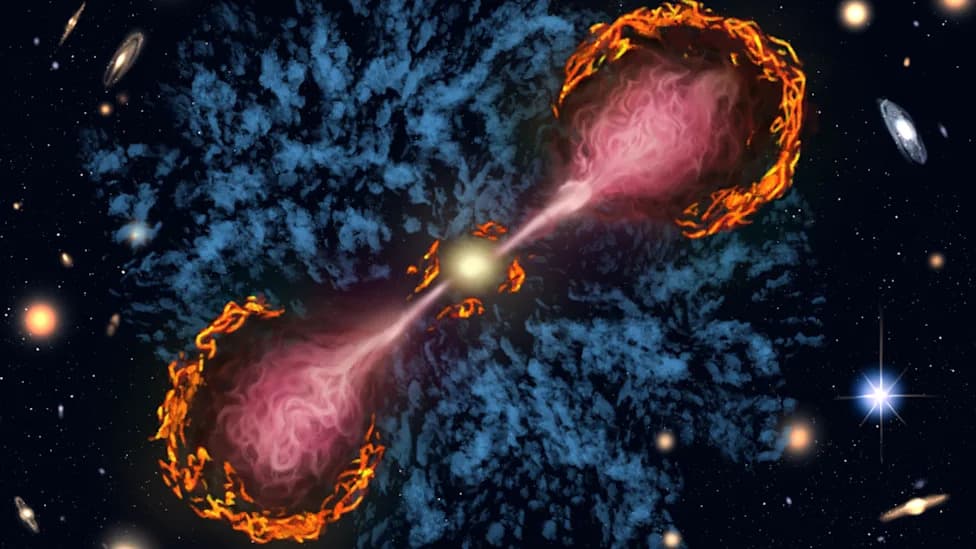
The IllustrisTNG100 analysis of 11,724 simulated galaxies finds that mergers rarely cause long-term quenching: only a few percent of major mergers precede shutdown within 1–2 Gyr. Machine-learning tests show central black hole mass (and then stellar mass) far outpredict merger history. In this model, slow black-hole-driven halo heating — not single quasar outbursts — best explains sustained suppression of star formation. Observations at earlier cosmic times will help determine which pathway dominates in the real universe.
New Simulation Study: Galaxy Collisions Rarely Stop Star Formation — Slow Black Hole Growth and Halo Heating Matter More
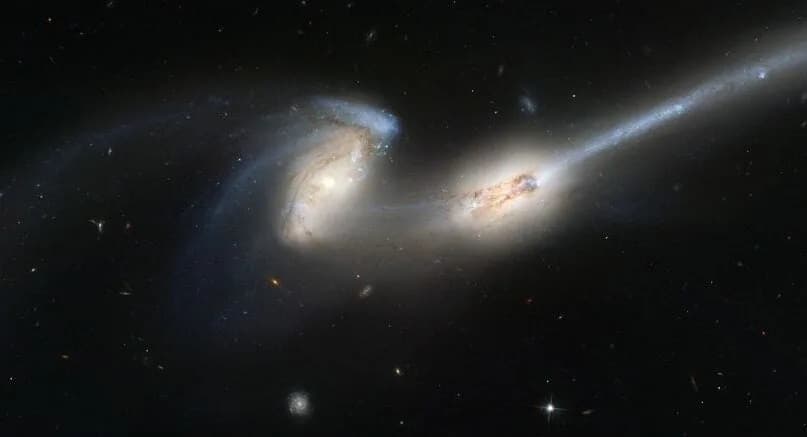
Interacting galaxies NGC 4676, known as "The Mice," as captured by the Hubble Space Telescope. (CREDIT: NASA/H. Ford (JHU), G. Illingworth (UCSC/LO), M. Clampin (STScI), G. Hartig (STScI) and the ACS Science Team)
A large new analysis of the IllustrisTNG100 cosmological simulation finds that galaxy mergers rarely produce long-term shutdowns of star formation. Instead, gradual internal evolution — especially the slow growth and sustained feedback of central supermassive black holes that keep halo gas hot — better explains persistent quenching in the model.
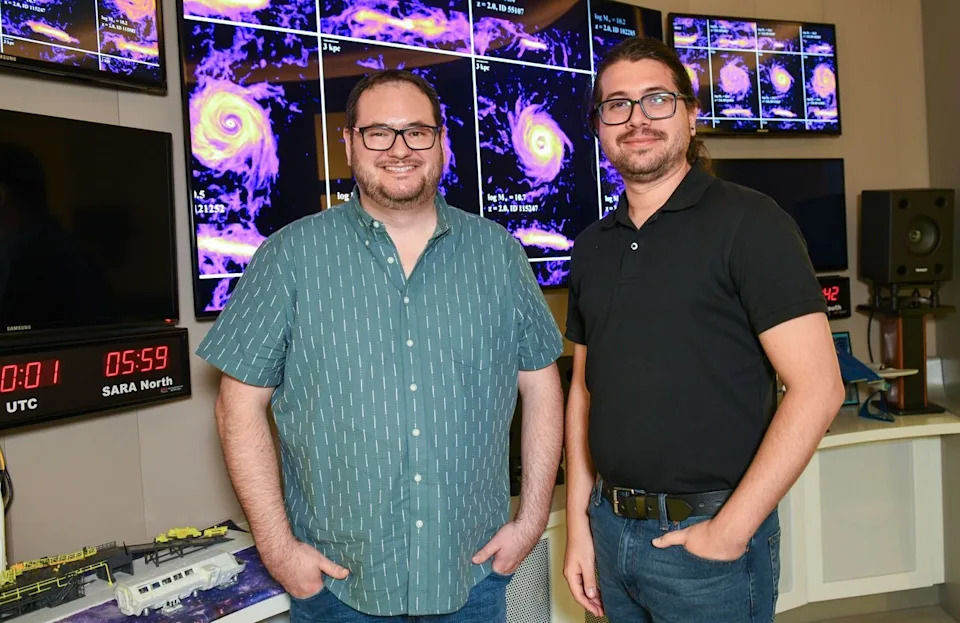
Dr. Asa Bluck, Assistant Professor of Physics, stands with Camilo Casimiro, an FIU Physics graduate student. (CREDIT: FIU)
Researchers at Florida International University reconstructed the star-formation and merger histories of 11,724 simulated galaxies and tested the classic merger–quasar–quench picture: mergers drive gas to galactic centers, feed black holes that flash as quasars, and expel or heat cold gas so star formation ends. The new results show that this dramatic sequence is neither a necessary nor a sufficient pathway to lasting quenching in IllustrisTNG100.
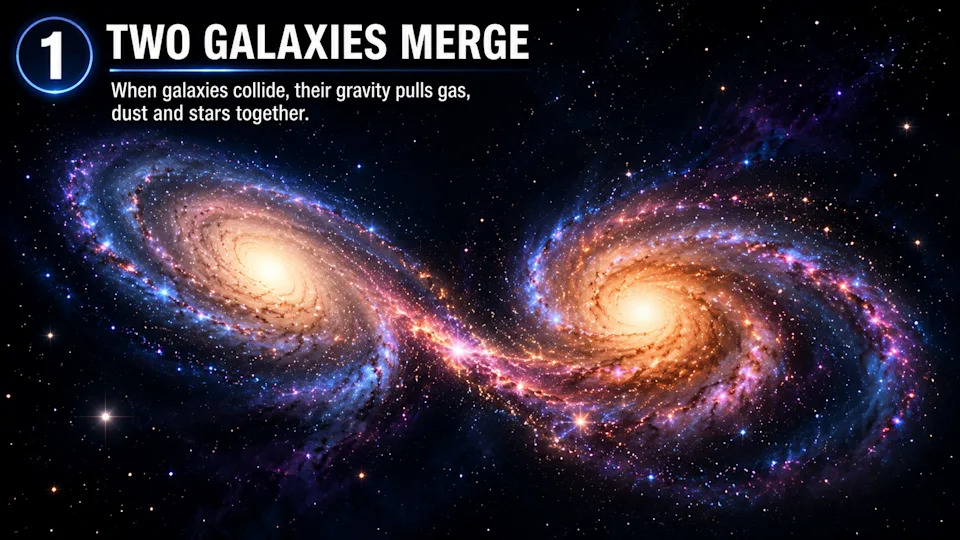
Quasar quench paradigm. Step 1: Two Galaxies Merge. (CREDIT: FIU)
What the Team Did
The authors tracked each galaxy's transitions through the 'green valley' between blue, star-forming systems and red, quenched systems. They then measured how often mergers of various mass ratios occurred near the onset of quenching, and used random-forest machine-learning models to identify which galaxy properties best predict shutdown.
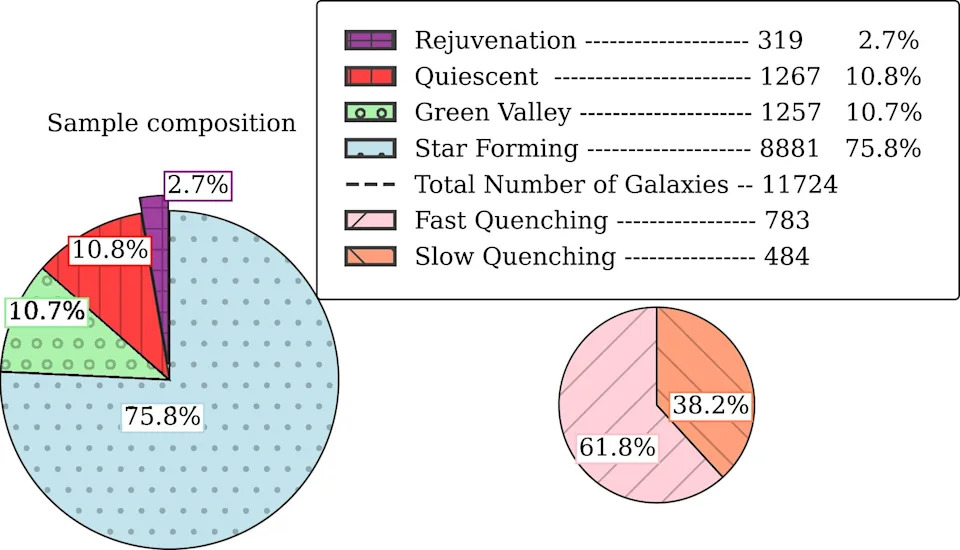
Fractional composition of our central galaxy sample (left-hand panel) and the breakdown of quenching time-scales for Q galaxies (right-hand panel). (CREDIT: Camilo Casimiro et al. / Monthly Notices of the Royal Astronomical Society)
Key Findings
Low association between mergers and quenching: Only about 3% of major mergers were followed by quenching within a 1 Gyr window that begins one billion years before shutdown; that rises to roughly 5% for a 2 Gyr window. Counting mergers of all sizes increases the shares to ~12% (1 Gyr) and ~16% (2 Gyr).
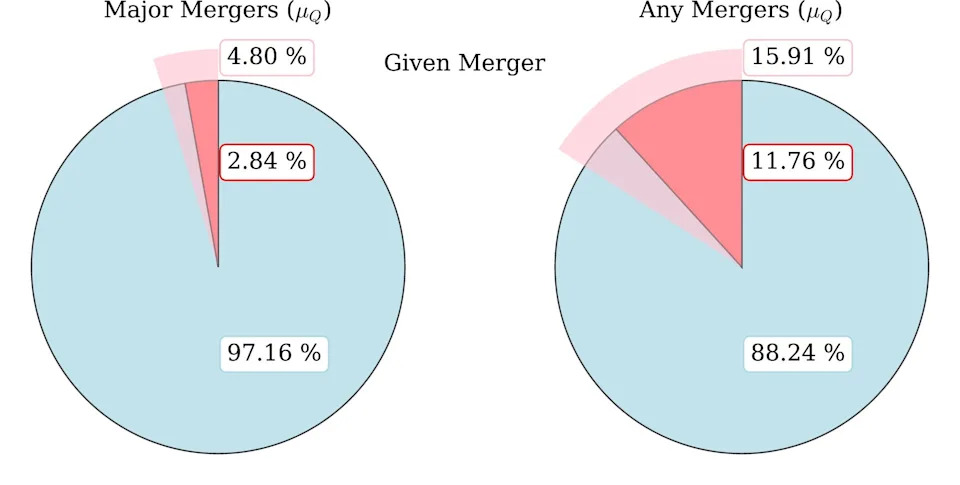
The fraction of mergers that are followed by quenching within various time windows. Left-hand panel: the fraction of all major mergers that take place within the quenching window, defined as spanning from 1 Gyr before the onset of quenching to the completion of the transition. Right-hand panel: the same analysis as in the left-hand panel, but here considering any mergers. (CREDIT: Camilo Casimiro et al. / Monthly Notices of the Royal Astronomical Society)
Viewed another way, roughly 97% of major mergers and about 88% of all mergers occurred without an accompanying quench in the 1 Gyr window. Conversely, just ~11% of quenched galaxies had a major merger within 1 Gyr of quenching (~17% within 2 Gyr).
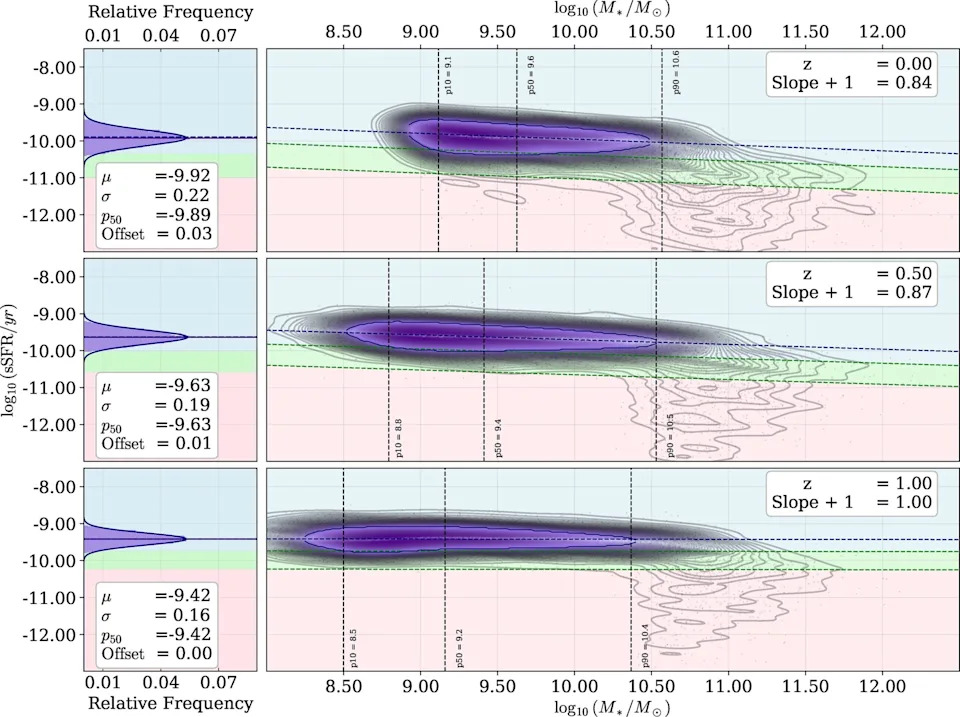
Examples of the KDE-based procedure used to fit the MS and estimate its scatter at three snapshots. (CREDIT: Camilo Casimiro et al. / Monthly Notices of the Royal Astronomical Society)
Central black hole mass dominates prediction: Random-forest models show central black hole mass is the strongest predictor of quenching. When black hole mass is removed, stellar mass becomes most important; if both are excluded, dark matter halo mass rises to the top. Merger-related measures (number of mergers, mass acquired in mergers, time since last merger) add little predictive power, contributing under ~6% of the signal once internal properties are included.
Interpretation
In IllustrisTNG, long-term quenching depends on preventing fresh gas from cooling and replenishing the galaxy. Rather than a single explosive quasar purge, IllustrisTNG's low-accretion, kinetic black hole feedback injects energy over long timescales to stabilise halo gas and suppress inflow. The analysis suggests central black holes grow mainly through steady feeding (star formation, gas inflow and internal instabilities) until their feedback becomes strong enough to maintain a hot halo and cut off future fuel.
Caveats and Next Steps
These conclusions apply to the IllustrisTNG framework and may not describe every real galaxy. Observations still link some recent mergers to post-starburst systems and elevated AGN activity, while many mergers leave galaxies star-forming and some rapidly quenched galaxies show no clear merger signatures. The authors recommend targeted observational tests: compare merger frequencies in quenched and star-forming samples after carefully matching stellar and black hole properties, and extend studies to earlier cosmic epochs when mergers and luminous quasars were more common.
Publication: The full results are published in Monthly Notices of the Royal Astronomical Society and are based on the IllustrisTNG100 simulation.
Credit: Camilo Casimiro et al., Florida International University; IllustrisTNG.
Help us improve.